Film
Stop the Blame Game: Rennie gave wrongly accused dogs a public defence
 By Archit
·
·
5 min read
By Archit
·
·
5 min readAI-assisted
Quick summary
The idea: Rennie and McCann London launched Stop the Blame Game to promote Rennie Wind Relief Pro by defending dogs wrongly blamed by their owners for flatulence.
The execution: The campaign features three documentary-style interviews with dogs voiced by well-known performers and a fourth film showing dogs protesting outside Westminster.
Why it matters: The campaign turns an awkward digestive-health conversation into British comedy while introducing Rennie's first dedicated trapped-wind product to the UK market.
AI-generated from this article. For complete context and credits, read the full story.
Dogs have been blamed for their owners’ embarrassing flatulence for generations. Rennie decided it was time for them to defend themselves.
Created by McCann London with Initiative Media, “Stop the Blame Game” introduces Rennie Wind Relief Pro through a series of films featuring dogs who are tired of being used as excuses.
The campaign presents three documentary-style interviews with Molly, Baxter and Duke. A fourth film takes the issue to Westminster, where a group of dogs stages a public protest against the accusations.
Together, the films turn an awkward digestive-health conversation into a simple piece of British comedy.
An old excuse became the campaign idea
Flatulence can be embarrassing to discuss. Blaming the dog gives people an easy way to escape the moment, even when the animal is completely innocent.
Rennie built its campaign around this familiar behaviour. Instead of focusing entirely on symptoms, the films give the accused dogs an opportunity to tell their side of the story.
The animals speak with distinctly human personalities, but their stories remain grounded in recognisable situations. Each interview begins like a serious personal testimony before moving into increasingly absurd details.
Every story arrives at the same conclusion. People no longer need to blame their pets when Rennie Wind Relief Pro can help relieve trapped wind, flatulence, bloating and abdominal cramps.
Molly lists the names she has endured
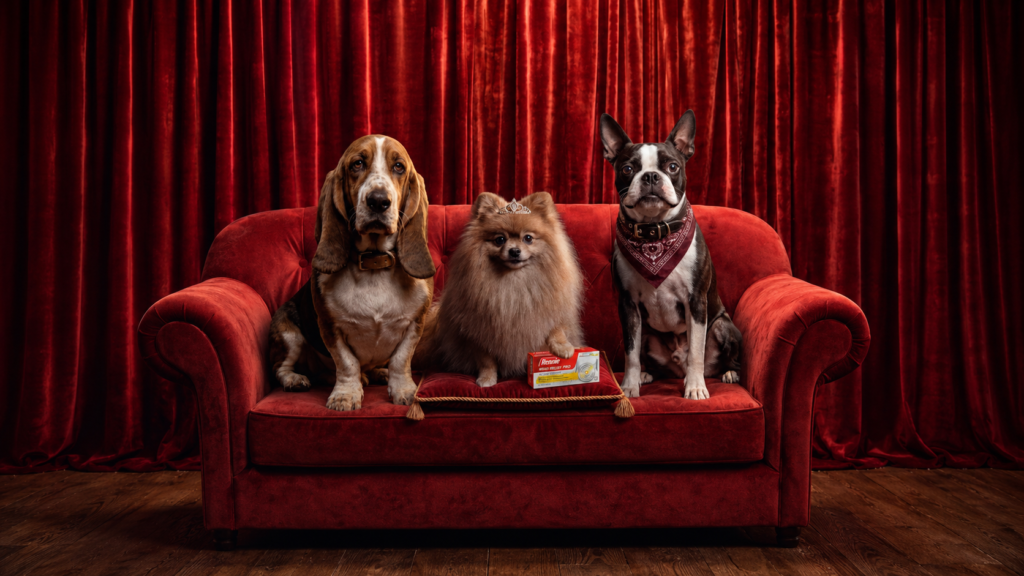
“Molly’s Story” features a small Pomeranian wearing a miniature tiara. She sits on a velvet couch in front of a theatrical red curtain and speaks directly to the camera.
Molly explains that owners regularly blame their pets for smells they did not create. She has even been given a collection of fart-themed nicknames, including “Pomerainian,” “Rottenweiler,” “Leonardo Stinky” and “Pharaoh Tutankhamun.”
The increasingly ridiculous names give Molly’s complaint a playful rhythm while making the repeated injustice clear.
She then introduces Rennie Wind Relief Pro as an alternative to blaming the nearest animal. The film ends with the “Stop the Blame Game” message before Molly notices a bottle beside her and suspiciously asks whether it contains sparkling water.
Baxter remembers a Christmas betrayal
A Basset Hound takes the couch in “Baxter’s Story.” A dog bowl and newspaper beside him make the set feel like his own private interview room.
Baxter says that simply seeing a Brussels sprout now causes an involuntary twitch. The reaction comes from a Christmas dinner when his owner ate too many sprouts, passed gas and immediately shouted, “Bad dog.”
Everyone laughed while Baxter received the blame.
He pushes a pack of Rennie Wind Relief Pro towards the camera with his paw and explains that humans can address their digestive discomfort without using their pets as scapegoats.
After delivering the product message, Baxter looks towards the crew and asks whether he gets a biscuit. The final line breaks the serious interview style at exactly the right moment.
Duke brings Gran to give evidence
“Duke’s Story” introduces a Boston Terrier who arrives carrying a chewed tennis ball. Duke loves his owner, but he has grown tired of accepting responsibility for someone else’s flatulence.
During one incident, Duke’s owner avoided blaming him and accused Gran instead.
Duke brings Gran onto the set so she can explain what happened. However, she quickly loses track of the subject. She talks about being born in a bathtub in 1946 and complains about oat milk, soya and other parts of modern life.
Unable to return Gran to the original question, Duke places his paw on a box of Rennie Wind Relief Pro and delivers the practical solution himself. He finishes the interview by saying that he needs a walk after dealing with the situation.
The dogs take their case to Westminster
The fourth film expands the individual stories into a public movement. Presented as an exclusive news report, it follows a dog protest outside the Houses of Parliament in Westminster.
A reporter named “Jack Russell” covers the demonstration as dogs sit along the embankment holding signs that read “It Wasn’t Me,” “This Corruption Stinks,” “Toxic Accusations,” “Bark for Change” and “Stop Gaslighting Us.”
The report claims that 83% of UK dog owners admit to blaming their pets for gas emissions. The statistic gives the protest a mock-serious reason to exist while supporting the campaign’s central observation.
Passersby stop to interact with the dogs before the reporter introduces Rennie Wind Relief Pro and closes with “Have the Rennie Ready.”
Four films support one product launch
“Stop the Blame Game” launched in the UK in August 2026 to introduce Rennie’s first dedicated trapped-wind product.
The campaign began in cinemas before expanding across television, digital and social. The activity was scheduled to run across multiple channels for three months.
Bill Bailey, Pete Wicks, Susie Dent and Annette Badland provide voices across the films. Their performances give each dog a different personality while maintaining the campaign’s dry British delivery.
The product remains connected to every joke. The dogs are not included simply because they are entertaining. Their supposed mistreatment creates the problem, their stories develop it and Rennie provides the resolution.
Credits
“Stop the Blame Game” was created for Bayer’s Rennie by McCann London, with Initiative Media handling media. Jon Elsom served as Creative Director, with Tom Smith and Darren Urquhart as Creatives. Rebecca Harrison was Client Partner, Richard Kelly was Global Creative Strategy Partner, Amie Meadowcroft was Account Manager, Julia Shuker and Katie Ferris were Senior Account Directors, and Trevor Davis was Operations Director. Production was handled by Omnicom Production, with James Faupal as Director of Production, Neil Checketts as Implementation Manager, Ellery Wooff as Junior Producer, Chloe Brown as Senior Producer and Amarlyllis Hind handling Business Affairs.
Related
More in Film

Popular
Popular posts

More stories