Volkswagen Trucks turned a measuring tape into a truck to show every vehicle could fit its cargo
 By Archit
·
·
5 min read
By Archit
·
·
5 min readAI-assisted
Quick summary
The idea: Volkswagen Trucks and agency AlmapBBDO demonstrated that commercial vehicles are custom-made for specific cargo by transforming an ordinary measuring tape into a miniature truck in a 2011 campaign.
The execution: The measuring tape case was designed as a Volkswagen truck cab, while the extended tape ran alongside five different types of cargo to show that the vehicle length matches the load.
Why it matters: The article does not report performance results, but notes the campaign received a Wood Pencil in 2011 and communicated a complex B2B proposition with consumer simplicity.
AI-generated from this article. For complete context and credits, read the full story.
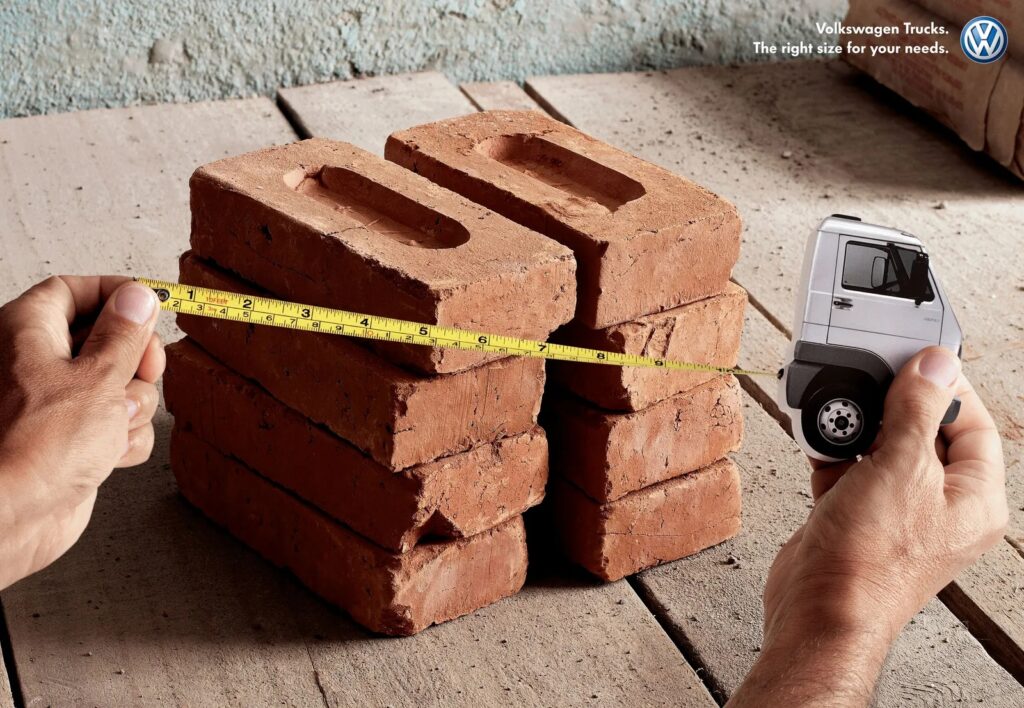
Volkswagen Trucks demonstrated the made-to-measure nature of its commercial vehicles by transforming an ordinary measuring tape into a miniature truck.
Created in Brazil by AlmapBBDO, the 2011 campaign presented the measuring tape’s case as a Volkswagen truck cab. Its extended tape ran alongside different kinds of cargo, measuring each load as if it were also determining the exact length of the vehicle required to carry it.
The line “Custom-made for your cargo” completed the idea.
Instead of explaining multiple chassis lengths, body configurations or payload requirements, the campaign reduced Volkswagen’s proposition to one familiar object: if a business could measure its cargo, Volkswagen could provide the truck to match it.
Commercial vehicles are not one-size-fits-all
Buying a commercial truck is different from choosing an ordinary passenger vehicle. The most suitable model depends on what the business transports, how much space the cargo needs and the conditions in which the vehicle operates.
A drinks distributor, dairy supplier and produce business may all require different body dimensions and configurations. A truck that is too small limits capacity, while one that is unnecessarily large can increase operating costs and waste space.
Volkswagen Trucks wanted to communicate that its vehicles could be tailored around these different commercial requirements.
That is a useful benefit for business owners, but it is not naturally visual. Specifications, measurements and configuration options can quickly turn an advertisement into a technical catalogue.
AlmapBBDO found a way to explain the same proposition with almost no explanation.
The tape measure becomes the product
The campaign’s central object performs two roles at once.
At first glance, it is a measuring tape placed next to a row of cargo. On closer inspection, the tape’s casing has been designed to resemble the cab of a Volkswagen truck. As the tape extends along the products, it also begins to resemble the truck’s chassis and loading area.
This visual combination turns measurement into customisation.
The tape does not simply establish how long the cargo is. It suggests that the truck itself can extend to the appropriate length, stopping exactly where the load ends.
A tool normally used before something is built therefore becomes a representation of the finished vehicle.
The visual metaphor makes “tailor-made” feel literal. Volkswagen is not shown offering a truck and asking businesses to adapt their operations around it. The vehicle appears to be measured and configured around the customer’s cargo.

Five executions demonstrate different businesses
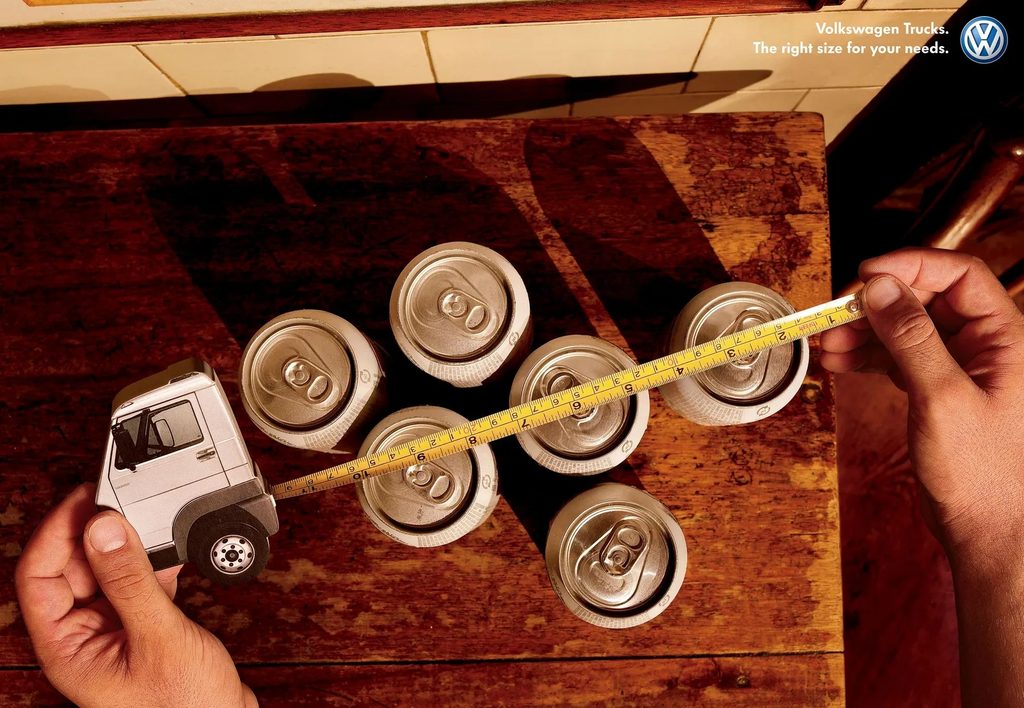
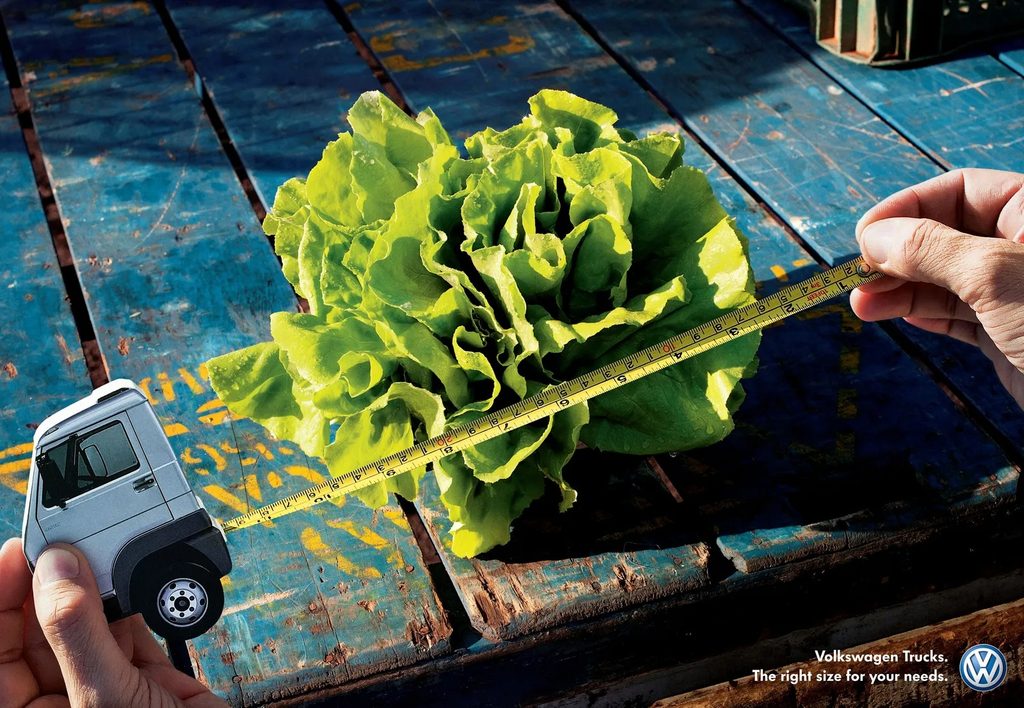
The campaign applied the same visual system to five types of cargo: milk, beer, eggs, oranges and peppers.
Each execution arranges the products into a distinct load and places the truck-shaped measuring tape beside them. Although the composition remains consistent, the changing cargo shows that the proposition is relevant to several kinds of business.
Bottles and crates represent beverage distribution. Eggs suggest the transportation of delicate goods. Oranges and peppers connect the trucks with agricultural producers and food suppliers.
The variety gives the campaign scale without making the idea more complicated. Volkswagen does not need to display every truck in its range. The cargo changes, while the measuring system remains the same.
This repetition also strengthens brand recognition. Once viewers understand the first image, the remaining executions reinforce the promise that Volkswagen can supply a suitable truck regardless of what the business needs to move.
Product complexity is replaced by visual precision
Automotive advertising often focuses on horsepower, fuel efficiency, durability or driving performance. Commercial-vehicle buyers also need practical answers about dimensions and cargo suitability.
The Volkswagen Trucks campaign focuses on that operational reality.
Its design communicates precision through the markings printed along the tape. The cargo appears carefully measured rather than loosely estimated, suggesting that the resulting vehicle will provide the necessary space without unnecessary excess.
The surrounding layout remains minimal, keeping attention on the relationship between the miniature truck cab, the extended tape and the products being measured.
This restraint is particularly effective for a business audience. The advertisement does not rely on lifestyle imagery or an emotional story. It presents a functional advantage through a piece of visual problem-solving.

The medium suits the sales message
The idea works naturally in print and outdoor formats because it does not require movement to explain the transformation.
The viewer can recognise the truck, follow the tape across the cargo and reach the conclusion independently. The line confirms what the image has already communicated.
That short process of discovery gives the work its memorability. A lengthy description of configurable trucks might be accurate, but the information would be easy to ignore. The measuring-tape image turns the same information into a small visual puzzle.
It also creates a physical sense of scale within a two-dimensional advertisement. The truck may be represented by a compact object, but the extended tape allows its potential size to be determined by the load beside it.
A B2B message delivered with consumer simplicity
The campaign shows how a specialised business proposition can be communicated with the clarity of consumer advertising.
Volkswagen Trucks needed to reach people making practical purchasing decisions. Those buyers may require detailed specifications later in the sales process, but the advertisement’s first job is to establish one meaningful advantage.
“Custom-made for your cargo” provides that entry point.
No campaign performance results were publicly announced. The work did, however, receive a Wood Pencil in the Press & Outdoor category in 2011, recognising the strength of its visual solution.
More than a decade later, the campaign remains easy to understand because neither the object nor the problem requires explanation. Businesses have cargo. Cargo needs measuring. Volkswagen presents itself as the manufacturer capable of building the truck around those measurements.
The campaign does not merely claim that the vehicles are tailor-made. It makes the truck itself look like the tool used to tailor them.
Credits
Volkswagen Trucks was created in Brazil by AlmapBBDO for Volkswagen. Chief Creative Officer and Executive Creative Director: Marcello Serpa; Creative Director: Luiz Sanches; Copywriter: Renato Simões; Art Directors: Bruno Prosperi and Denis Peralta; Account Supervisor: Ricardo Barion.
About the work
Campaign details
- Brand
- Volkswagen
- Agency
- BBDO
- Country
- Brazil
- Year
- 2011
Related
More in Print



Popular
Popular posts




More stories