Film
The World Will Wait: Coca-Cola Thailand brought work to the dinner table to prove meals matter more
 By Archit
·
·
6 min read
By Archit
·
·
6 min readAI-assisted
Quick summary
The idea: Coca-Cola Thailand launched two surreal comedy films as part of the global The World Will Wait campaign. Created by Ogilvy Singapore and Ogilvy Thailand, the campaign addresses the modern struggle of balancing professional duties with personal time. It aims to remind audiences that while work responsibilities may feel urgent, people waiting to share a meal deserve attention too, positioning the dining table as a protected space to disconnect from work.
The execution: The Thai chapter features two films directed by Wuthisak Anarnkaporn of Factory01. The Dentist shows a dentist examining a patient on his kitchen table during dinner, while The Cable Guy features a technician working from a bucket truck and a grandmother performing an extraordinary vertical Coca-Cola pour. Both films use offbeat local humour and escalating visual situations rather than serious lectures to illustrate how work intrudes upon home life.
Why it matters: The campaign uses entertaining comedy to challenge the habit of treating every job request as more important than a shared meal. Coca-Cola integrates into the action as a social invitation that helps protagonists pause and return their attention to the table. No performance results have been announced for the Thai campaign, but it reframes digital distraction and work-life balance by highlighting that meals have their own deadlines.
AI-generated from this article. For complete context and credits, read the full story.
Coca-Cola Thailand is asking people to stop working long enough to share a meal in two surreal comedy films that take “bringing work home” to ridiculous extremes.
Created by Ogilvy Singapore and Ogilvy Thailand, “The Dentist” and “The Cable Guy” form the Thai chapter of Coca-Cola’s global “The World Will Wait” campaign.
Both films follow people who remain mentally trapped in their jobs even after reaching the table. Emails and phone calls are replaced by exaggerated physical versions of their occupations, making work impossible to ignore.
The message is that responsibilities may feel urgent, but the people waiting to share a meal deserve attention too.
Modern work rarely ends at the office
Phones, laptops and remote-working tools have made it difficult to establish a clear boundary between professional and personal time.
A person may leave the workplace while continuing to answer emails, join calls and think about unfinished tasks. Even when they sit down with friends or family, part of their attention remains elsewhere.
“The World Will Wait” challenges the habit of treating every notification or request as more urgent than a shared meal.
The campaign positions the dining table as a protected space where people can temporarily disconnect from work and reconnect with those around them. Coca-Cola becomes part of that pause, acting as a familiar signal that the meal and conversation can begin.
For Thailand, the agencies replace a serious lecture about work-life balance with strange, escalating comedy.
“The Dentist” places a patient on the kitchen table
“The Dentist” follows a dentist who has become so consumed by work that his profession appears to follow him into his home.
Instead of simply checking a message or thinking about a patient during dinner, the dentist has an actual patient stretched across the kitchen table. The patient makes unusual bubbling sounds while the dentist continues examining his mouth.
The dentist’s wife watches the disruption with growing frustration. A space intended for food and conversation has effectively become another treatment room.
The deliberately uncomfortable image gives physical form to a common problem. The dentist may technically be home, but he has not returned to his personal life.
As the surreal situation develops, the film uses misdirection, unexpected sounds and unusual character reactions to push the joke beyond an ordinary work interruption. The presence of Coca-Cola helps return the dentist’s attention to the meal.
“The Cable Guy” takes the joke several metres higher
The second film follows a cable technician who also struggles to separate work from mealtime.
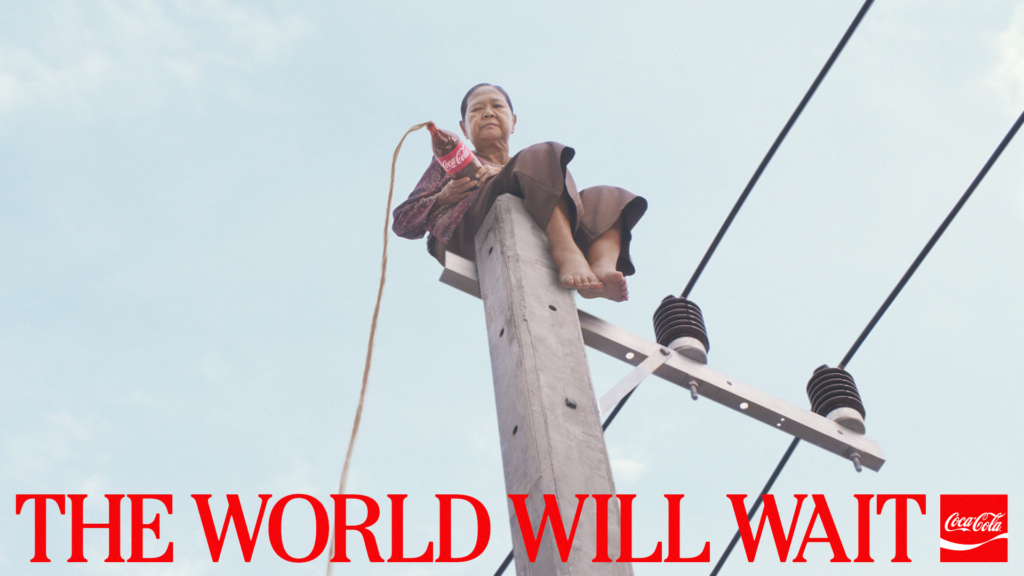
His equipment and working environment become part of the dining situation, with a bucket truck carrying the visual joke upwards. A grandmother then performs an extraordinary five-metre vertical Coca-Cola pour, connecting the elevated worker with the meal below.
The pour was created practically during filming, using a tube to control the flow of the drink. Its scale turns the simple act of serving Coca-Cola into the film’s biggest visual gag.
Like the dentist’s patient, the bucket truck represents work intruding into a place where it does not belong. The difference is that the family does not wait passively for the technician to finish. The meal reaches him in an exaggerated invitation to return his attention to the people around him.
The result is absurd, but the underlying behaviour remains recognisable. People often promise to join a meal after completing one final task, only for another task to follow.
Thai humour gives the global idea a local character
“The World Will Wait” launched globally in August 2026 to encourage Gen Z and Millennial audiences to reclaim shared meals from the pressures of everyday life.
The wider platform includes films, influencer activity, social content, digital experiences and outdoor advertising. Global executions contrast supposedly urgent responsibilities with moments around food, using lines such as “Laundry can wait. Fried chicken and Coca-Cola can’t.”
The Thai films retain that proposition but adopt a more locally distinctive tone.
Director Wuthisak Anarnkaporn, founder of Factory01, uses restrained performances, strange pauses and escalating visual situations to create the offbeat comedy associated with many celebrated Thai commercials.
The characters behave as if their impossible circumstances are almost normal. That contrast allows the films to communicate a serious observation without becoming judgemental.
Coca-Cola becomes permission to pause
The product is integrated into the action as more than a drink placed beside the food.
Opening and sharing Coca-Cola marks the moment when the protagonists stop treating work as the most important thing in the room. The drink functions as a social invitation to come back to the table.
This reflects Coca-Cola’s long-standing association with meals and togetherness, but updates it for a culture in which attention is constantly divided.
The campaign does not argue that work is unimportant or that responsibilities can always be ignored. It asks people to recognise that not everything needs an immediate response.
A meal has its own deadline. Food cools, conversations move on and opportunities to spend time together cannot always be rescheduled.
The table becomes the campaign’s point of resistance
Many campaigns about digital distraction focus directly on phones or screens. “The World Will Wait” broadens the issue by examining the culture of urgency behind those devices.
In the Thai films, there is no need to show a constant stream of notifications. A dental patient and a bucket truck make the same point more dramatically: work has entered the home because nobody decided where it should stop.
The table offers that stopping point.
No performance results have been announced for the Thai campaign. Its immediate strength lies in making a familiar reminder entertaining enough to earn attention. Rather than telling hardworking people to relax, Coca-Cola lets them see how ridiculous life would become if their jobs literally followed them everywhere.
The patient can wait. The cable can wait. The world can wait.
The people at the table should not have to.
Credits
“The World Will Wait” was created for Coca-Cola Thailand by Ogilvy Singapore and Ogilvy Bangkok. Chief Creative Officer, Ogilvy Bangkok: Thasorn Boonyanate; Chief Creative Officer, Ogilvy Singapore: Nicolas Courant; Regional Executive Creative Director, Ogilvy Singapore: Nikhil Panjwani; Senior Art Director: Grace Wong; Senior Copywriter: Enkainia Lee; Creative Director, Ogilvy Bangkok: Pannarai Juanroong; CEO, Ogilvy Bangkok: Mettipapan Tongton; Business Director, Ogilvy Singapore: Khoo Suat Ling; Account Director, Ogilvy Bangkok: Nerissa Yoksuwan; Account Associate: Napatra Punnachaiya; Senior Program Director: Eugenia Ngan; Strategic Planning Director: Arjun Vendanayagam; WPP Production Group Account Director: Tamara De Jesus; Account Director: Thunkorn Jomsangawong; Producer: Sasamon Kamnungnate; Production Company: Factory01; Director: Wuthisak Anarnkaporn; Production Producers: Rungtawan Nanthasaen and Sawanya Jumchart; Director of Photography: Pasit Tandaechanurat; Assistant Directors: Mattanee Uajarernsup and Wityawat Lakam; Senior Marketing Director, Coca-Cola Thailand: Jack Kitisak Manoratana; Senior Director, IMX: Asawin Rojmethatawee; Director, Creative and Content: Komkrib Chockchaikatanyu; Senior Director, CCTM: Han Thwe Pro; Director, CCTM Meals and Zero: Kiratirat Busamongkol; Category Leader, CCTM, Coca-Cola ASEAN and South Pacific: Cesar Gangoso; Marketing Director, CCTM Meals, Coca-Cola ASEAN and South Pacific: Rachelle Marcaida.
About the work
Campaign details
Related
More in Film



Popular
Popular posts


More stories