Editor's Pick
Tennis Becomes Art: Ralph Lauren suspended 2,000 tennis balls to reveal two sporting icons
 By Archit
·
·
5 min read
By Archit
·
·
5 min readAI-assisted
Quick summary
Polo Ralph Lauren celebrated the 2026 US Open with an 18-foot-tall public installation at Hudson Yards in New York City. Created in collaboration with local perceptual artist Michael Murphy, the sculpture suspends 2,000 brightly painted tennis balls across 444 precision wires.
Depending on the viewer's physical perspective, the stationary materials transform into two distinct images. From one specific angle, the arrangement forms an action-oriented tennis player, while stepping to another viewpoint dissolves the athlete and reveals Ralph Lauren's signature Polo Pony. The work remained on view within the US Open Experience through September 5, 2026.
AI-generated from this article. For complete context and credits, read the full story.
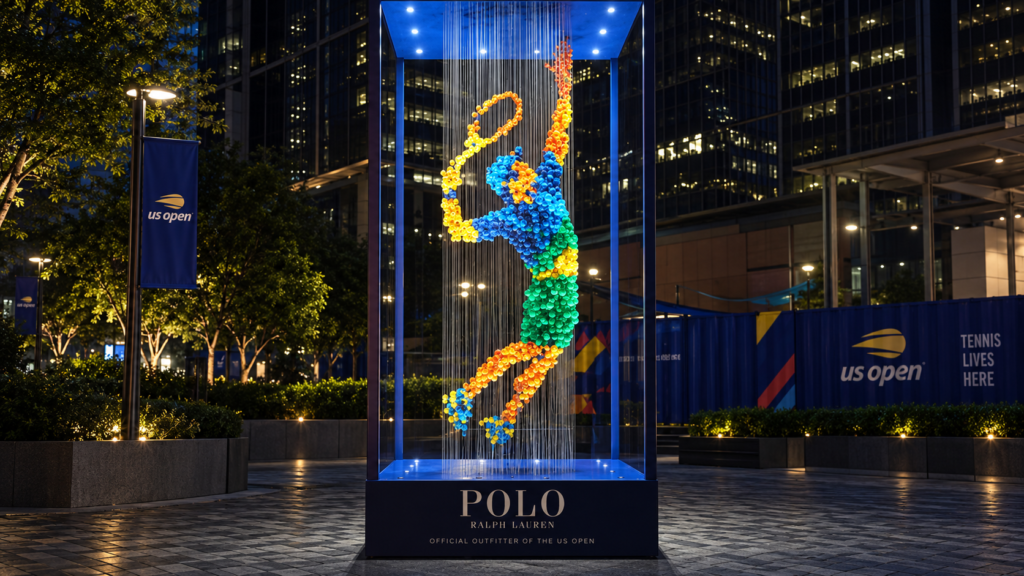
Polo Ralph Lauren celebrated the 2026 US Open with an 18-foot-tall installation that transforms thousands of tennis balls into two different images depending on where the viewer stands.
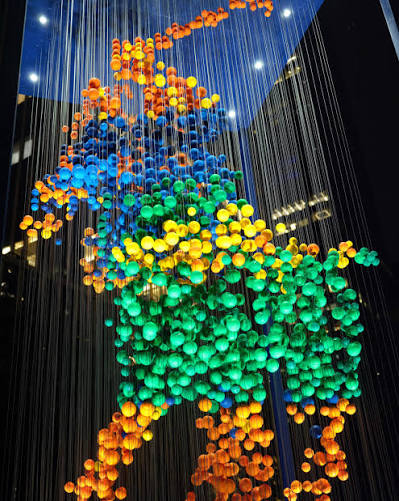
Created with New York-based perceptual artist Michael Murphy, the sculpture was installed at Hudson Yards in New York City as part of the US Open Experience. From one carefully chosen position, its suspended balls align to form a tennis player in action. Viewed from another angle, the same pieces reorganise themselves into Ralph Lauren’s familiar Polo Pony.
The installation turned a simple piece of sporting equipment into a large-scale expression of art, fashion and tennis heritage.
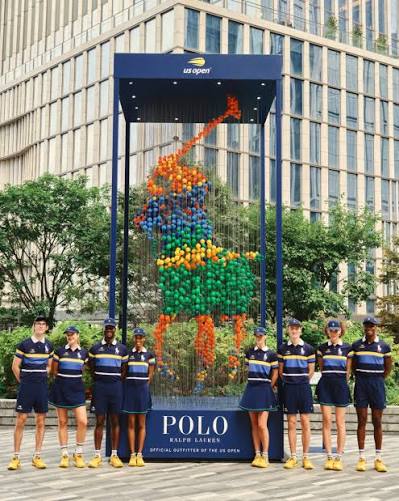
Two images occupy the same space
The sculpture is made from 2,000 tennis balls suspended across 444 precision wires.
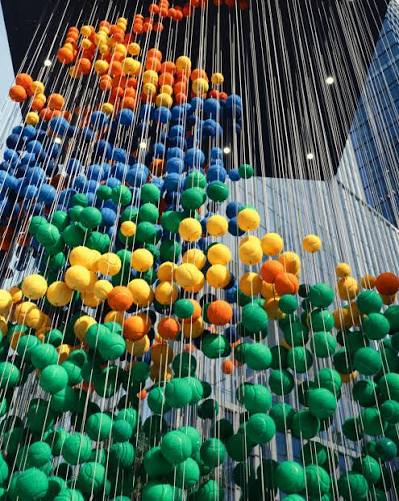
Each ball was painted in orange, green, yellow or blue and positioned at a specific height and distance. Seen from most locations, the installation resembles a colourful cloud of sporting equipment floating in the air.
However, when visitors reach one of its intended viewpoints, the apparently scattered objects align. The balls create the recognisable silhouette of a tennis player, with the colours giving the figure movement and depth.
Walking around the installation produces its second transformation. From another viewpoint, the player disappears and the Polo Pony emerges.
The physical elements remain stationary. Only the viewer’s position changes, making movement an essential part of understanding the work.
Hundreds of hours went into the illusion
Although the result appears spontaneous, the sculpture required careful planning and hundreds of hours of construction.
The position of every tennis ball had to contribute to both images. A ball that forms part of the athlete’s body from one direction may become part of the horse, rider or polo mallet from another.
The 444 wires also had to hold the balls securely while remaining visually unobtrusive. Their spacing allows light and surrounding architecture to remain visible through the sculpture, helping the installation appear almost weightless.
This approach reflects Murphy’s practice of creating perceptual artworks from many separate suspended objects. His pieces initially look abstract but become complete images when audiences find the correct viewing angle.
Tennis equipment becomes brand material
The installation avoids placing a conventional advertisement beside the tournament. Instead, it builds Ralph Lauren’s identity directly from the visual language of tennis.
Using real tennis balls immediately connects the work to the US Open. Transforming those balls into the Polo Pony then brings the sporting occasion and the fashion brand together without requiring a large printed logo.
The two perspectives also represent the relationship at the centre of the activation. One celebrates the athlete and the movement of tennis, while the other represents Ralph Lauren’s heritage and longstanding association with American sport.
Orange, green, yellow and blue give the piece greater visibility while separating its different visual layers. As visitors move around it, individual colours and balls merge into larger shapes before breaking apart again.
The audience completes the artwork
The sculpture was designed to reward curiosity.
A static photograph taken from the right location captures one of its hidden images, but walking around the installation reveals how the illusion works. Visitors can see the athlete dissolve into abstraction before the Polo Pony appears from a different direction.
That transition gives audiences a reason to stop, explore and document the work. The installation does not simply show people an image. It turns discovering the image into the experience.
Hudson Yards also placed the activation beyond the tournament grounds, allowing residents, shoppers and visitors to encounter the US Open atmosphere in another part of New York.
The installation remained on view within the US Open Experience through September 5, 2026.
Ralph Lauren continues its connection with tennis
Polo Ralph Lauren has built a prominent presence around the US Open through apparel, uniforms and tournament experiences.
This installation extends that association into public art. Rather than focusing on a new garment or collection, it uses scale, craftsmanship and perspective to express the brand’s connection with the sport.
The idea also brings together two activities that depend on viewing angles. Tennis players constantly judge movement, distance and position, while the sculpture only becomes legible when spectators locate the correct perspective.
That relationship gives the execution more relevance than a decorative display made from tennis balls alone.
Precision turns familiarity into surprise
Every component of the sculpture is familiar. Tennis balls, coloured paint, metal wires, a player and the Polo Pony require little explanation.
The surprise comes from how those elements work together.
By converting 2,000 individual balls into two recognisable images, Ralph Lauren created an installation that changes without physically moving. It demonstrates how a brand symbol can appear inside the culture of an event instead of being placed on top of it.
Public engagement figures and wider campaign results have not been announced. However, the work shows how a sponsorship can become a participatory visual experience rather than another piece of tournament signage.
Credits
The installation was created by Polo Ralph Lauren in celebration of the 2026 US Open, in collaboration with New York-based perceptual artist Michael Murphy. It was presented as part of the US Open Experience at Hudson Yards in New York City. Further production and agency credits were not publicly announced.
About the work
Campaign details
- Country
- United States
- Year
- 2026
Related
More in Editor's Pick

Popular
Popular posts

More stories