Editor's Pick
Niu Lai: China’s “worst” animated movie became an anti-AI box-office rebellion
 By Archit
·
·
6 min read
By Archit
·
·
6 min readAI-assisted
Quick summary
The idea: The article does not describe an intentional advertising idea, as the low-budget Chinese animated movie Niu Lai launched with no trailer or major promotional campaign. Instead, online mockery of its rough animation unintentionally served as free viral marketing.
The execution: Created by self-taught mother-and-son duo Sun Lifang and Xin Yumeng, the film featured stiff animation and awkward transitions. Audiences turned the mockery into an organic campaign by sharing clips, crafting homemade posters and merchandise, and attending communal cinema screenings to experience the movie firsthand.
Why it matters: After earning minimal initial revenue, the film surpassed 45 million yuan at the box office. Audiences embraced its visible technical flaws as sincere proof of genuine human effort, turning the release into an unexpected anti-AI rebellion celebrating imperfect, handmade art over polished digital content.
AI-generated from this article. For complete context and credits, read the full story.
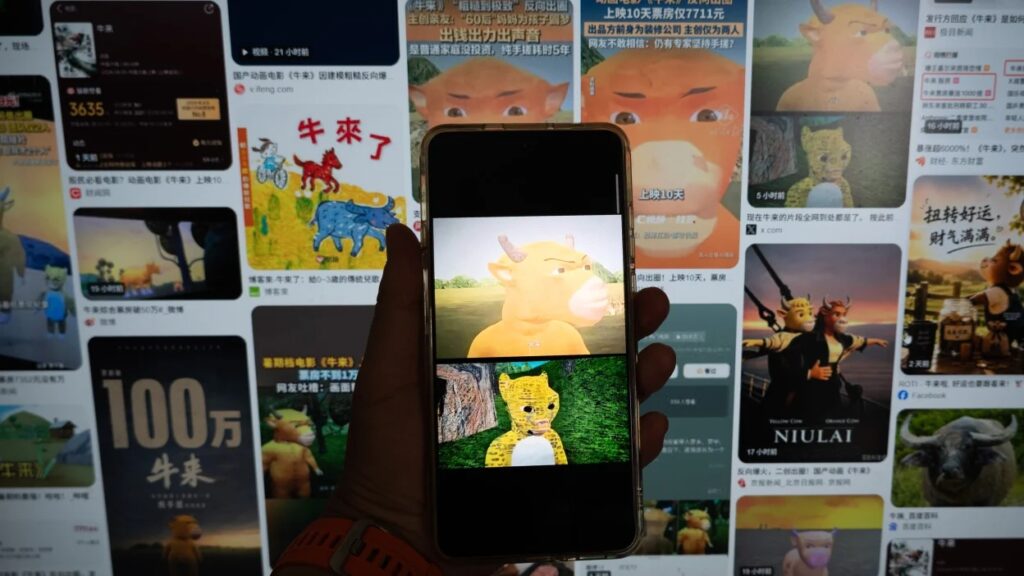
A Chinese animated film created by a mother-and-son team has gone from selling fewer than 300 tickets to earning more than 45 million yuan.
“Niu Lai,” variously translated as “The Bull Comes” or “Here Comes the Cow,” opened in China on 5 August 2026 with almost no promotion. It had no trailer, major advertising campaign or official theatrical poster.
Its rough animation initially attracted ridicule rather than admiration. Viewers shared clips to show how strange and technically limited the film appeared.
That mockery became free publicity. People began buying tickets to experience the film together, transforming a near-empty theatrical release into one of China’s most unexpected box-office stories.
A mother and son made almost everything
“Niu Lai” was created over approximately five years by Xin Yumeng and his mother, Sun Lifang.
Xin had worked as an interior designer and had no professional filmmaking background. He taught himself animation and handled directing, modelling, editing, cinematography, production and much of the voice acting.
Sun taught herself screenwriting, wrote the film’s music, performed its theme song and contributed character voices.
The pair worked with second-hand equipment and extremely limited resources. Reported production estimates vary considerably, although the creators consistently operated with a tiny budget compared with conventional animated features.
The film’s imperfections are therefore not the result of a deliberately manufactured style. They reflect two inexperienced creators learning how to make a feature while making it.
The story follows a calf learning courage
The 86-minute film follows Niu Lai, a weak newborn calf struggling to stand and meet his herd’s expectations.
As migration approaches, the calf begins a dreamlike journey involving his mother, a leopard cub and other unlikely companions. The story explores friendship, courage, loss and survival as the herd searches for safer, greener land.
Its emotional intentions are sincere, but the execution is unconventional.
The dialogue moves slowly, character movements are stiff and action sequences can be difficult to follow. Pixelated textures and awkward visual transitions make the film look considerably less polished than the animated productions normally released in cinemas.
Audiences initially used these qualities as evidence that the movie should never have reached theatres. They later became the exact reasons people wanted to see it.
Fewer than 300 tickets started the story
“Niu Lai” earned only 342 yuan on its opening day.
Across its first ten days, it generated approximately 7,700 yuan and sold fewer than 300 tickets nationwide. Under normal circumstances, those numbers would have ended the theatrical run.
Instead, clips of the animation began circulating across Chinese social platforms. Users described it as a disaster, compared it unfavourably with amateur projects and joked that it looked “worse than AI-generated animation.”
The criticism created a challenge that people wanted to investigate for themselves. Audiences began purchasing tickets simply to discover whether the complete film could be as unusual as the circulating clips suggested.
From 14 August, screenings and ticket sales increased rapidly. Cinemas added sessions as curiosity turned into genuine demand.
Mockery became the marketing campaign
The production did not have an official campaign capable of reaching a national audience, so viewers effectively created one.
Memes, reviews and short clips gave “Niu Lai” greater visibility than paid advertising could have provided. Fans designed their own promotional artwork and placed handmade posters inside cinemas because the production had not supplied an official one.
Other viewers created toys, costumes, illustrations and unofficial merchandise based on the film’s characters.
Screenings developed into communal events. Audiences arrived already familiar with the jokes, laughed together at specific moments and treated the film as an experience rather than a conventional piece of cinema.
Some people attended ironically. Others began defending the movie’s emotional honesty and the relationship between the two creators behind it.
The film’s success was produced by both reactions at once.
Its imperfections became proof of human effort
The film arrived during growing debate about generative AI and the increasing amount of polished but impersonal digital content appearing online.
“Niu Lai” was not created with generative AI. Its rough surfaces, repeated movements and visible mistakes showed the labour of two people learning unfamiliar skills.
Younger audiences began celebrating those flaws as evidence that the film was genuinely handmade. What critics saw as technical failure, supporters interpreted as sincerity.
This did not suddenly make the animation professionally accomplished. The cultural response was more complicated.
People were supporting the creators’ right to make something imperfect, personal and emotionally direct. The film became an informal rejection of the idea that every creative work needed to be technically flawless, algorithmically optimised or supported by expensive marketing.
Its anti-AI reputation came from the audience rather than an official message from the filmmakers.
The box office increased beyond 45 million yuan
By 23 August, “Niu Lai” had passed 45 million yuan at the Chinese box office, equivalent to approximately $6.7 million.
That represented an extraordinary increase from the 7,700 yuan earned during its first ten days.
At one point, the film appeared near major international releases in China’s daily box-office rankings. Its success was not large by blockbuster standards, but it was remarkable for an almost unknown film created with minimal resources.
The title also produced another unexpected joke. “Niu Lai” can be interpreted as “the bull is coming,” encouraging social-media references to an approaching bull market.
The joke spread into financial conversations, and companies with “bull” in their names reportedly experienced speculative interest. The frenzy became large enough for a journal associated with China’s central bank to warn against irrational meme-stock investing.
Niu Lai succeeded because it could not be planned
The film’s rise offers a powerful lesson about earned attention, but it is not a formula that other creators can easily reproduce.
A deliberately bad movie would probably feel calculated. An agency attempting to manufacture the same online mockery could quickly lose the sincerity that made “Niu Lai” appealing.
Its success depended on an unusual combination of failure, humour, cultural frustration and affection for its creators.
The film did not defeat professional animation by becoming technically better. It gave audiences permission to enjoy something for different reasons.
“Niu Lai” began as a movie almost nobody knew existed. It became a national inside joke, a communal cinema experience and a symbol of human imperfection in the age of AI.
Credits
Film: Niu Lai. Alternative English titles: The Bull Comes, Here Comes the Cow and The Arrival of the Ox. Director, producer, animator, editor and cinematographer: Xin Yumeng. Writer, composer, songwriter, performer and producer: Sun Lifang. Voice cast: Xin Yumeng and Sun Lifang. Production Company: Dalian Jingyuan Culture Film and Television Media. Distributor: Tianjin Yamazaki Film. Country: China. Language: Mandarin. Running time: 86 minutes. Theatrical release: 5 August 2026. No advertising agency or formal national marketing campaign was announced.
About the work
Campaign details
Related
More in Editor's Pick



Popular
Popular posts


More stories