Outdoor
Corona Sun Shadows: four outdoor campaigns created by real sunlight
 By Archit
·
·
6 min read
By Archit
·
·
6 min read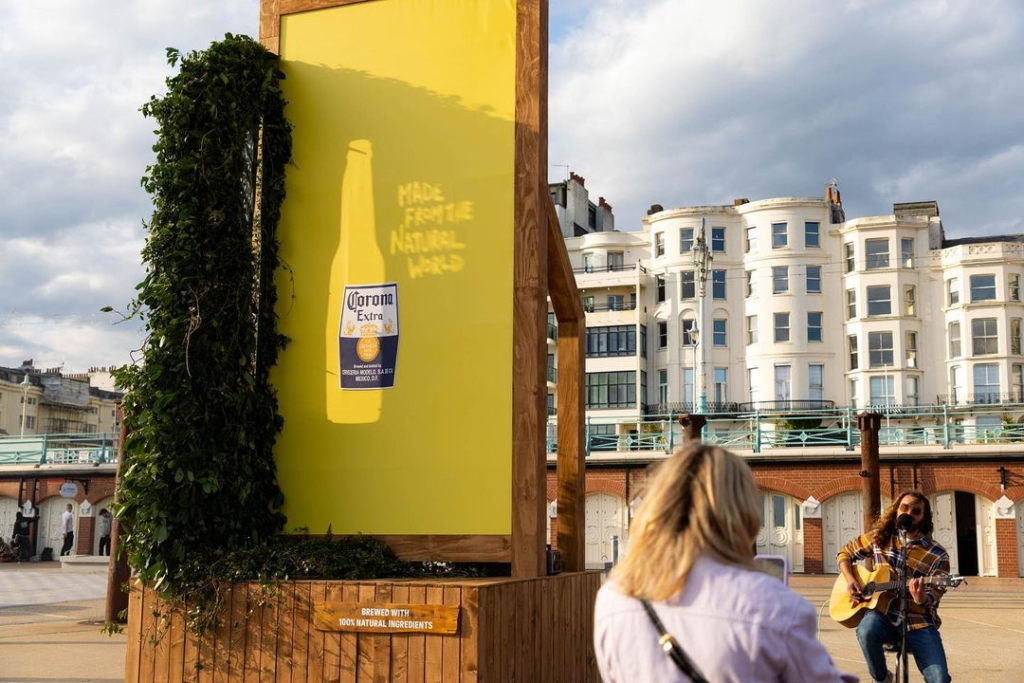
In June 2026, Corona waited for winter sunset shadows in Cape Town to stretch across the pavement and form a beer bottle. A white chalk label completed the shape for a few minutes before the light moved on. Sun Shadows, created by Boundless, was the latest chapter in a longer run of Corona advertising that treated the sun as photographer, broadcaster and printing press.
Across four campaigns, the brand kept returning to the same source of light. However, the sun performed a different job each time.
The billboard that finished at golden hour
In 2022, Corona installed a six-metre yellow billboard on Brighton’s seafront in England.
During most of the day, the board showed little more than a Corona label. Foliage and a specially designed structure stood along one side. Then, between approximately 6.30 pm and 6.45 pm, the setting sun passed through the structure and cast the missing parts of the advertisement.
The shadow created the outline of a Corona bottle and revealed the message “Made From the Natural World.”
Wieden+Kennedy developed the installation to communicate that Corona was brewed with natural ingredients. Instead of placing a photograph of the sun inside the advertisement, the team allowed real sunlight to complete it.
The narrow viewing window made the board feel alive. Someone arriving too early saw an unfinished layout. Someone arriving at the right moment watched nature turn it into a finished advertisement.
After that, the bottle slowly disappeared again.
The eclipse became a slice of lime
In October 2024, Corona used an annular solar eclipse to create For Every Slice of Sun.
A Corona bottle is often served with a lime wedge placed inside its neck. During the eclipse, the moon covered part of the sun and temporarily changed it into a similar curved shape.
DAVID Miami positioned photographers across locations in South America and the Pacific. The teams studied the movement of the eclipse, the height of the sun and the expected weather. They then aligned real Corona bottles with the sky and waited for the moon to create the missing lime.
Five final photographs captured the moment.
The images required no artificial reconstruction of the eclipse. Each depended on the camera, bottle and sun reaching the correct positions within a short window. By comparison, the Brighton billboard had used the sun to reveal the bottle. Here, the sun became part of the product ritual.
The photographs were released quickly while the eclipse was still part of the day’s conversation. As a result, a predictable natural event became a live production schedule.
Lima’s billboards became windows
In March 2025, Corona used the sunset in a different way.
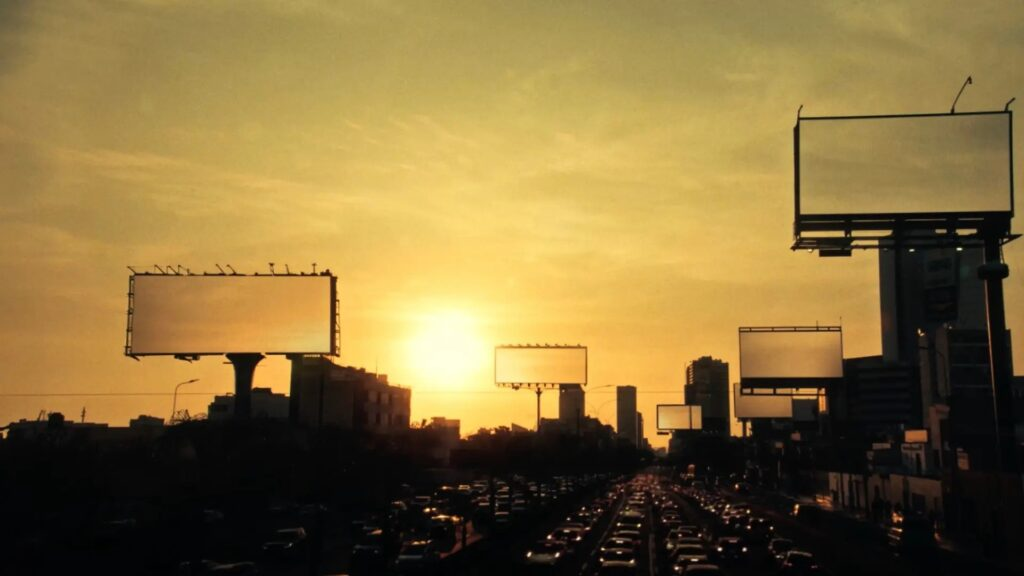
Rush-hour drivers on Lima’s Javier Prado Avenue were surrounded by traffic and digital advertising. Corona took over screens along the road and replaced the usual commercial messages with a live view of the setting sun.
Cameras positioned behind the boards recorded the sky. The screens then broadcast that view towards the drivers facing the other direction.
For a short period, each billboard worked like a window cut through the city.
Leo Perú created the activation around Corona’s invitation to disconnect from routine and spend more time outside. However, the work reached people at a moment when going anywhere was difficult. They were sitting inside cars, moving slowly through one of Lima’s busiest roads.
The sunset did not remove the traffic. Still, it changed what people could see while waiting.
The execution also reversed the purpose of digital outdoor media. The screens usually competed for attention through brighter images and faster movement. Corona used the same network to show one continuous natural event.
Cape Town’s shadows drew the bottle
Sun Shadows brought the idea back to physical outdoor media in 2026.
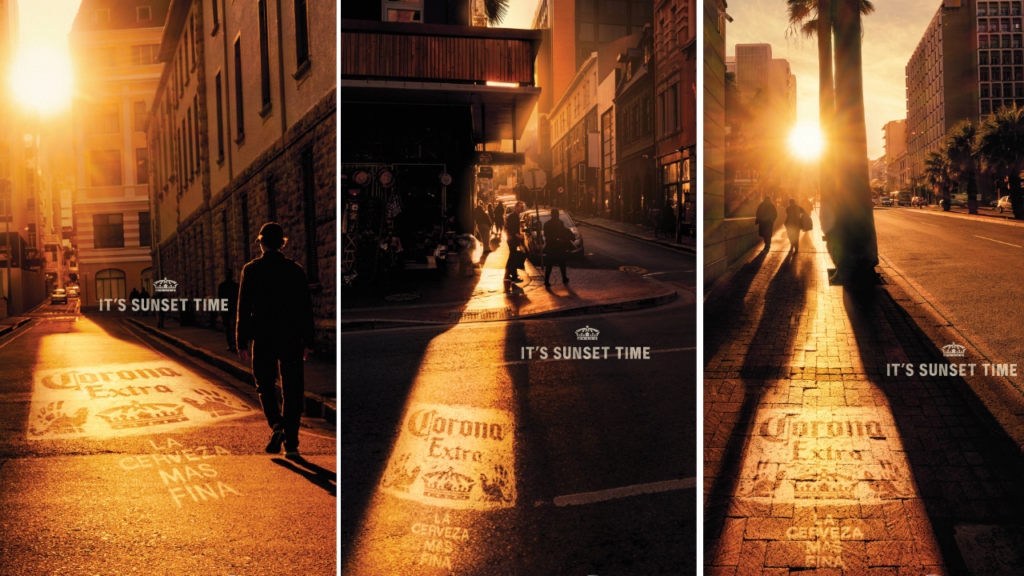
Boundless studied where the setting sun would fall across streets in Cape Town. As the sun approached the horizon, buildings, trees and other objects cast long winter shadows across the ground.
The team selected places where those shapes could align into the silhouette of a Corona bottle. A white chalk drawing supplied the label and small product details. Meanwhile, the moving shadows supplied the glass.
There was no permanent poster carrying the complete image. The advertisement existed only while the sun remained at the correct height.
The campaign was photographed and filmed without computer-generated shadows or digital manipulation. That required the agency to predict the light, prepare each location and capture the result before the shape moved away.
In fact, the imperfections made the bottle more convincing. Pavement texture, uneven edges and nearby objects remained visible. The street had not become a clean studio. It had become part of the artwork.
The Craft
These four campaigns assigned the sun a different creative role.
In Brighton, it completed a billboard. During the eclipse, it became a lime wedge. In Lima, it supplied a live broadcast. In Cape Town, it drew the bottle itself.
Each execution also accepted a limit. The work could only appear at a certain time, from a certain position and under suitable conditions. Clouds could interrupt it. A small change in angle could break the image. More importantly, the agency could prepare everything and still had to wait for nature to finish the job.
That uncertainty suited Corona’s connection to outdoor life. The campaigns did not simply place natural scenery behind a bottle. They made the natural world necessary to the production.
The sun was not pictured in the advertising. It created the advertising.
Credits
Natural Billboard / Made From the Natural World (2022) — Corona Europe, Brighton, United Kingdom. Agency: Wieden+Kennedy. Creative Directors: Dan Viens and Josh Bogdan. Creative team: Caio Mattoso and Rodrigo Mendes. Research, development, design and installation: Sketch Events.
For Every Slice of Sun / Corona Eclipse (2024) — Corona, South America and Pacific locations. Agency: DAVID Miami. Global Chief Creative Officer: Pancho Cassis. Chief Creative Officers: Daniel Lobatón and Edgard Gianesi. Associate Creative Directors: João Corazza and Bruno Reis. Creative team: Seiji Wakabayashi and Thomas Nitti. Production: Corona Studios. Photographers: Marcelo Maragni, Lucas D’Ortone, Diego Weisz, Nicholas Aguayo, Connor Trimble and Victor Eleuterio. Awards: D&AD Wood Pencil and The One Show Merit.
Sunset Broadcast / City Traffic to Sunset Experience (2025) — Corona / Backus, Lima, Peru. Agency: Leo Perú. Chief Creative Officer: Beto Noriega.
Sun Shadows (2026) — Corona, Cape Town, South Africa. Agency: Boundless. Chief Creative Officers: Roanna Williams and Fran Luckin. Executive Creative Director: Felix Kessel. Art Directors: Roanna Williams and Alexa Craner. Copywriters: Fran Luckin and Felix Kessel. Agency Producer: Lara Bayley. Photographer: David Prior. Experience Design: Control A.
Related
More in Outdoor

Popular
Popular posts


More stories