Editor's Pick
Airlink flew two jets over the stadium to celebrate its Rugby’s Greatest Rivalry partnership
 By Ridhi
·
·
4 min read
By Ridhi
·
·
4 min readAI-assisted
Quick summary
The idea: Airlink celebrated its partnership as the official domestic airline for the 2026 Rugby’s Greatest Rivalry tour by reviving a famous South African tradition of pre-match stadium flypasts.
The execution: Airlink painted two Embraer jets in the green and black team colours of South Africa and New Zealand. Crewed by senior captains with aviation authority approval, the aircraft performed low-altitude formation flypasts over Ellis Park and Cape Town's DHL Stadium, passing roughly 12 to 14 metres above the Cape Town roof amidst stadium pyrotechnics.
Why it matters: The spectacle turned Airlink's operational transport role into a viral match-day event seen worldwide, connecting modern audiences to the iconic 1995 World Cup flypast while also sparking global debate among aviation experts regarding low-altitude safety margins.
AI-generated from this article. For complete context and credits, read the full story.
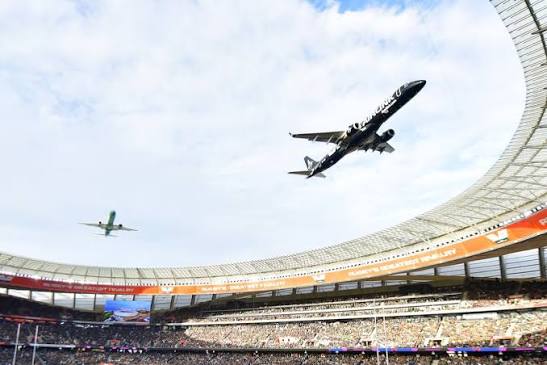
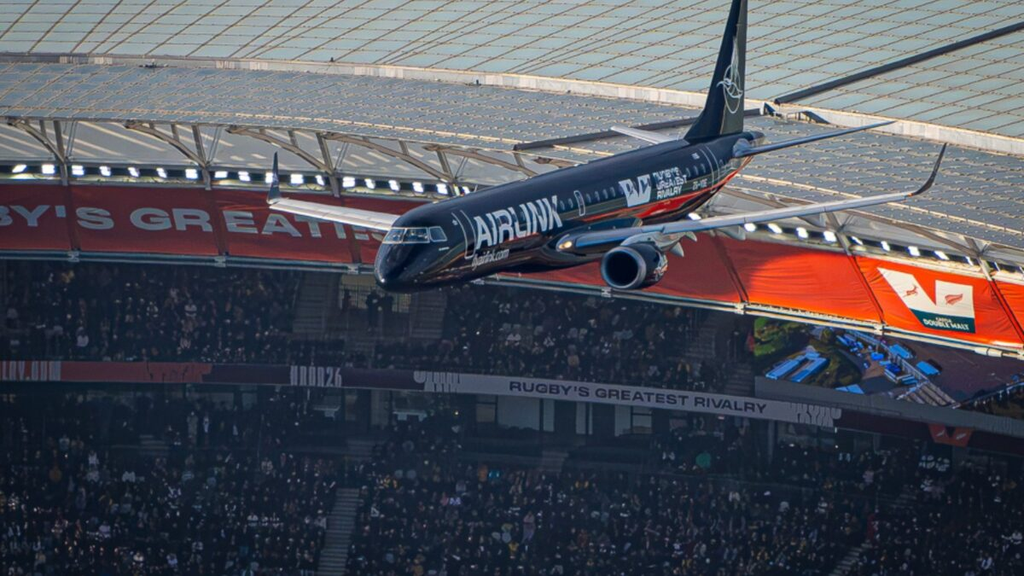
Two passenger jets painted in the colours of South Africa and New Zealand flew just metres above Cape Town’s DHL Stadium before the Springboks faced the All Blacks on 29 August 2026.
It looked extreme even by flypast standards. But Airlink was not inventing a new rugby spectacle. It was continuing a South African tradition that goes back more than three decades, while turning its partnership with Rugby’s Greatest Rivalry into something 56,000 people could see above their heads.
A rugby tradition that started in 1995
Aircraft flypasts have been part of major Springbok matches since one of the most famous moments in South African rugby history.
Before the 1995 Rugby World Cup final at Ellis Park, a South African Airways Boeing 747 flew low over the stadium with “Good Luck Bokke” written underneath. The opponents that day were New Zealand.
South Africa went on to beat the All Blacks 15-12 and win its first Rugby World Cup.
The flypast became part of the memory of that final. Since then, aircraft over the stadium have returned for other major Springbok games.
Thirty-one years later, the same two rugby nations were meeting again in South Africa. This time, Airlink had a reason to take over the tradition.
Airlink turned its partnership into two flying team colours
Airlink became the official domestic airline for Rugby’s Greatest Rivalry in June 2026.
The partnership means the airline is transporting the Springboks, All Blacks, coaches, management and support staff between matches across South Africa during the tour.
Airlink also prepared two specially liveried Embraer jets for the series. An E190 was painted green and an E195 black, representing the colours of the two teams. Both carried the Rugby’s Greatest Rivalry tour logo.
Then the aircraft became part of the match-day show.
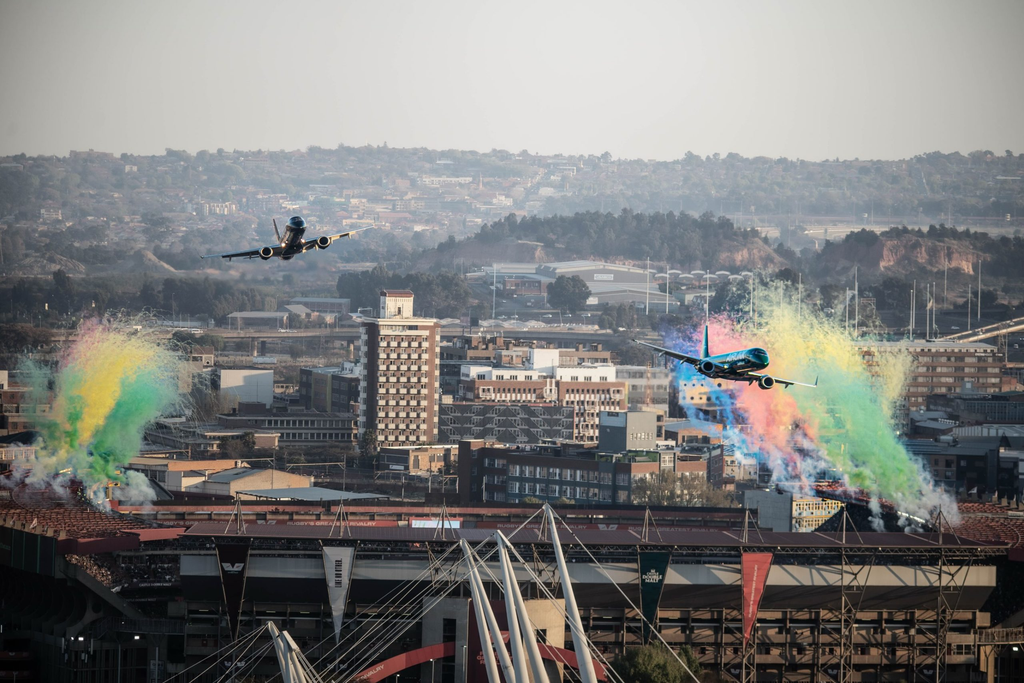
On 22 August, both jets performed a formation flypast over Ellis Park before the first Springboks versus All Blacks Test. A week later, Airlink took the idea to Cape Town.
That second flypast became the one seen around the world.
The Cape Town flypast came within metres of the roof
Shortly before kick-off at DHL Stadium on 29 August, the two aircraft approached in formation at around 150 knots.
The green jet crossed first. The black aircraft followed closely behind as coloured smoke and pyrotechnics erupted around the stadium.
Flight tracking data later estimated that the lead aircraft passed around 41 to 46 feet above the stadium roof. That is roughly 12 to 14 metres.
Videos filmed from inside and around the stadium made the distance look even smaller. Within hours, footage had moved far beyond rugby audiences.
The flypast had done exactly what a major sports partnership hopes to do. Airlink was no longer simply the airline moving the teams between cities. Its aircraft had become part of the event itself.
The spectacle also started a safety debate
The same footage that made the flypast famous also raised questions about how low the aircraft had flown.
Airlink said the manoeuvre had been carefully planned and rehearsed with support and approval from the South African Civil Aviation Authority and Air Traffic Navigation Services.
There were no passengers aboard. Each aircraft carried three senior captains working as commander, co-pilot and safety or technical officer.
Airlink also said recorded flight data showed both aircraft remained within the approved altitude and speed limits.
Still, several aviation experts questioned whether flying passenger jets that close to a packed stadium left enough room if something unexpected happened.
That debate became inseparable from the images. Some viewers saw an extraordinary piece of precision flying. Others saw a margin that looked far too small.
Where the partnership fits in
The flypast makes more sense when seen as part of the full Airlink partnership rather than as a standalone stunt.
Airlink is physically moving the teams through South Africa. Its aircraft wear the colours of both sides. Then those same planes appear above the stadium before they play.
It also connects the 2026 partnership to a piece of rugby history that South African fans already understand. The first famous flypast happened before South Africa and New Zealand met in 1995. Three decades later, the same rivalry brought the aircraft back overhead.
This time, the airline was not simply flying past the rugby.
It was part of the tour.
Credits
Airlink — Airlink, South Africa. Official domestic airline partner of Rugby’s Greatest Rivalry 2026. Aircraft: Embraer E190 ZS-YAE in green and Embraer E195 ZS-YDE in black. Ellis Park formation flypast: 22 August 2026. DHL Stadium formation flypast: 29 August 2026.
About the work
Campaign details
- Brand
- Airlink
- Country
- South Africa
- Year
- 2026
Related
More in Editor's Pick


Popular
Popular posts




More stories