WWF turned the words of a proposed law into endangered wildlife
 By Archit
·
·
4 min read
A few changes to a legal document can look harmless on paper. For the animals and plants living within a protected landscape, however, those words can carry consequences that extend far beyond the page.
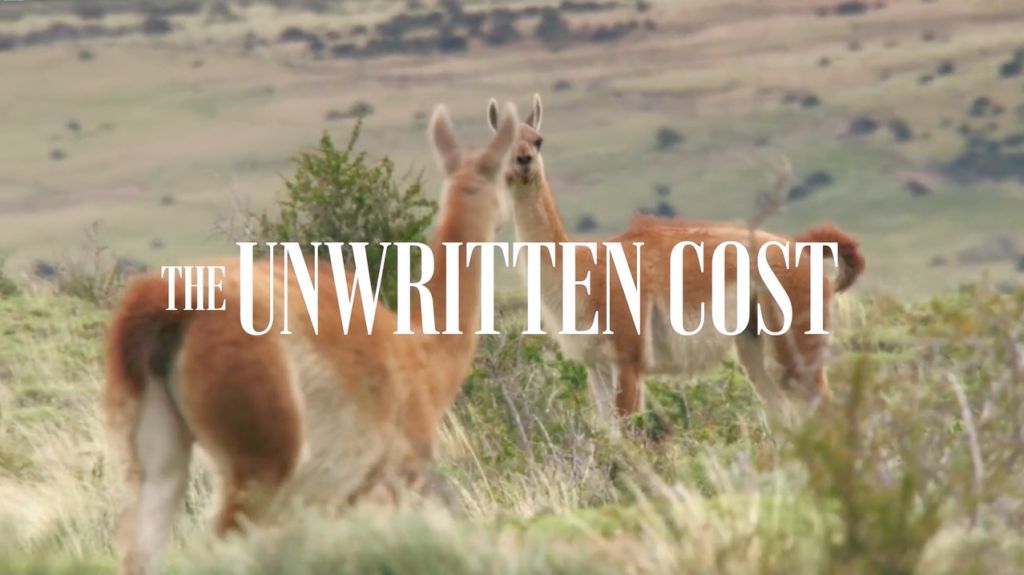
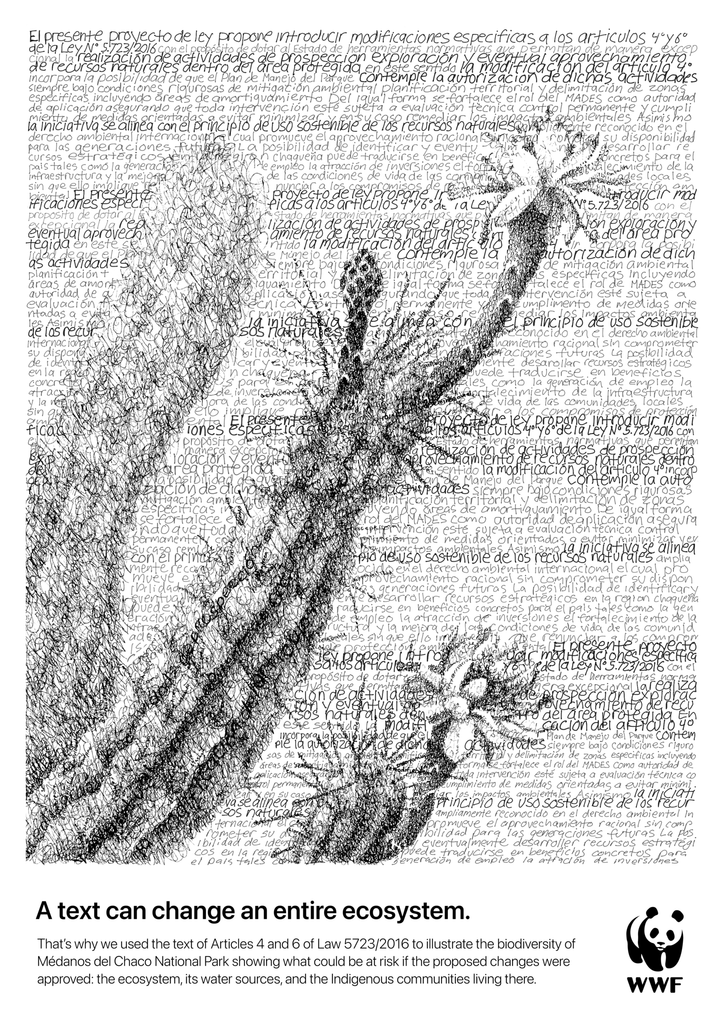
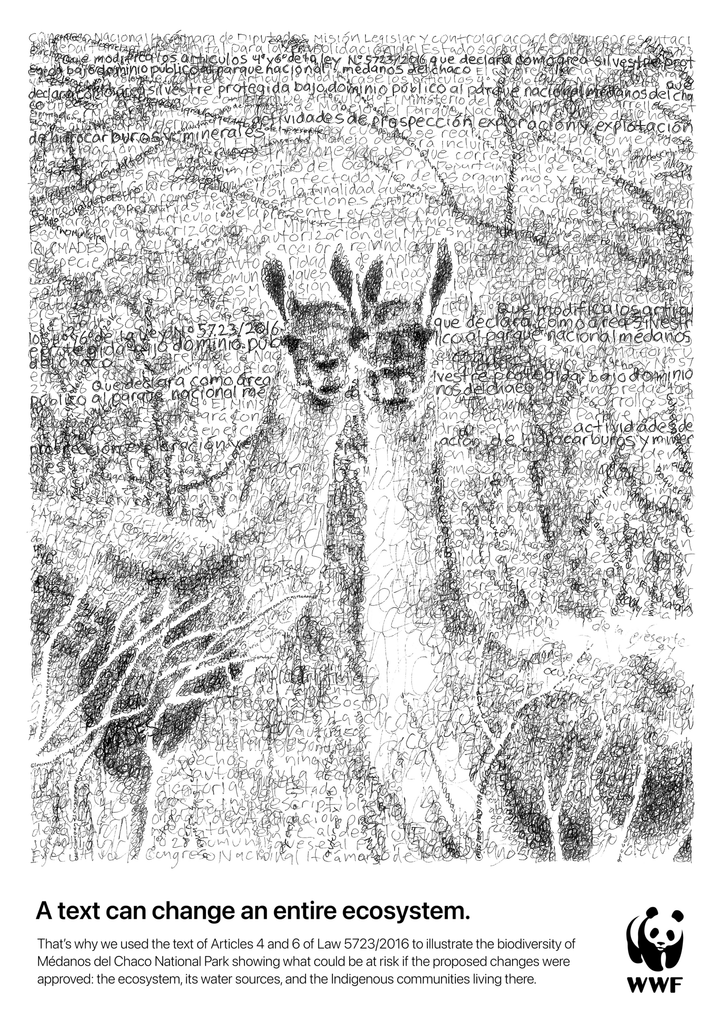
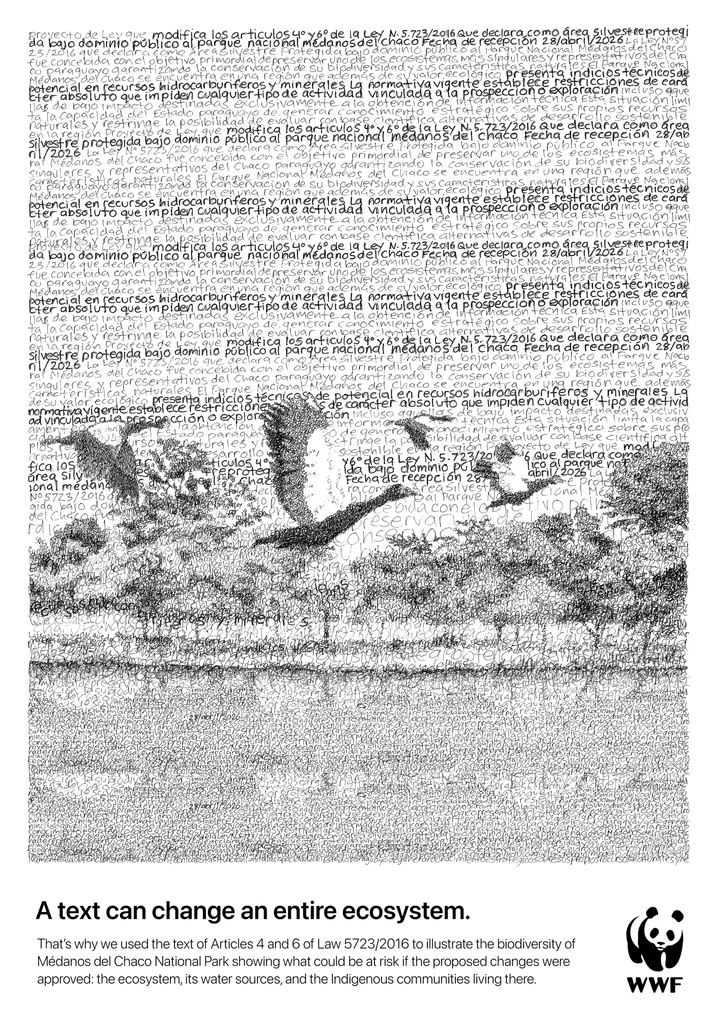
WWF Paraguay’s The Unwritten Cost campaign used the wording of a proposed amendment affecting Médanos del Chaco National Park to create illustrations of its biodiversity.
The animals were not simply accompanied by the legislative text. They were constructed from the words themselves, turning an apparently technical proposal into a visual representation of what could be lost.
A proposed amendment could weaken existing protections
Médanos del Chaco National Park is one of Paraguay’s protected natural areas. Its landscape supports native plants and wildlife adapted to the distinctive conditions of the Gran Chaco.
A proposed bill sought to modify the park’s existing protections relating to activities such as prospecting, exploration and the extraction of hydrocarbons and minerals.
Read as a legal document, the proposed changes could appear distant and administrative. The language describes articles, permissions and procedures rather than habitats and living species.
WWF Paraguay wanted people to see the territory hidden behind that language.
The legal text became the raw material for the artwork
The campaign used the amendment’s actual wording to form three detailed illustrations representing biodiversity that could be affected.
Lines of text curve and overlap to create the shapes, features and textures of the animals. What initially resembles a conventional wildlife illustration reveals itself, on closer inspection, as a picture built from legislative language.
This technique connects cause and consequence within a single image. The words that could alter the park’s protections physically become the creatures that may have to live with the results.
The execution also gives the audience two ways to understand the campaign. From a distance, viewers see wildlife. Up close, they encounter the legal text responsible for the threat.
Technical language concealed an environmental consequence
Environmental decisions are often communicated through documents that are difficult for the public to interpret. Their immediate subjects are laws and regulations, while their eventual effects may be felt across forests, water, soil and wildlife.
The Unwritten Cost translated that complexity without replacing the original language. Rather than summarising the bill through a separate message, WWF used its own words to reveal what was absent from them.
No animal appears in the proposed amendment, yet animals could be among those most affected by its approval. No habitat may be described in emotional terms, yet changes to its protection could influence an entire ecosystem.
The campaign’s central idea is that the true cost of a law is not always included in its written text.
Typography connected policy with the natural world
The illustrations rely on a tension between bureaucratic language and organic forms.
Legal writing is usually precise, formal and visually uniform. Wildlife is complex, irregular and alive. Combining the two makes the proposed amendment feel less abstract while showing that political language can reshape physical environments.
The monochromatic treatment keeps attention on the construction of each image. There are no dramatic scenes of destruction. Instead, the threat is communicated through the fragile presence of animals made from words that could determine their future.
This restraint allows the print work to invite closer examination rather than delivering its warning through shock alone.
WWF made the unseen cost visible
The campaign demonstrates how design can help people understand a policy issue that might otherwise remain confined to legislative debate.
By turning legal language into wildlife, WWF Paraguay gave the proposed changes a recognisable subject. The park’s biodiversity became part of the public conversation rather than an indirect consequence hidden behind technical terminology.
The work does not rewrite the amendment. It asks audiences to look beyond what the document says and consider everything its words could affect.
Credits
The Unwritten Cost, 2026. Client WWF Paraguay. Agency Garabato. CEO Mauricio Alfaro. Chief Creative Officer Paloma Cella. Creative Directors Renzo Renna, Mathias Duarte and Arami Torres. Art Director Bruno Sarabia. Account Director Beta Alonso. Project Manager Camila Fischer. Illustration by Phil Vance. Creative team Sergio López Mussi, Maryan Villamayor, Geraldine Carrasco, Mavi Verano, Fuh Bobadilla and Facundo Tau. The print campaign was published in Paraguay in September 2026.
About the work
Campaign details
Related
More in Print

Popular
Popular posts

More stories