Outdoor
See It at The Warhol: The Andy Warhol Museum made absence the main attraction
 By Archit
·
·
5 min read
By Archit
·
·
5 min readAI-assisted
Quick summary
The idea: The Andy Warhol Museum and agency BarkleyOKRP launched "See It at The Warhol," a campaign promoting famous artworks without showing any imagery, instead relying on audience memory to mentally recreate the art.
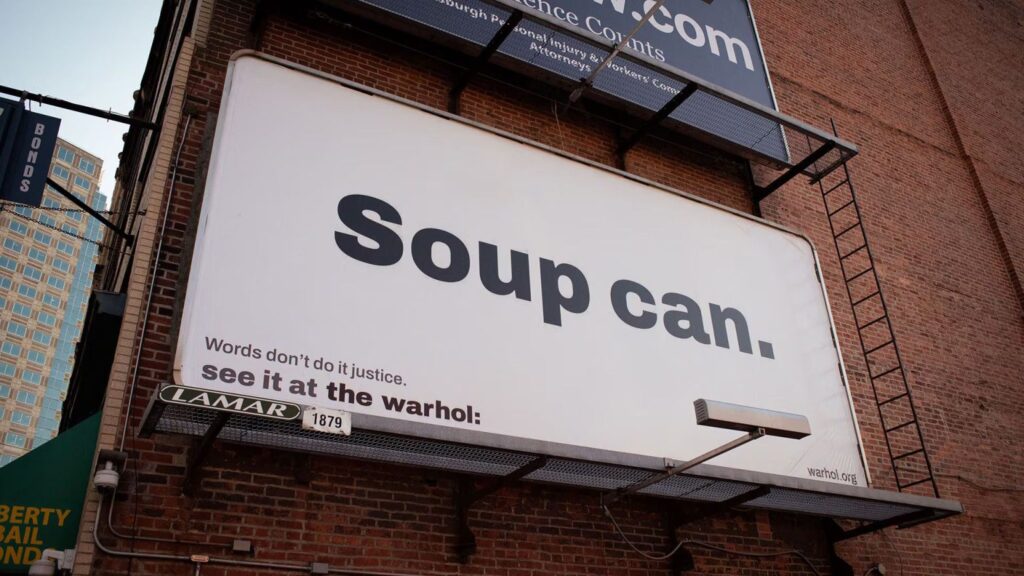
The execution: Appearing across outdoor and digital formats, the minimalist advertisements feature brief descriptions like "Soup can" or "Shiny balloon," concluding with the line: "Words don't do it justice. See it at The Warhol."
Why it matters: The approach turns cultural familiarity into active audience participation, cutting through visual clutter while emphasizing that verbal descriptions cannot replace the physical museum experience.
AI-generated from this article. For complete context and credits, read the full story.
The Andy Warhol Museum has launched an advertising campaign that promotes some of the world’s most recognisable artworks without showing any of them.
Created with BarkleyOKRP, “See It at The Warhol” replaces Warhol’s paintings and installations with short verbal descriptions. Instead of reproducing an artwork, each execution gives viewers just enough information to form the image in their own minds.
The campaign is appearing across outdoor and digital placements, where its minimal design stands apart from the crowded, image-heavy advertising that usually fills public spaces.
The art disappears from the advertising
Museums commonly advertise exhibitions by placing their most famous artworks at the centre of a poster or billboard. The Andy Warhol Museum has taken the opposite approach.
There are no reproductions, cropped details or portraits of the artist. The campaign removes the artwork completely and leaves behind a few carefully chosen words.
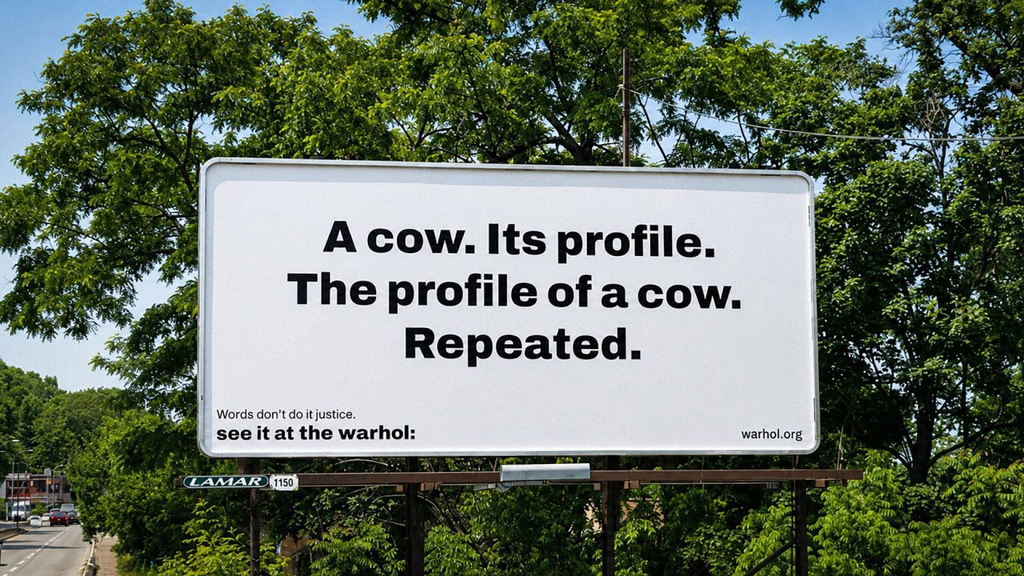
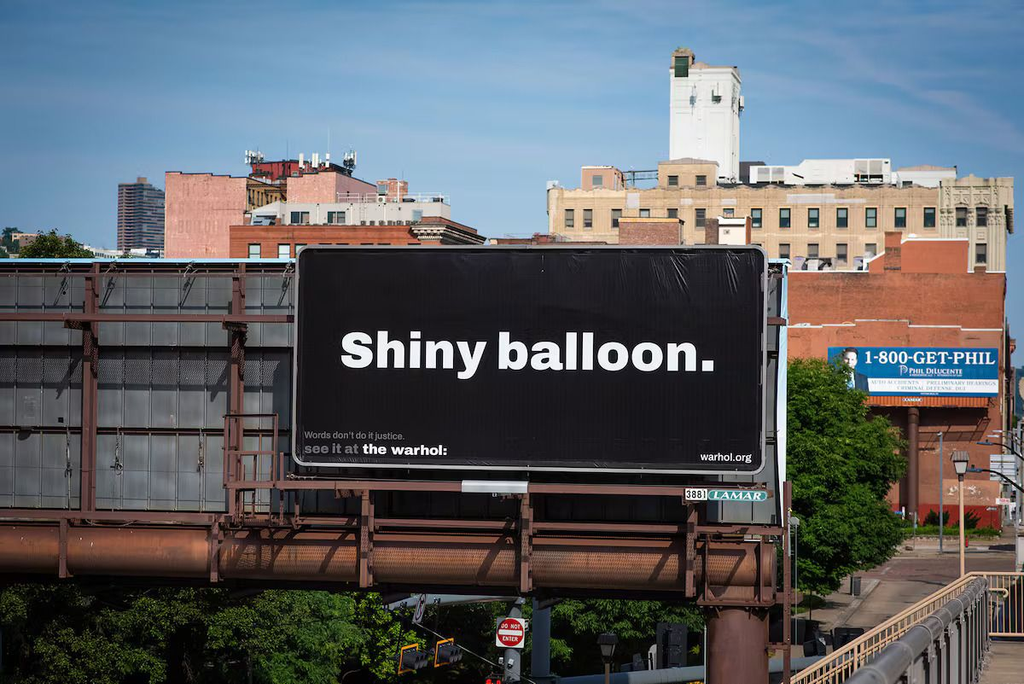
One execution simply reads, “Soup can.” Another offers “Shiny balloon.” A third describes “A cow. Its profile.”
The references are deliberately incomplete, but the cultural familiarity of Warhol’s work makes them instantly evocative. A soup can becomes Campbell’s Soup Cans. A metallic balloon suggests Silver Clouds. The description of a cow recalls Warhol’s Cow Wallpaper.
Rather than presenting the answer, the advertisements allow the audience’s memory to supply it.
Recognition becomes the creative mechanism
The campaign depends on a rare advantage: Warhol’s images have travelled far beyond museums.
His brightly coloured portraits, consumer products and repeated symbols have been reproduced in books, clothing, films, posters and popular culture for decades. Many people recognise the visual language even if they cannot name a specific work or explain its place in art history.
“See It at The Warhol” turns that familiarity into participation. Viewers do not passively receive an image. They interpret a clue, search their memory and mentally reconstruct what has been removed.
That small act of completion makes the outdoor work more engaging than a conventional museum poster. The missing image is not an empty space. It is the central idea.
A closing line explains why the art is absent
Each execution concludes with the statement: “Words don’t do it justice. See it at The Warhol.”
The line transforms the campaign’s apparent limitation into its invitation. The words may help someone remember the artwork, but they cannot reproduce its scale, surface, colour or physical presence.
It also gives the campaign a clear destination. If the verbal clue has reminded viewers of an artwork or made them curious about it, the museum is presented as the place where that curiosity can be resolved.
The advertising therefore avoids pretending that a billboard can replace the museum experience. It openly admits that the real work needs to be encountered in person.
The restraint reflects Warhol’s visual directness
The creative approach feels appropriate for an artist who repeatedly turned familiar objects into art.
Warhol selected images people already understood, including soup cans, soft-drink bottles, celebrities and newspaper photographs. Through repetition, scale and colour, he encouraged audiences to look again at things they believed they already knew.
This campaign performs a similar reversal. It begins with familiar Warhol images and removes them, asking people to consider how clearly those pictures remain in the collective imagination.
The short copy also borrows the directness of commercial labelling. Phrases such as “Soup can” sound closer to product descriptions than traditional art commentary, creating a connection between the campaign’s language and Warhol’s fascination with advertising and consumer culture.
Outdoor becomes a test of cultural memory
The concept is particularly suited to outdoor advertising because people often have only a few seconds to process a billboard.
The copy is short enough to understand immediately, while the absence of detailed imagery gives each execution a strong visual presence. Against streets filled with photography, promotional offers and elaborate graphics, a nearly empty advertisement can command attention through restraint.
The idea can also move easily into digital formats. Individual clues can be adapted for different works while retaining the same structure, tone and closing invitation.
This creates a flexible campaign system rather than a single advertisement. Every new description offers another opportunity for audiences to test what they recognise.
The campaign protects the value of seeing art in person
The Andy Warhol Museum in Pittsburgh holds the world’s largest collection of Warhol’s art and archival material. Its collection extends across paintings, prints, photographs, films, videos and personal records from the artist’s life and career.
That physical experience is difficult to communicate through a reproduction. By refusing to show the art, the campaign preserves a sense of discovery and makes the museum visit the final part of the creative idea.
It is a confident decision for an institution with access to an enormous archive of powerful imagery. Instead of using those assets to make the advertisements visually impressive, the museum uses their absence to demonstrate how deeply Warhol’s work has entered popular culture.
No performance figures or visitor results have been announced. However, the campaign’s strength is already clear in its central proposition: if a few ordinary words can make someone picture a Warhol, the original may be worth seeing again.
Credits
“See It at The Warhol” was created for The Andy Warhol Museum by creative agency BarkleyOKRP and launched across outdoor and digital media in August 2026. The museum is located in Pittsburgh, Pennsylvania. Additional creative, production and media team credits, along with campaign performance results, have not been publicly announced.
About the work
Campaign details
- Country
- United States
- Year
- 2026
Related
More in Outdoor


Popular
Popular posts


More stories