Malaysian Nature Society turned felled trees into bleeding animals
 By Archit
·
·
4 min read
By Archit
·
·
4 min read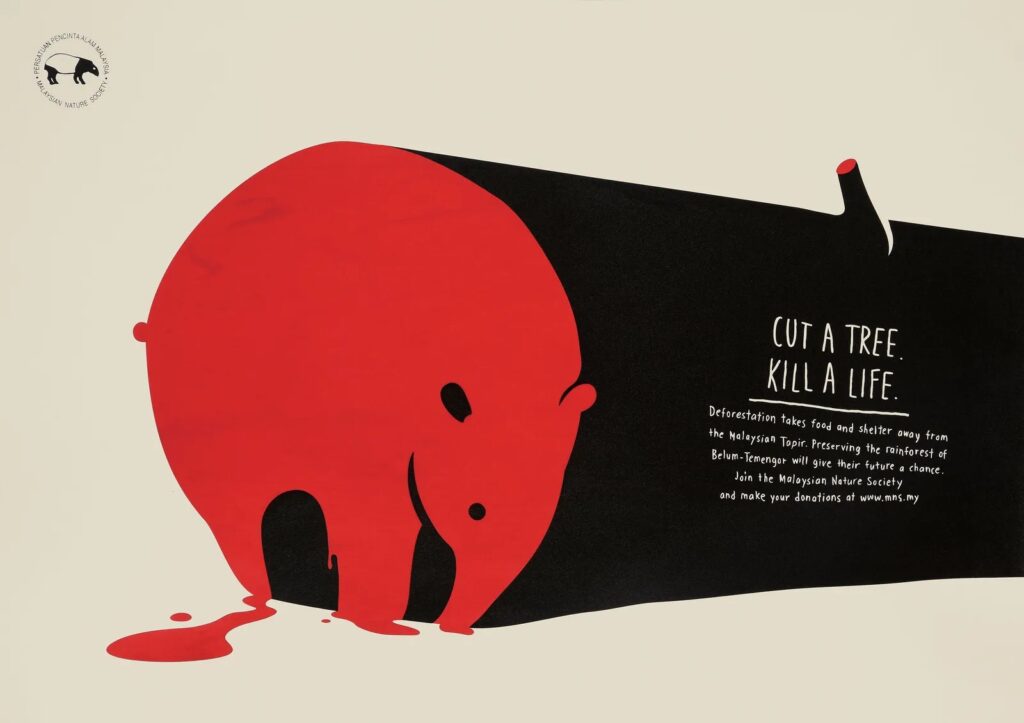
A tree does not fall alone. When forests disappear, the animals relying on them lose their food, shelter and protection.
The Malaysian Nature Society made that connection visible in Cut A Tree. Kill A Life., a poster campaign created to raise awareness of deforestation in the Belum-Temengor rainforest.
Each minimalist illustration transformed a severed tree trunk into the body of an endangered animal, making the destruction of wildlife appear as the immediate consequence of cutting down a tree.
Cut trunks became wounded animals
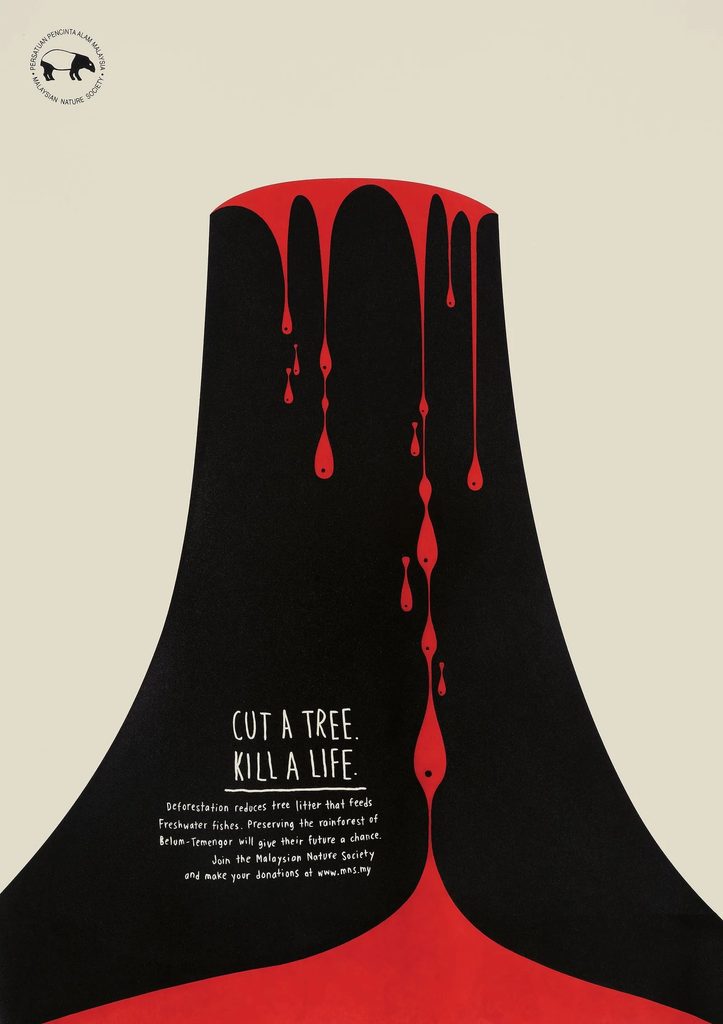
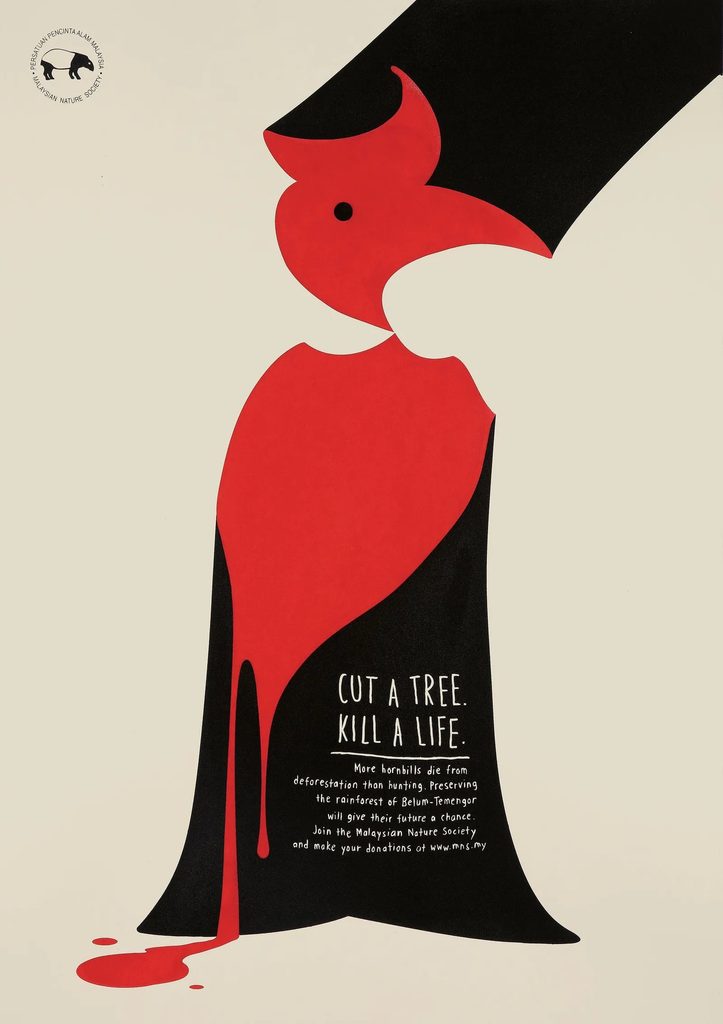
The posters used a limited palette of black, red and cream to combine trees with animals including the Malayan tapir, Sumatran rhino, hornbill and fish.
In one execution, the circular end of a felled log becomes a tapir’s head. Its red face appears to bleed onto the ground while the black trunk forms the rest of its body.
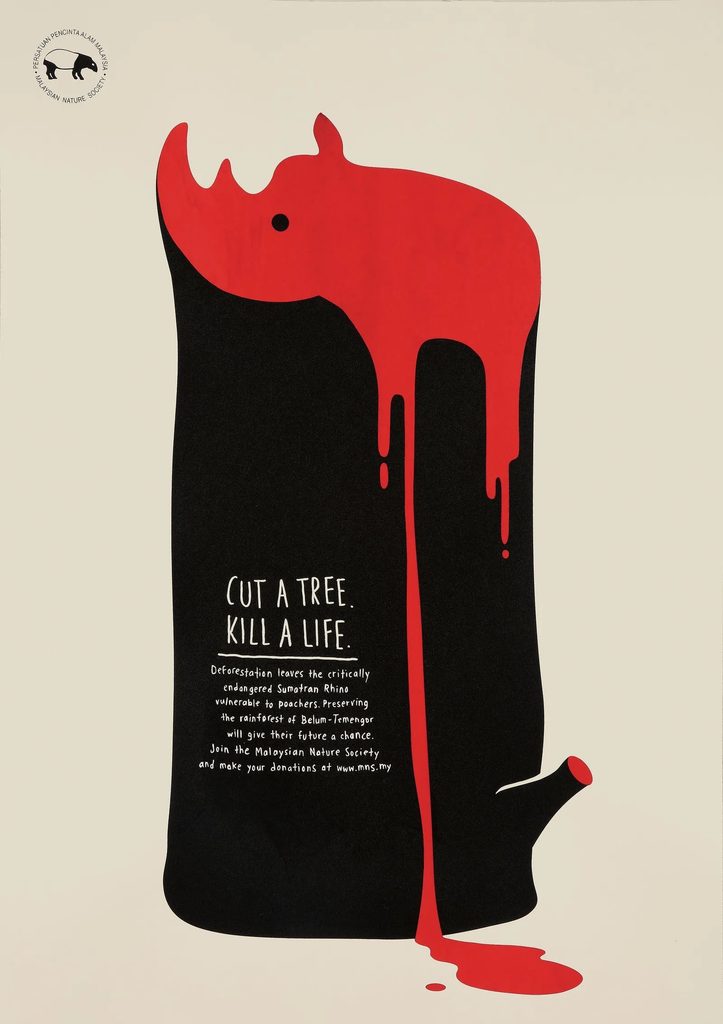
Another poster places a red Sumatran rhino on top of a tall black stump. Its body melts down the cut surface like blood, connecting the animal’s vulnerability directly to the loss of its habitat.
The images require little explanation. The animal and the tree appear to share the same body, so cutting one becomes an act of violence against the other.
One sentence connected the action with its consequence
Every execution carried the line “Cut A Tree. Kill A Life.”
The statement removes the distance between deforestation and wildlife loss. It does not describe cutting trees as something that may eventually harm animals. It presents the two actions as parts of the same event.
Shorter messages beneath the headline explained how deforestation affected each species. Losing the forest removed food and shelter from the Malayan tapir, while exposing the critically endangered Sumatran rhino to greater danger from poachers.
The campaign therefore combined an immediate emotional image with specific information about the threats facing individual animals.
The posters focused on Belum-Temengor
Malaysia has lost more than half of its natural rainforest. This makes Belum-Temengor one of the country’s most important remaining wildlife sanctuaries.
The rainforest is estimated to be more than 130 million years old, making it older than the Amazon rainforest. It supports rare and endangered species that have increasingly fewer places left to survive.
The campaign asked people to support the Malaysian Nature Society’s work to preserve the rainforest. Rather than discussing deforestation only through the number of trees lost, the posters showed what disappeared alongside them.
Recycled paper became part of the message
The designs were silkscreened by hand onto recycled paper, giving each poster a raw and tactile appearance.
The production method supported the environmental subject instead of treating sustainability as something separate from the creative execution. Recycled material reduced the campaign’s impact, while the irregular qualities of silkscreen printing complemented the rough shapes and hand-drawn typography.
The physical construction of the posters therefore reinforced the campaign’s argument. A message about protecting forests was produced with greater consideration for the resources it consumed.
Minimal design made the violence difficult to ignore
The campaign avoided photography, detailed landscapes and conventional images of animals standing in forests.
Its simple graphic language reduced the issue to three elements: a tree, an animal and blood. The negative space and limited colours made the posters easy to understand from a distance while rewarding closer inspection.
The same visual system could also adapt to different species without weakening the central idea. Every animal was shown differently, but each appeared physically joined to a damaged tree.
Cut A Tree. Kill A Life. received a Wood Pencil for Graphic Design in 2016. The tapir execution also received a Bronze Lion in 2015, while the wider poster series was recognised across several international design and advertising awards.
By merging wildlife with the trees that sustain it, the Malaysian Nature Society turned habitat destruction into something immediate and physical. The posters showed that when a tree is removed from a rainforest, the loss extends far beyond the timber.
Credits
Cut A Tree. Kill A Life., 2015, Malaysia. Client Malaysian Nature Society for the Belum-Temengor rainforest. Advertiser Supervisor Andrew J. Sebastian. Agency Y&R Malaysia, Kuala Lumpur. Executive Creative Director Gigi Lee. Creative Director and Art Director Joshua Tay. Copywriter Wilcox Yap. Illustrators Law Kok Yew and Nicholas Siew. Design and typography by Nicholas Siew. Account Supervisor Eliza Wong. Art Buyer T L Tan. Print Maker Ooi Cheing Tam.
About the work
Campaign details
Related
More in Print


Popular
Popular posts



More stories