Case Studies
Forbidden Pharmacy: McCann New Zealand locked away 200 medicines to expose a national access crisis
 By Archit
·
·
6 min read
By Archit
·
·
6 min readAI-assisted
Quick summary
The idea: McCann New Zealand and 17 patient organisations created Forbidden Pharmacy to expose a national healthcare crisis, highlighting that over 600,000 New Zealanders cannot access necessary medicines publicly funded in other countries.
The execution: Ahead of the national election, Auckland's Shed 10 was transformed into a pharmacy displaying over 200 life-changing medicines locked behind glass cases. The one-day installation paired physical treatments with stark international price comparisons and screens showing real patient testimonies. The project was supported by promotional and documentary-style films, social content, and an open letter to political leaders.
Why it matters: More than 1,500 people visited the installation, physically confronting a funding gap where 95 percent of modern medicines fail to reach New Zealand's publicly funded shelves, urging politicians to make medicine access an urgent election priority.
AI-generated from this article. For complete context and credits, read the full story.
More than 600,000 New Zealanders cannot access medicines they need, despite many of those treatments being publicly funded in countries such as Australia, Canada and the United Kingdom.
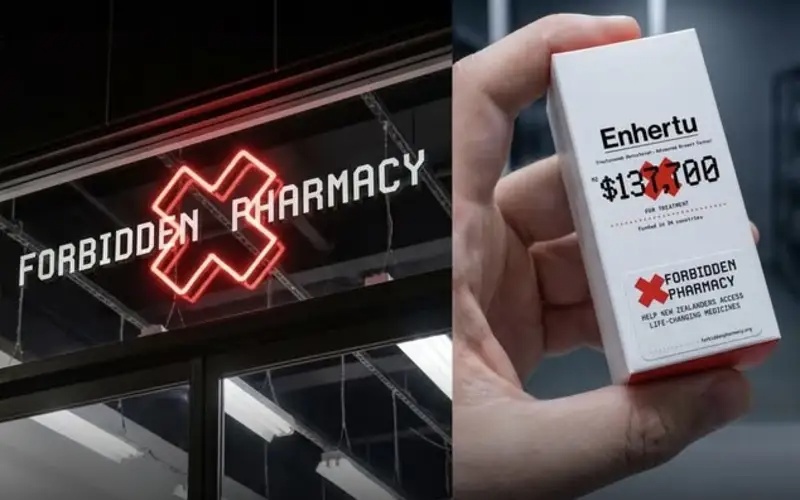
“Forbidden Pharmacy” made that inequality physical by transforming Auckland’s Shed 10 into a pharmacy filled with more than 200 life-changing medicines locked behind glass.
Created by McCann New Zealand with 17 patient organisations, the public awareness campaign connected medicine prices, funding statistics and real patient stories ahead of New Zealand’s election.
Visitors entered a pharmacy that could not serve them
The installation opened at Shed 10 on Saturday, 25 July 2026, from 10am to 5pm.
Inside the dark, carefully lit space, visitors encountered rows of illuminated glass cases containing medicine bottles, syringes and treatment packaging. Products including Keytruda, Enhertu, Luxturna and Elahere were visible but physically inaccessible.
The locked cabinets represented the experience of patients who know an appropriate treatment exists but cannot receive it through New Zealand’s publicly funded health system.
Every medicine was connected to an illness, a patient community and a story about living with delayed or denied treatment.
The campaign transformed medicine funding from a complicated policy debate into something people could immediately understand. The products were present, but they remained behind a transparent barrier.
The films gave the locked medicines a human meaning
Two campaign films extended the installation beyond Shed 10.
A documentary-style hero film follows visitors moving through the darkened pharmacy while real patients speak about their lives, families and diagnoses. They introduce themselves as parents, grandparents and partners before explaining the illnesses that have changed their futures.
One of the central voices is Nikita, a woman living with advanced ovarian cancer and a prognosis of less than 12 months. Appearing on a screen inside the installation, she describes herself as living on borrowed time while a potentially life-extending medicine remains financially out of reach.
Other participants discuss the embarrassment and emotional pressure of asking friends, relatives and strangers to help crowdfund treatment costs that can exceed $100,000.
The film avoids treating them as anonymous medical cases. Their family roles are introduced before their diagnoses, reminding viewers of the lives connected to every locked medicine.
A second film turned the scale into an invitation
The campaign’s shorter promotional film begins with close-up portraits and the statement: “Over 600,000 New Zealanders can’t get the medicines they need.”
It then moves through the illuminated cabinets, showing recognisable treatments alongside their prices. The visual language is clinical and restrained, allowing the numbers and expressions of the patients to carry the message.
The film ends with “Help us unlock these medicines” and invites people to visit the one-day installation at Shed 10.
A red pixelated medical cross forms the Forbidden Pharmacy identity. The broken, digital appearance makes the familiar pharmacy symbol look restricted or incomplete, reflecting a health system in which treatments exist but access has been interrupted.
Together, the two films serve different purposes. One brings people into the installation, while the other preserves the emotional experience and patient testimonies after the physical event has closed.
Price comparisons exposed the financial paywall
Each display compared the private cost of treatment in New Zealand with the subsidised price available overseas.
A medicine for heterozygous familial hypercholesterolaemia was presented as costing approximately NZD $9,000 annually, compared with about AUD $25 per prescription in Australia.
Treatment for advanced breast cancer was shown at NZD $137,700, while eligible Australian patients could access it for approximately AUD $25 per prescription.
A medicine for platinum-resistant ovarian cancer carried a New Zealand cost of NZD $45,000 every three weeks. The comparison showed that patients could receive the treatment without charge through the United Kingdom’s public health system.
Luxturna, a treatment for inherited retinal dystrophy, was displayed with a New Zealand price of NZD $1.5 million for both eyes. In Australia, access is supported through its Highly Specialised Therapies Program, reducing the cost paid by eligible patients to a small monthly amount.
These comparisons gave the installation its emotional force. The medicines were not forbidden because they were experimental or unavailable. They were forbidden by a funding barrier determined partly by where a patient lived.
The statistics showed a wider funding gap
The campaign reported that 95% of modern medicines do not reach New Zealand’s publicly funded shelves.
Of 477 modern medicines launched internationally during the previous decade, only 24 received public funding in New Zealand.
The country also invests approximately 0.4% of GDP per capita in publicly funded medicines, compared with an OECD average of 1.4%.
For patients, those percentages can translate into hospital visits, worsening symptoms, reduced independence, time away from work and pressure on entire families.
Judith Ansell, who is living with metastatic HER2-low breast cancer, had already spent more than $90,000 on private treatment. She also faced the possibility of paying an estimated $64,000 for six months of Enhertu.
The campaign showed how patients may be forced to sell property, enter debt, move overseas, organise public fundraisers or continue without treatment.
Patient voices shaped the filmmaking
Director Reagen Butler conducted two days of individual conversations with participating patients and also served as director of photography.
The production initially considered using a voiceover, but the team decided that the patients’ own statements should form the structure of the film. Their interviews were edited and placed on screens inside the installation, making their testimony part of the environment experienced by visitors.
The handheld cinematography observes without overwhelming the participants. An original score featuring violinist Joni Fuller supports the emotional weight while leaving space for every voice.
The campaign continued through social content, the documentary film and an open letter asking New Zealand’s political leaders to make timely medicine access an election priority.
It did not ask politicians to select individual treatments or remove the independence of Pharmac, the country’s medicine-funding agency. Its demand was for adequate investment so that assessed medicines could reach patients sooner.
More than 1,500 people entered the installation
Organisers reported that more than 1,500 people visited the Forbidden Pharmacy during its one-day opening. The audience included members of the public, media representatives and political figures.
The event brought patients and decision-makers into the same space, with each locked cabinet making the consequences of delayed access visible.
The final call to action asked people to share their stories, add their voices to the campaign and demand action during the election.
No confirmed funding commitment or policy change has yet been attributed to the campaign. However, Forbidden Pharmacy succeeded in turning an invisible administrative barrier into a physical experience that could be seen, heard and felt.
Credits
“Forbidden Pharmacy” was created by McCann New Zealand with experience and design partner dotdotdash, communications partner FleishmanHillard Aotearoa and production company Supernormal, working alongside a coalition of 17 New Zealand patient organisations. Reagen Butler directed the hero film and served as director of photography, Joseph Leary contributed to the film and installation design, Matt McKenzie was Executive Producer for Supernormal, and the original score featured violinist Joni Fuller. Tim Edmonds served as campaign spokesperson, while the patients and families who shared their experiences formed the central voices of the work.
About the work
Campaign details
- Agency
- McCann
- Country
- New Zealand
- Year
- 2026
Related
More in Case Studies


Popular
Popular posts
More stories