Car Crashes: Burger King turned real restaurant accidents into ads for home delivery
 By Archit
·
·
6 min read
By Archit
·
·
6 min read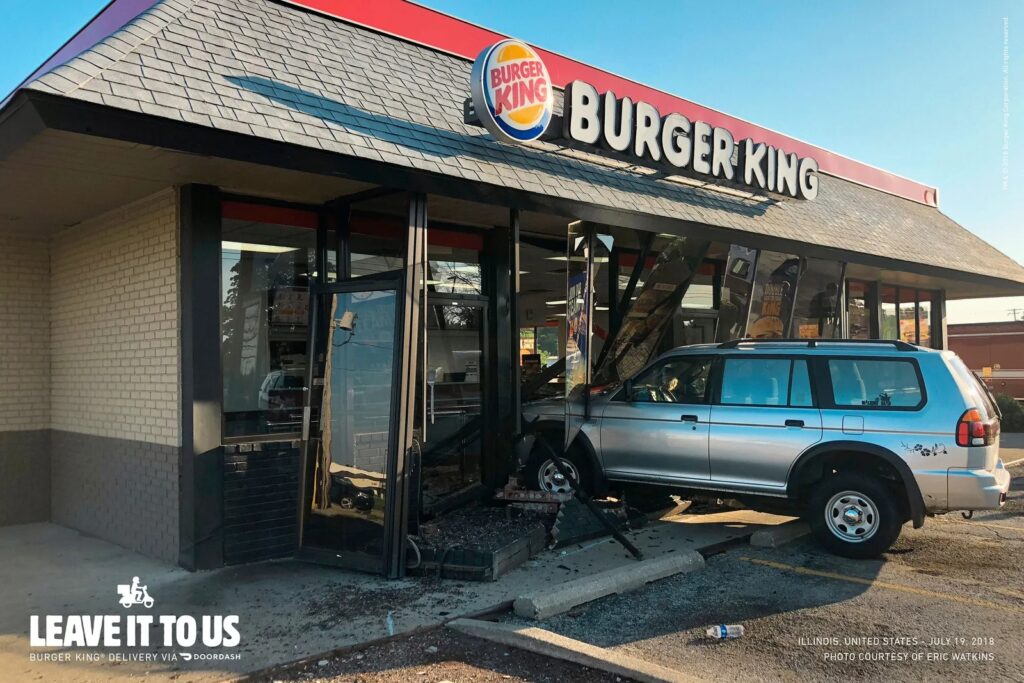
Burger King used photographs of real cars that had crashed into its restaurants to promote the launch of its US delivery service.
Created by LOLA MullenLowe Madrid, “Car Crashes” transformed the unusual accidents into a series of print and outdoor advertisements carrying the message “Leave it to us.”
The joke suggested that some customers were so eager to reach a Whopper that they drove directly through the restaurant. Burger King then presented delivery as the safer and more convenient alternative.
Although the images showed heavily damaged cars and restaurant buildings, the brand confirmed that none of the incidents featured in the campaign resulted in injuries.
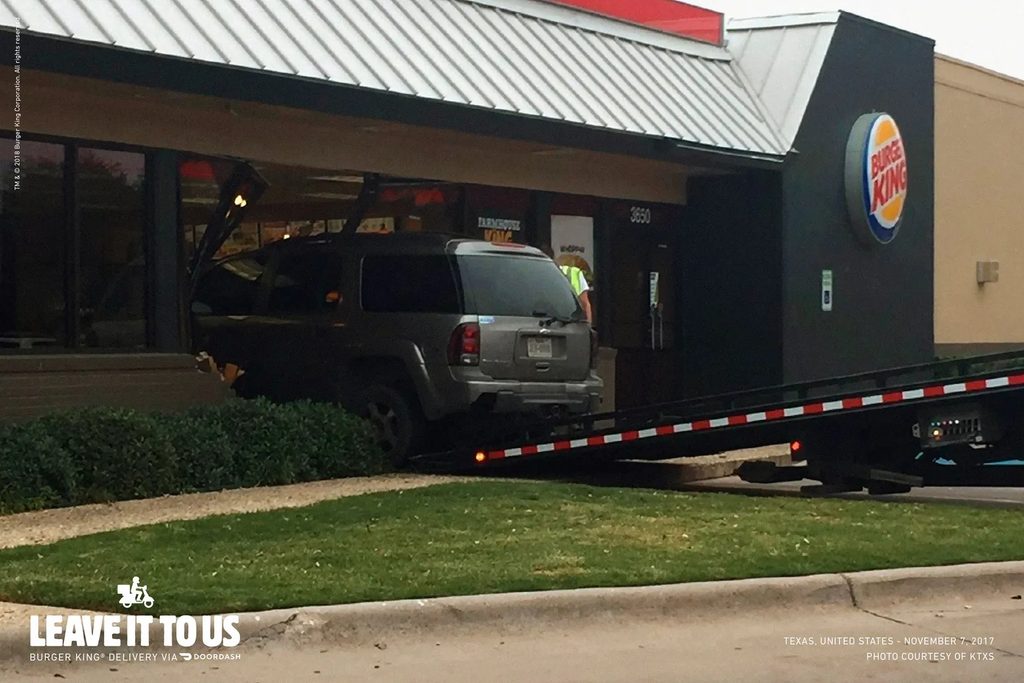
The campaign began with real restaurant accidents
Cars crashing into restaurants are uncommon, but Burger King found that enough incidents had taken place at its US locations to create an entire advertising series.
Instead of recreating those accidents for a photo shoot, the campaign used authentic images taken after the crashes. The photographs show vehicles lodged in restaurant walls, windows and entrances.
Their documentary appearance makes them look more like local news photographs than traditional fast-food advertising.
Burger King added minimal copy and branding, allowing viewers to understand the strange visual before reaching the joke. The main message, “Leave it to us,” reframed each accident as evidence that customers should order their food instead of trying to reach the restaurant themselves.
Other executions used lines such as “Don’t drive hungry” and “Safety first.”
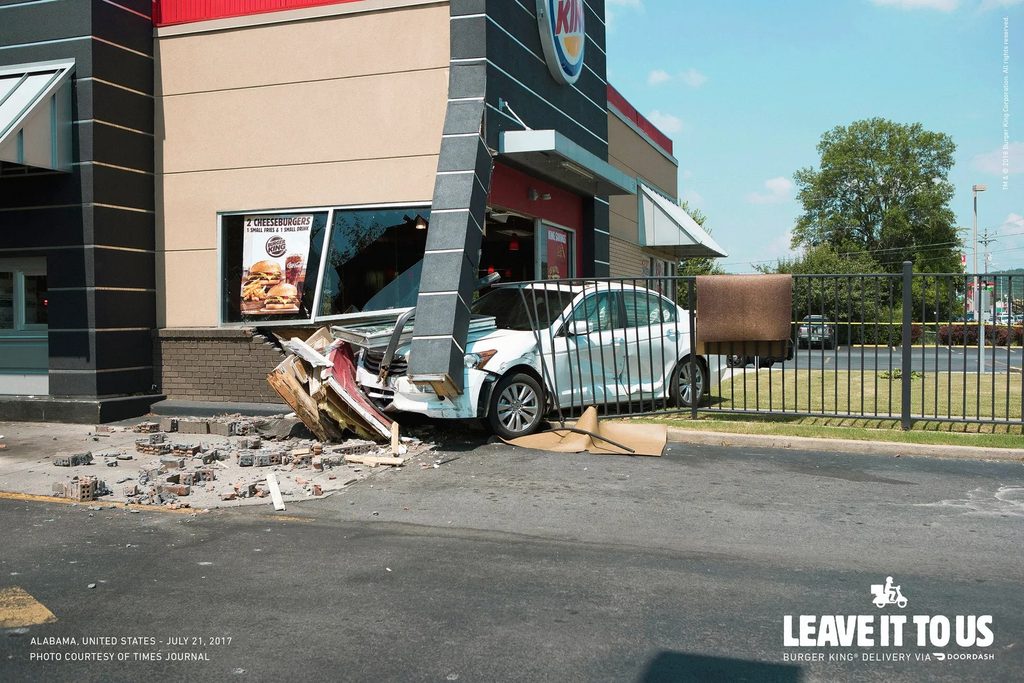
An accident becomes a delivery message
The campaign was created to support Burger King’s home-delivery launch in the United States.
Customers could order items from the Burger King menu through DoorDash and have them delivered directly to their homes. A limited promotion also offered free delivery on qualifying orders of $15 or more.
“Car Crashes” gave that functional service announcement a provocative visual idea.
A conventional delivery advertisement might have shown a meal arriving at someone’s door. Burger King instead focused on what customers would no longer need to do: get into a car and travel to a restaurant.
The accidents allowed the brand to take that argument to an absurd extreme. If craving a Whopper could lead someone to drive through the building, it was clearly better to let Burger King bring the food to them.
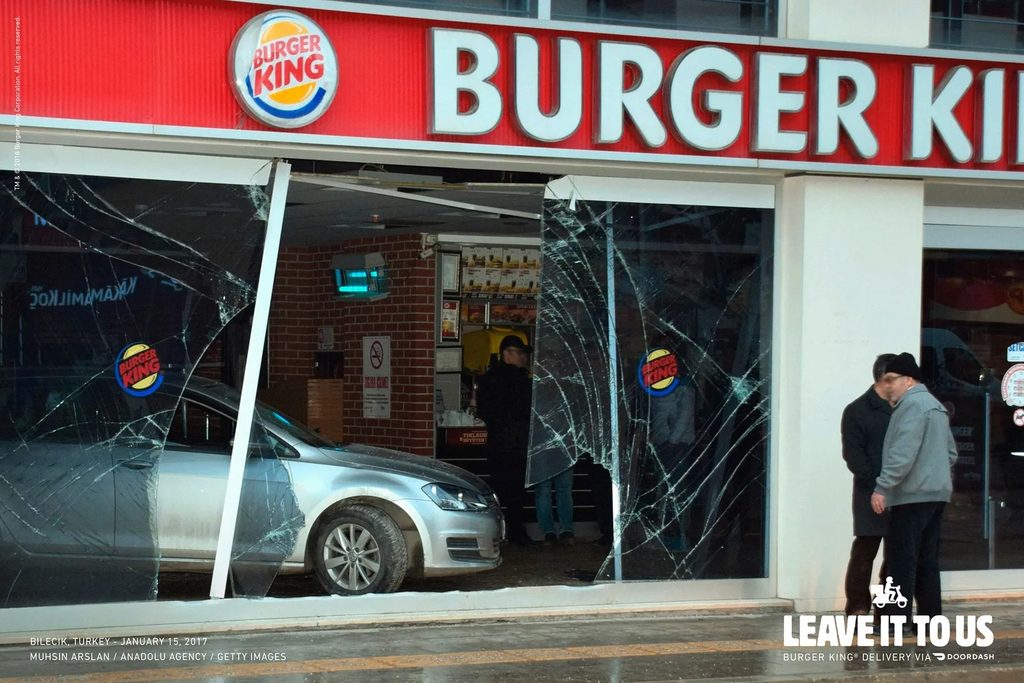
The photographs do most of the work
Each execution follows a simple structure.
A photograph establishes the accident, a short line explains Burger King’s interpretation, and the delivery message supplies the solution. The brand does not need to add illustrations, elaborate typography or a lengthy description of what happened.
The restaurant itself provides most of the branding. Burger King signs, architecture and colours remain visible around the damaged vehicles.
This gives the advertisements an unusual level of authenticity. The campaign is not asking audiences to believe that a fictional driver became dangerously distracted by a burger. It is using images of events that actually occurred and then inventing a humorous explanation for them.
The restraint also helps the work travel across magazines, posters and social media. People can understand the setup from a single image, even when the advertisement appears without additional context.
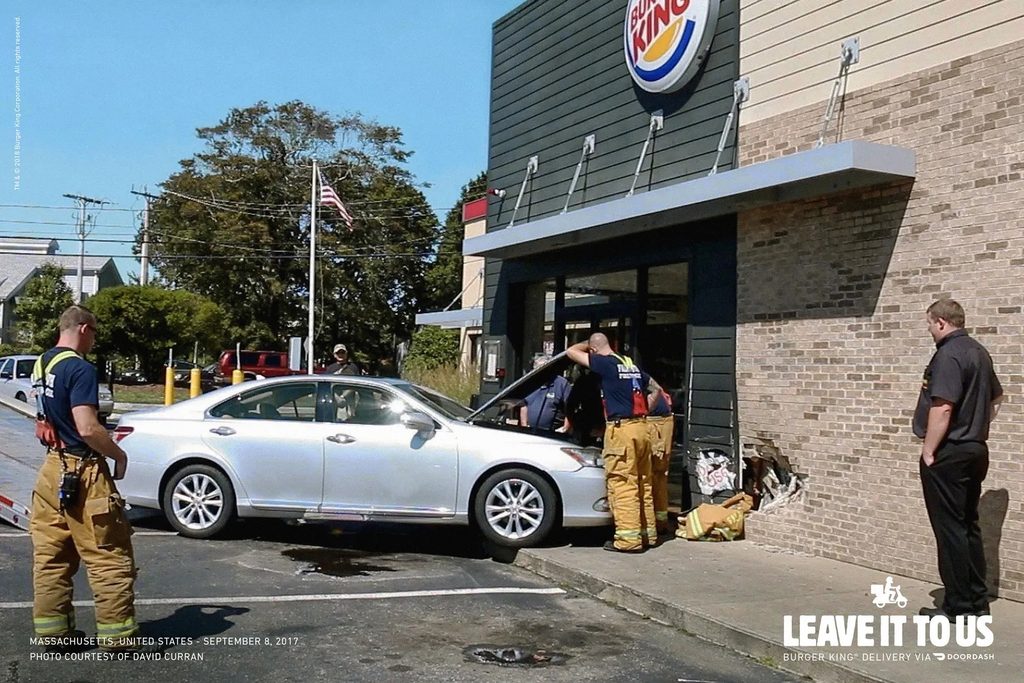
Burger King turns misfortune into self-aware humour
Using real accidents for advertising creates an obvious risk. Serious injuries would have made the humorous interpretation inappropriate.
Burger King therefore clarified that nobody was injured in any of the incidents used for the campaign. This allowed the brand to focus on the property damage and the visual absurdity of cars ending up inside restaurants.
The campaign also avoids blaming the actual drivers or describing the real causes of the crashes. Its claim that people simply could not wait for a Whopper is presented as an intentionally exaggerated brand joke.
That tone matched Burger King’s wider advertising behaviour during the period. The company regularly used real events, imperfections and apparent disasters as evidence of the brand’s desirability.
In its earlier “Burning Stores” campaign, for example, Burger King used photographs of restaurants that had caught fire to support its “flame-grilled since 1954” positioning. “Car Crashes” applies the same approach to delivery.
A US launch became an international campaign
“Car Crashes” initially ran nationwide in the United States in 2018.
The idea later expanded into other markets, including Spain, Brazil and Germany, appearing through magazines and outdoor placements.
Its ability to travel came from the simplicity of the visual. A car embedded in a Burger King restaurant requires little explanation, while the delivery message can be adapted into different languages.
The images also attracted attention beyond their paid placements. Their news-like appearance and dark humour encouraged people to share the campaign online, where viewers added their own drive-through jokes and comments.
Burger King and the agency did not publish delivery-order figures, app-download numbers or sales results directly connected with the campaign. Its international rollout and awards performance nevertheless indicate that the idea travelled well beyond its original US service announcement.
Car Crashes collected awards in 2019
The campaign received a Graphite Pencil and a shortlist recognition in 2019 within Press and Outdoor.
It also earned a Silver Lion and three shortlist placements at Cannes Lions, a Bronze at the Clio Awards and two Merit awards at The One Show.
Further recognition included two Silver awards at El Ojo de Iberoamérica, Silver at Club de Creativos, Silver and a shortlist at El Sol and Bronze from JCDecaux.
Those awards recognised how the campaign converted found material into advertising. The photographs were not originally created to sell burgers, but a short line of copy gave them a new commercial meaning.
“Car Crashes” made Burger King’s delivery service memorable by presenting it as the answer to a problem nobody expected the brand to have.
Credits
“Car Crashes” was created for Burger King by LOLA MullenLowe Madrid. The client team included Chief Marketing Officers Fernando Machado and Marcelo Pascoa, alongside Rogelio Magaña, Renato Rossi, Diego Suarez, Liza Keller and Madeline McDermott. The agency team included Chief Creative Officer Chacho Puebla, Executive Creative Director Pancho Cassis, Creative Directors Tomás Ostiglia, Fabio Brigido and Fred Bosch, Art Directors and Copywriters Enrique Torguet and Manuel Castillo, Account Director Tom Elliston, Account Manager Ana Pozuelo, Account Executive Adriana González Cid, Strategic Planner Marcelle Santos, Agency Producers Felipe Calviño and Diego Baltazar and Head of Communications Sarah Okrent. Media was handled by Horizon Media.
About the work
Campaign details
- Brand
- Burger King
- Agency
- LOLA MullenLowe
- Country
- Spain
- Year
- 2019
Related
More in Print

Popular
Popular posts

More stories