
Alzheimer’s campaign turned family portraits into fading puzzles
 By Archit
·
·
5 min read
AI-assisted
Quick summary
Created for the Alzheimer Forschung Initiative by BBDO Group Germany in 2018, the print campaign Remember Me uses altered family portraits to illustrate the impact of Alzheimer's disease on memory and facial recognition. The series features four executions—titled Sarah, Farhad, Nikolai and Fernando—depicting various family structures where selected individuals have their facial features divided into geometric pieces, rearranged, and partially erased.
This visual disruption portrays memory loss as a gradual process that creates emotional distance and isolation between patients and their loved ones. By pairing minimal copy with familiar photography, the campaign offers an accessible metaphor for the disorientation of the disease, transforming ordinary pictures of belonging into representations of fragmented relationships.
AI-generated from this article. For complete context and credits, read the full story.
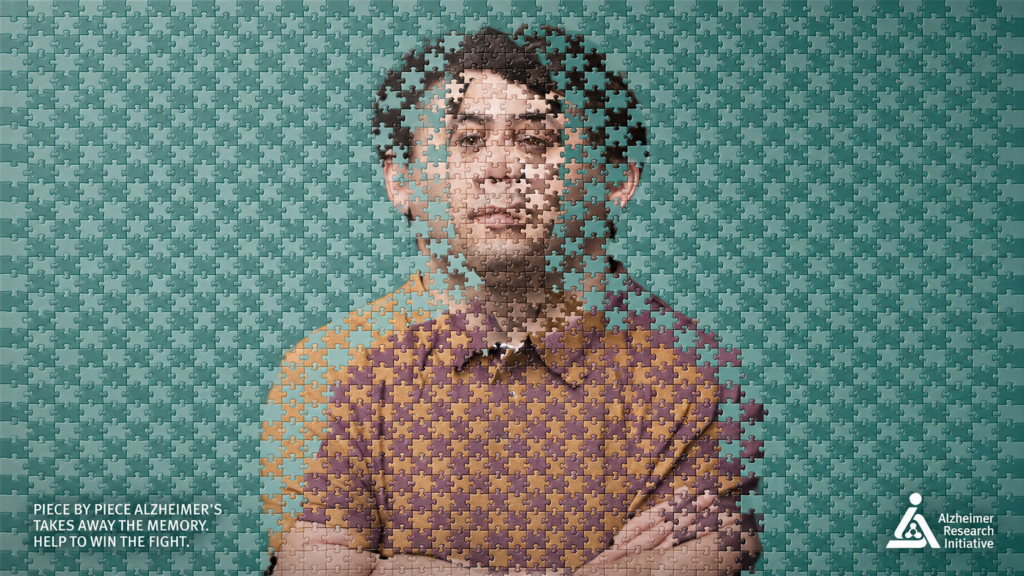
A family photograph is meant to preserve the faces and relationships people never want to forget. In Remember Me, those familiar portraits become difficult to recognise.
Created for Alzheimer Forschung Initiative, the print campaign shows families posing together while the faces of selected individuals appear fragmented, rearranged and partially erased.
The altered photographs present a visual interpretation of how Alzheimer’s can make familiar people and shared memories increasingly difficult to recognise.
Familiar faces became unsolvable puzzles
At first glance, each image resembles an ordinary family portrait. Parents stand beside children, couples pose together and several generations gather in front of the camera.
Closer inspection reveals that some faces have been divided into geometric pieces. Eyes, noses, mouths and other features appear in the wrong positions, making the people almost impossible to identify.
The effect turns a familiar face into an unsolvable puzzle. All the individual pieces remain present, but they no longer form a recognisable person.
This reflects the campaign’s central idea. As Alzheimer’s progresses, memories and facial recognition can deteriorate, changing how a person understands relationships that were once deeply familiar.
Four portraits showed different family relationships
The campaign consisted of four executions titled Sarah, Farhad, Nikolai and Fernando.
Each portrait presents a different family structure. One shows an older woman surrounded by younger relatives, while another places an elderly man beside his wife and family. Other images focus on couples and relationships between parents and children.
The variety makes the idea feel broader than one person’s experience. Alzheimer’s affects the individual living with the condition, but its consequences are also felt by partners, children, grandchildren and friends.
The title Remember Me can therefore be understood as a request from the people inside the photographs. They remain present, even when the person affected by Alzheimer’s can no longer identify them clearly.
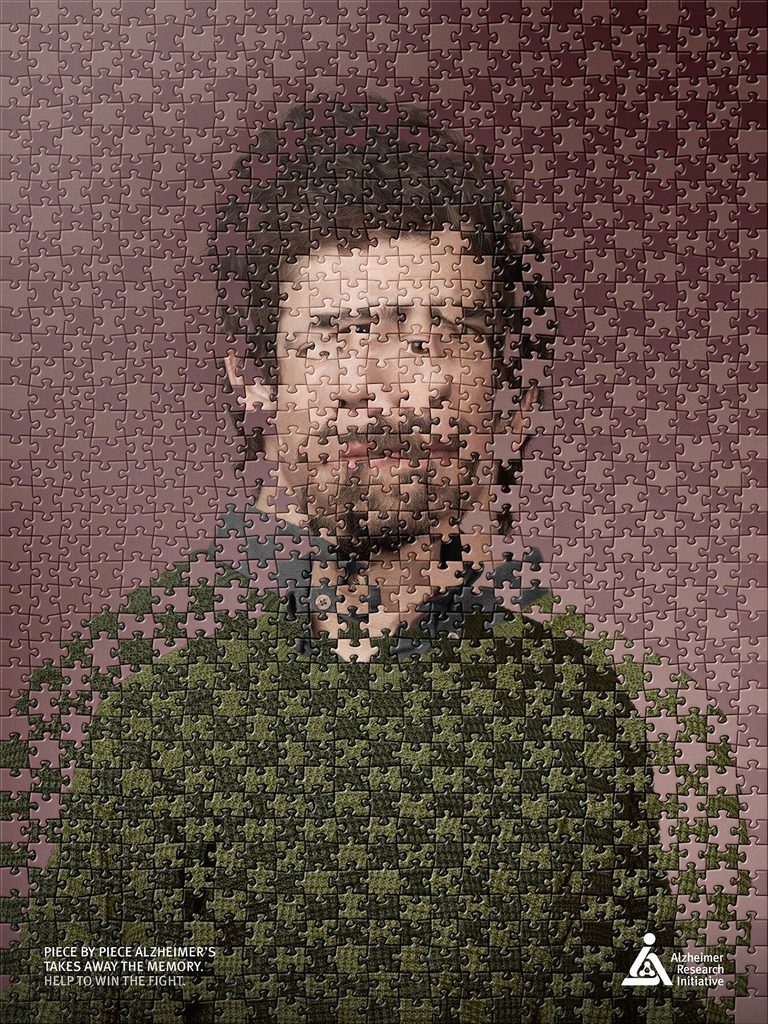
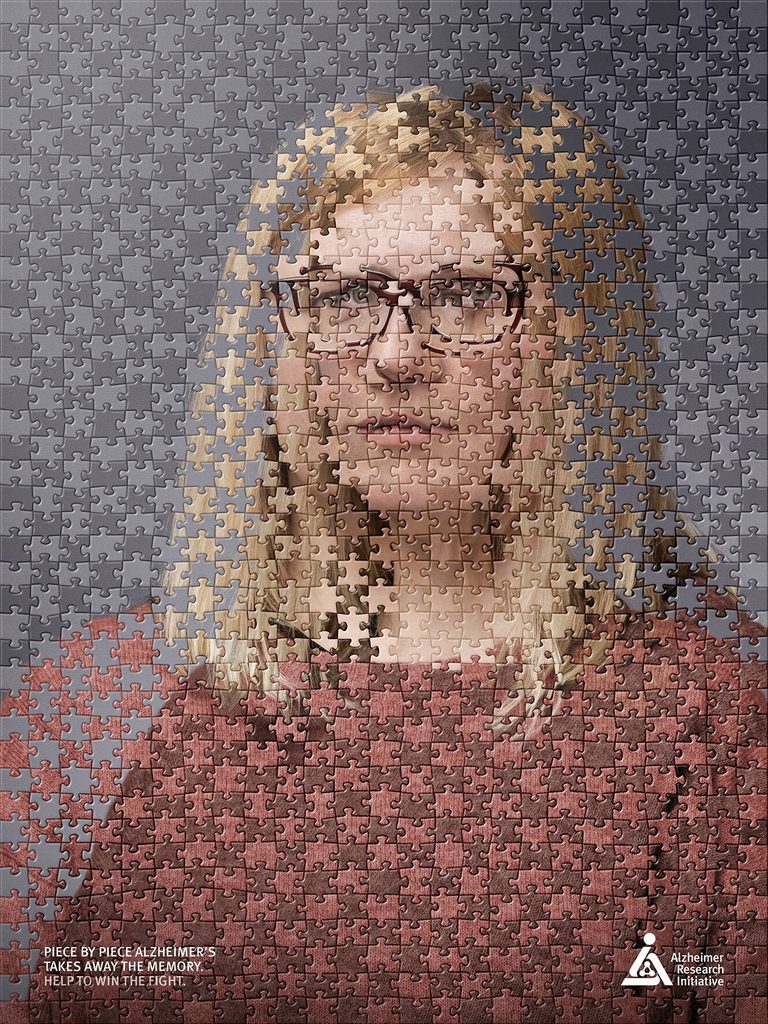
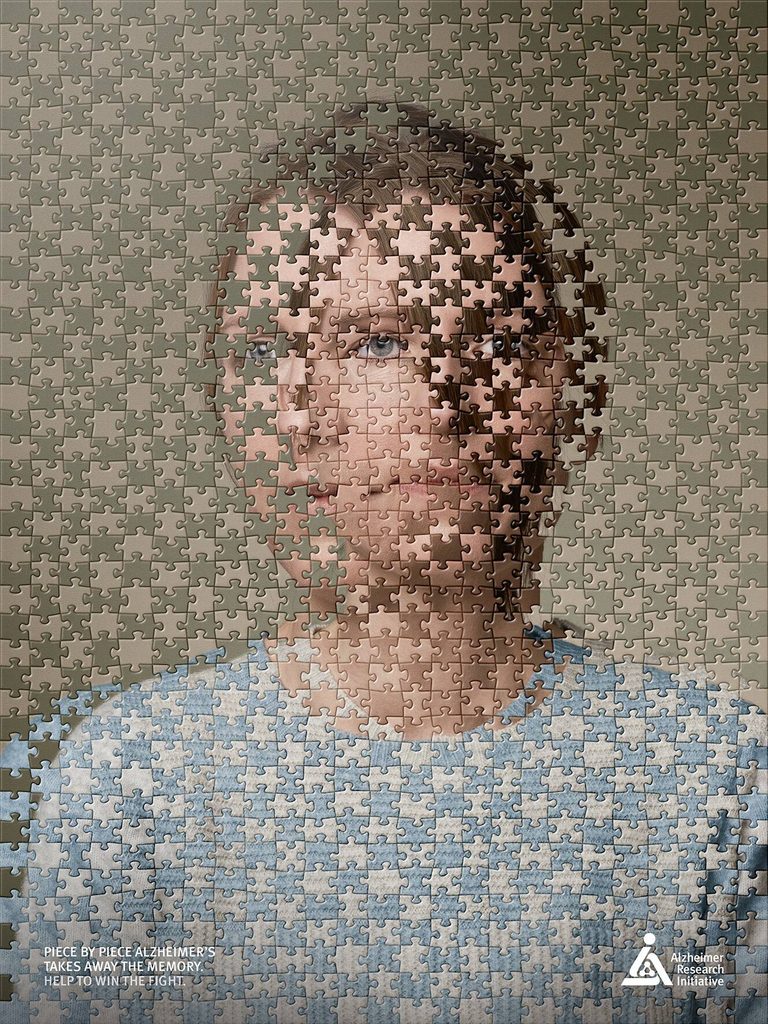
The visual distortion communicated gradual memory loss
The faces were not completely removed from the images. Instead, they were broken into folded and rearranged sections.
That distinction is important to the campaign’s message. Memory loss is represented as a gradual process in which fragments remain but become harder to organise into a complete picture.
A person may remember isolated details while struggling to connect them with a name, relationship or shared experience. The campaign translates that complex cognitive change into a visual form that can be understood immediately.
The fragmented faces also create an uncomfortable contrast with the traditional warmth of family photography. Clothing, body language and backgrounds remain ordinary, but the people at the centre of those relationships are becoming visually inaccessible.
The portraits showed how the disease can create isolation
Remember Me focuses on more than forgetting names or misplacing objects. It considers what happens when someone can no longer recognise the people who provide familiarity, care and emotional support.
The portraits place family members physically close together, yet the distortion creates a sense of separation. They occupy the same photograph but no longer appear fully connected.
This visual distance represents the loneliness that can affect people living with Alzheimer’s and those caring for them. Relationships may remain emotionally important to relatives even as the patient’s ability to recognise those bonds changes.
By showing the experience through family photographs, the campaign made the effects of the disease personal rather than clinical.
Minimal copy allowed the images to carry the message
The executions avoid lengthy explanations. A short headline and the Alzheimer Forschung Initiative identity accompany each portrait, leaving the altered faces to communicate the main idea.
This restraint suits the print format. Viewers first encounter a familiar family scene, notice that something is wrong and then attempt to reconstruct the faces themselves.
That moment of confusion becomes part of the campaign experience. The viewer briefly confronts the inability to recognise a person who should be familiar.
The portraits cannot reproduce the experience of living with Alzheimer’s, but they offer an accessible visual metaphor for the disorientation and loss of recognition associated with the disease.
Remember Me made memory loss visible
Alzheimer’s is often discussed through symptoms, statistics and medical explanations. Remember Me approached the subject through relationships.
The campaign did not show hospitals, brain scans or medication. It used photographs of families because those images normally act as evidence of identity, history and belonging.
By disrupting the faces within them, the campaign transformed the family portrait into a representation of memories becoming fragmented.
The result is a print series that asks viewers to consider what Alzheimer’s can take away from a person and from everyone who wants to remain remembered.
Credits
Remember Me, 2018. Client Alzheimer Forschung Initiative. Agency BBDO Group Germany, Düsseldorf. Chief Creative Officer Wolfgang Schneider. Creative Managing Director Kristoffer Heilemann. Executive Creative Directors Daniel Haschtmann and Tobias Feige. Creative Directors Sebastian Steller and Jacobo Concejo. Art Directors Martino Monti and Dejan Handjiski. Copywriter Sebastian Steller. Jigsaw concept by Alma Haser. Photography by Stefan Kranefeld. Postproduction by Stefan Kranefeld Imaging. Art Buying by Birgit Paulat.
About the work
Campaign details
Related
More in Print


Popular
Popular posts



More stories