Film
Wild Design: Canva’s stop-motion pigeon returned to get a stray cat adopted
 By Ridhi
·
·
4 min read
By Ridhi
·
·
4 min readAI-assisted
Quick summary
The idea: To demonstrate the everyday accessibility of its platform, Canva brought back Picci1, an animated pigeon, to resolve a personal crisis by turning a predatory stray cat into viral social media content that gets the feline adopted.
The execution: Created by Dude Milano and directed by Dan Richards at A+C Studios, the film uses handcrafted stop-motion animation. When a calico cat terrorizes his flock, Picci1 uses a phone to edit recorded footage with Canva templates, text, and heart-shaped glasses, successfully securing the cat an adoptive home.
Why it matters: The campaign moves beyond small business branding to highlight fast, everyday creative tools like video editing and social posts, relying on an absurd recurring animal character to prove the platform is easy enough for anyone to use.
AI-generated from this article. For complete context and credits, read the full story.
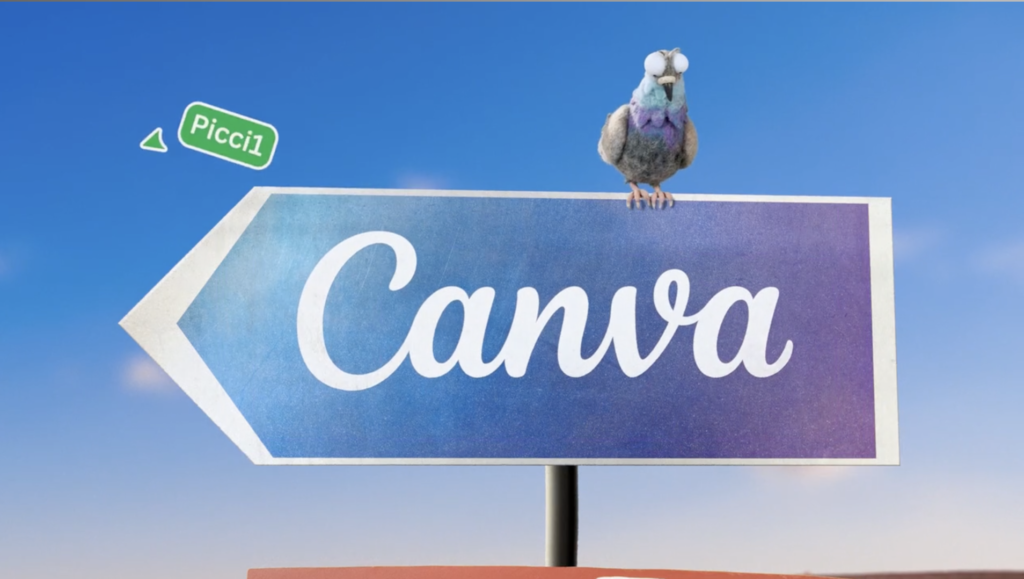
Back in May, Canva introduced Picci1, a stop-motion pigeon who somehow knew his way around a design platform.
His first job was helping a struggling Italian restaurant. Three months later, he is back with a much more personal problem. A stray cat keeps terrorising his flock.
So Picci1 turns the cat into social content good enough to get him adopted.
It started with a restaurant that needed customers
The first chapter of Wild Design introduced Picci1 in an Italian piazza where his flock was fighting over scraps.
Nearby, a trattoria had an even bigger problem. Empty tables.
Picci1 noticed the restaurant, found a laptop and opened Canva. Within moments, he had created a new visual identity, presentation and marketing material for the business.
The restaurant became Un Boccone al Volo, complete with a fresh red and white identity.
Soon the tables were full.
That was good news for the owner and even better news for the pigeons waiting underneath them for crumbs.
The film gave Canva a deliberately ridiculous way to make a very simple product point. The tools were meant to feel accessible enough that even a pigeon could use them.
Three months later, Picci1 has a cat problem
The second chapter brings the same flock back, but the threat is now sitting much closer.
A stray calico cat has been stalking the pigeons around a public square.
Then someone nearby starts filming them on a phone.
Picci1 sees the opportunity.
He takes over the footage and starts editing it in Canva. The scary cat gets animated heart-shaped glasses. Text is added to the video. The animal that looked like a predator moments earlier is suddenly being advertised as a cat looking for a home.
Then Picci1 posts it.
The video spreads, people respond and the cat gets adopted.
His new name is Bartolomiao.
The pigeons get their square back without having to defeat him at all.
The second film changes what Canva is demonstrating
The restaurant story was about design helping a small business.
This chapter moves into something much more everyday.
Picci1 uses templates, video editing and social content tools on a phone to solve a problem immediately. The campaign also expands into shorter films showing features such as social posts, flyers, printed material and video editing.
That shift matters for the larger Wild Design idea.
Canva is no longer only showing someone sitting down to make a logo or presentation. Creativity becomes something you can pull out whenever there is a problem worth solving.
Even if that problem happens to have four legs and a very strong interest in pigeons.
Everything is still made by hand
The irony is that a campaign about fast digital creation takes an enormous amount of physical craft to make.
A+C Studios produced both chapters using handcrafted stop-motion animation.
Picci1, Bartolomiao, the people, streets, furniture and tiny objects were physically built for the films. The characters move through textile-heavy sets that deliberately keep their handmade texture rather than trying to look perfectly digital.
Dan Richards returned to direct the second chapter.
That handmade world gives Wild Design its personality. Picci1 can create something on Canva in seconds, while the team behind him spent far longer building every feather, prop and frame around it.
Where Wild Design goes next
Canva has now given Picci1 something more useful than a single advertising role.
He has become a character who can keep finding problems and solving them with a different part of the platform.
First, he saved a restaurant.
Now, he got his enemy adopted.
The product demonstration changes each time, but Picci1 stays the same. He notices something going wrong, opens Canva and gets involved.
For a campaign about making design accessible to everyone, choosing a pigeon as the recurring creative director still makes the point better than almost anyone else could.
Credits
Wild Design Chapter II (2026) | Canva. Creative agency: DUDE Milan. Animation studio: A+C Studios. Director: Dan Richards. Music and sound design: Magma Music Agency. Media planning: OMD. Chief Creative Officers and Partners: Livio Basoli and Lorenzo Picchiotti. Creative Directors: Antonio Mitra and Stefano Summo. Senior Art Director: Antonio Gambino. Senior Copywriter: Alessandro Magnani.
About the work
Campaign details
- Brand
- Canva
- Agency
- Dude Milano
- Country
- Spain
- Year
- 2026
Related
More in Film

Popular
Popular posts

More stories