Outdoor
It’s Not a Hot Dog Without Heinz: Heinz poured ketchup onto Times Square’s giant hot dog
 By Archit
·
·
6 min read
By Archit
·
·
6 min read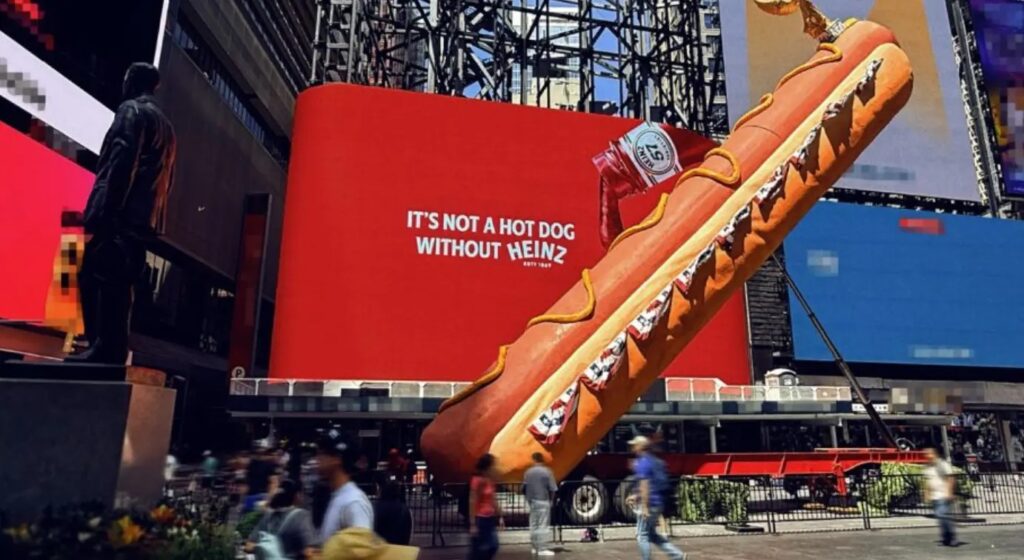
The world’s largest hot dog had a bun, a pink frankfurter and an enormous ribbon of yellow mustard.
It did not have ketchup.
When Heinz noticed the missing condiment, the brand did not attempt to change the sculpture. It bought advertising space directly above it.
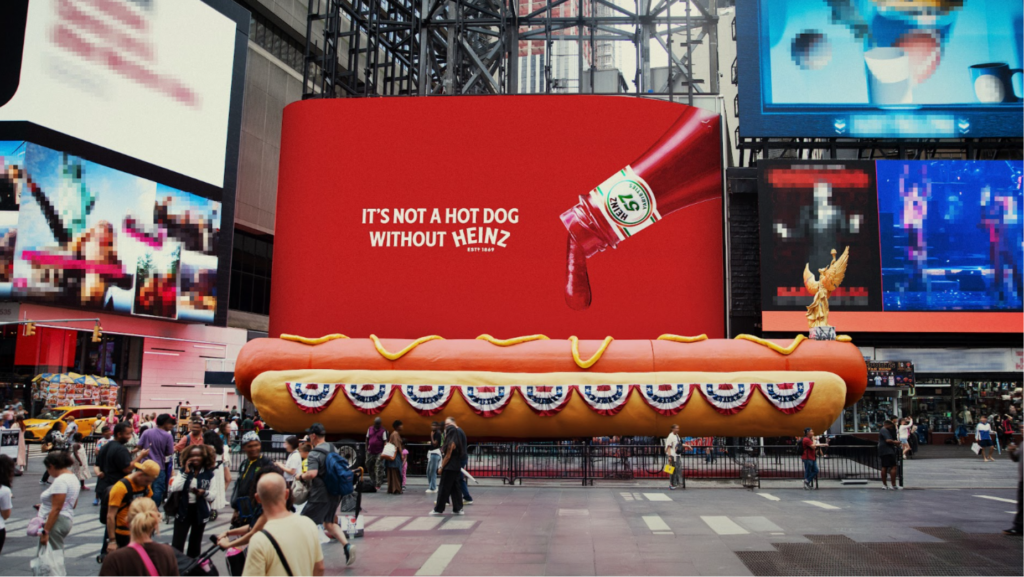
The resulting ad showed a tilted Heinz bottle appearing to pour ketchup onto the 65-foot hot dog below. A short line completed the message:
“It’s not a hot dog without Heinz.”
Created with Rethink and the sculpture’s artists, Jen Catron and Paul Outlaw, the Times Square placement turned an existing public artwork into the lower half of a Heinz billboard.
A 65-Foot Opportunity Appeared in Times Square
“Hot Dog: The Second Serving” arrived at Duffy Square in New York on 21 July 2026.
Created by Brooklyn artists Jen Catron and Paul Outlaw, the public artwork was a new version of “Hot Dog in the City,” which first appeared in Times Square in 2024.
The sculpture measured 65 feet from end to end. It included an oversized bun, a pink frankfurter, yellow mustard and red, white and blue decorations. A golden winged figure of Liberty was attached to one end.
Every day at noon, hydraulic mechanisms lifted part of the hot dog and released confetti over the surrounding plaza.
The artwork returned for the United States’ 250th anniversary. However, it was not simply a patriotic decoration.
Catron and Outlaw designed it as both a celebration and a satire of American spectacle, political power and national mythology. The familiar hot dog became a monument through which visitors could interpret the country’s identity.
The Times Square Arts project page confirms that the sculpture remained at Duffy Square from 21 July to 8 August 2026.
Its scale, movement and central location made it difficult to overlook. For Heinz, one detail was even harder to ignore.
The sculpture had mustard but no ketchup.
Heinz Completed the Image From Above
Rethink contacted Heinz after spotting the opportunity.
Jamie Mack, Associate Director of Brand Communications at Heinz, later explained that the agency alerted the brand to the sculpture and its missing condiment. The team purchased the appropriate media placement within hours.
Heinz then worked with Catron and Outlaw to place an advertisement on the screen immediately above the artwork.
The screen showed a Heinz bottle tilted towards the ground. Its stream of ketchup appeared to continue beyond the billboard and land directly on the giant hot dog.
The illusion worked because the two objects were aligned carefully. Viewed from the plaza, the screen became the top half of the image while the sculpture completed the bottom.
The brand did not need to reproduce the hot dog inside its advertising. The real one was already occupying the space.
According to LBB’s campaign report, Heinz collaborated with the original artists rather than altering or informally attaching itself to their work.
That collaboration matters because “Hot Dog: The Second Serving” had its own meaning. Heinz added a separate commercial layer without physically changing the sculpture.
The Location Did Most of the Work
The ad contained very little information.
There was a Heinz bottle, the apparent stream of ketchup and the line “It’s not a hot dog without Heinz.”
Anything more would have weakened the visual connection.
The hot dog supplied the product occasion. The missing red sauce created the problem. Heinz provided the solution from the screen above.
The Times Square location also gave the execution a natural audience. Visitors were already stopping to photograph the sculpture and watch its daily confetti display. The advertisement entered pictures that people were likely to take anyway.
This is what separates contextual outdoor advertising from a standard billboard.
A conventional Heinz ad could have appeared on almost any screen. This execution only worked in one exact position, during the limited period when the giant hot dog remained below it.
The media placement was therefore part of the creative idea rather than simply the place where the idea was displayed.
The Artwork and Advertisement Carried Different Meanings
The original sculpture used the hot dog as a symbol of America.
Catron and Outlaw connected the familiar food with celebration, consumer culture, patriotism and political spectacle. Its enormous size allowed the object to function as both a joke and a monument.
Heinz approached the same sculpture more literally.
For the brand, the hot dog was an unfinished meal. The mustard was already present, but the condiment Heinz considers essential was missing.
These interpretations existed together in the same space. Someone could see the sculpture as political satire, the Heinz placement as a condiment joke or the entire combination as another layer of commercial spectacle in Times Square.
The brand did not need to explain any of those readings. It only needed viewers to notice that the bottle and sculpture visually connected.
Heinz Continued Its Claim Over Hot Dogs
The execution follows several Heinz campaigns built around the idea that particular foods are incomplete without its ketchup.
In 2021, the Heinz Hot Dog Pact asked manufacturers to correct the mismatch between packs of ten wieners and packs of eight buns. Wonder later released limited-edition packs containing ten buns.
The brand has also developed activations such as “Smack for Heinz,” which encouraged people to hit the bottom of glass ketchup bottles, and the Heinz Dipper, a chip carton with a compartment designed specifically for ketchup.
Each idea gives Heinz a role inside the experience of eating familiar food.
“It’s Not a Hot Dog Without Heinz” continues that approach through outdoor media. The brand found the largest possible version of a food it already claims as a natural partner and pointed out the absence of its product.
The message worked because Heinz did not need to establish the connection between ketchup and hot dogs. The audience already understood it.
Speed Turned Observation Into Advertising
The campaign also demonstrates the importance of responding while an opportunity remains culturally relevant.
“Hot Dog: The Second Serving” was only available until 8 August. Heinz therefore had a narrow period in which to secure the correct screen, coordinate with the artists and prepare the artwork.
Moving within hours allowed the brand to join the conversation while the sculpture was still attracting visitors and media attention.
No performance figures have been published yet. The billboard should consequently be assessed as a new outdoor execution rather than a results-led case study.
Its immediate strength is visible without additional data.
Heinz found a public object that appeared incomplete according to its brand belief. It then used one precisely selected screen to finish the picture.
The world’s biggest hot dog did not need another advertisement beside it.
It needed ketchup above it.
Credits
Brand: Heinz
Campaign: It’s Not a Hot Dog Without Heinz
Agency: Rethink
Public Artwork: Hot Dog: The Second Serving
Artists: Jen Catron and Paul Outlaw
Public Art Presenter: Times Square Arts
Associate Director, Brand Communications, Heinz: Jamie Mack
Location: Duffy Square, Times Square, New York City
Activation: August 2026
Sculpture Exhibition: 21 July–8 August 2026
Related
More in Outdoor


Popular
Popular posts
More stories