Outdoor
The Last House: Netflix put a man inside a billboard above Sunset Boulevard
 By Archit
·
·
5 min read
By Archit
·
·
5 min read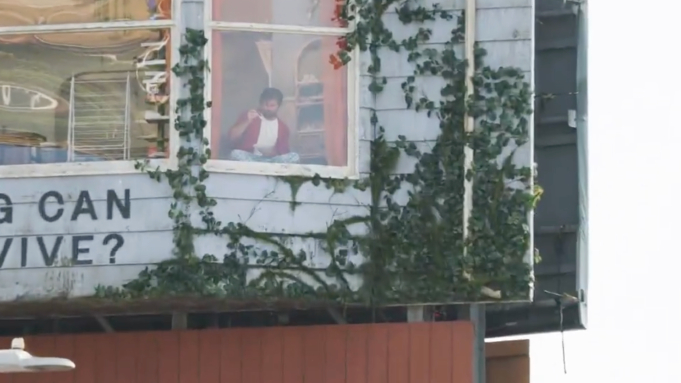
On 6 August 2026, Netflix placed a man inside a fully furnished billboard 30 feet above Sunset Boulevard in Los Angeles. He stayed behind the window, read books and communicated with people below through a whiteboard. The live installation promoted The Last House, Netflix’s new sci-fi thriller about a family mysteriously sealed inside their home.
The film asked how long someone could survive without getting out.
Netflix found someone willing to try it above the street.
The billboard became the house
The Last House follows Ann and Jason, played by Greta Lee and Wagner Moura, and their children after their home suddenly becomes impossible to leave.
The doors will not open. The windows cannot be broken. Meanwhile, the family’s supplies begin to disappear as an unknown threat remains outside.
Netflix carried that premise into Hollywood almost literally.
At the intersection of Sunset Boulevard and Selma Avenue, a billboard was transformed into part of a house. Vines covered its exterior. A front door, drainage pipe and chimney added to the illusion.
However, the part attracting the most attention was the window.
There was a person behind it.
A real performer occupied a furnished living room inside the structure while traffic and pedestrians continued below. Beneath the window, the billboard asked one question.
“How long can you survive?”
The advertising space had become a small survival experiment.
A performer stayed inside for three days
The man entered the billboard on 6 August and was scheduled to remain there until 8 August.
That meant his stay crossed the film’s Netflix release on 7 August.
During the activation, he attempted to behave as normally as possible inside the limited space. Shelves held books. Playing cards gave him something to do. At other moments, he looked down at Sunset Boulevard through binoculars.
However, he could not simply speak to the people watching from the pavement.
Instead, he used a whiteboard.
Messages including “What’s going on?” appeared behind the glass. Passersby could respond from the street, creating a conversation between someone apparently trapped inside a house and the world continuing outside.
Netflix also posted footage of the installation with the simple message, “There’s a guy in there.”
That was enough to make viewers look again.
From a distance, the structure could appear to be another elaborate Hollywood billboard. Once the person inside moved, the advertisement changed completely.
The actor made the premise physical
The stunt worked because the billboard recreated the central tension of the film without revealing much of its story.
In The Last House, the home begins as a place of safety. Then it becomes a prison.
The billboard followed the same structure.
It contained the objects associated with a comfortable living room, but the man inside appeared unable to leave. The window allowed him to see the outside world without joining it.
Meanwhile, thousands of people could move freely beneath him.
That contrast made the campaign understandable even for someone who had never watched the trailer.
The unusual behaviour attracted attention first. The question about survival provided the second clue. Finally, the film title explained why someone was living inside a billboard.
The outdoor format also changed the scale of the idea.
Netflix could have recreated the room at street level and invited people to enter. Placing it 30 feet above Sunset Boulevard made the occupant feel genuinely separated from everyone around him.
People could see him.
Reaching him was another matter.
Social media extended the window
The installation was designed for the street, but its strange image travelled easily online.
A photograph needed little explanation. One person was sitting inside what appeared to be a house built into an advertising board.
Video made the idea stronger.
The performer could walk around the room, look through the window or hold up another message. Every movement confirmed that the figure was not a photograph or digital effect.
Meanwhile, Netflix’s own social post framed the stunt as a discovery rather than a traditional announcement.
“There’s a guy in there.”
The wording matched what someone passing Sunset Boulevard might have said after noticing the window.
That helped the campaign retain its curiosity when it moved from outdoor media to a phone screen.
The film itself premiered while the activation was still running. As a result, anyone who discovered the billboard could move directly from the physical mystery to the story behind it.
What Made It Different
The Last House billboard used a person where a poster would normally place an actor’s face.
Netflix did not need the performer to portray a character from the film. His situation carried the message.
He had a room.
He had a window.
He had things to occupy his time.
The one thing he appeared not to have was a way out.
That made the billboard a compact demonstration of the film rather than another surface carrying its artwork.
The installation also gave a familiar media format an unexpected interior. A billboard usually has a front that people see and a structure behind it that does not matter.
This time, the space behind the advertisement became the advertisement.
Netflix promoted a film about being trapped inside a house.
For three days, someone appeared to be living inside one above Sunset Boulevard.
Credits
The Last House Billboard (2026) — Netflix, United States. Film promoted: The Last House. Location: Sunset Boulevard and Selma Avenue, Los Angeles. Live activation: 6 to 8 August 2026. Film director: Louis Leterrier. Film stars: Greta Lee and Wagner Moura. Campaign agency and production credits were not publicly confirmed in the material available at the time of writing.
Related
More in Outdoor


Popular
Popular posts


More stories