Case Studies
If You Can Take It, It’s Yours: Selleys made a billboard a glue test
 By Archit
·
·
5 min read
By Archit
·
·
5 min read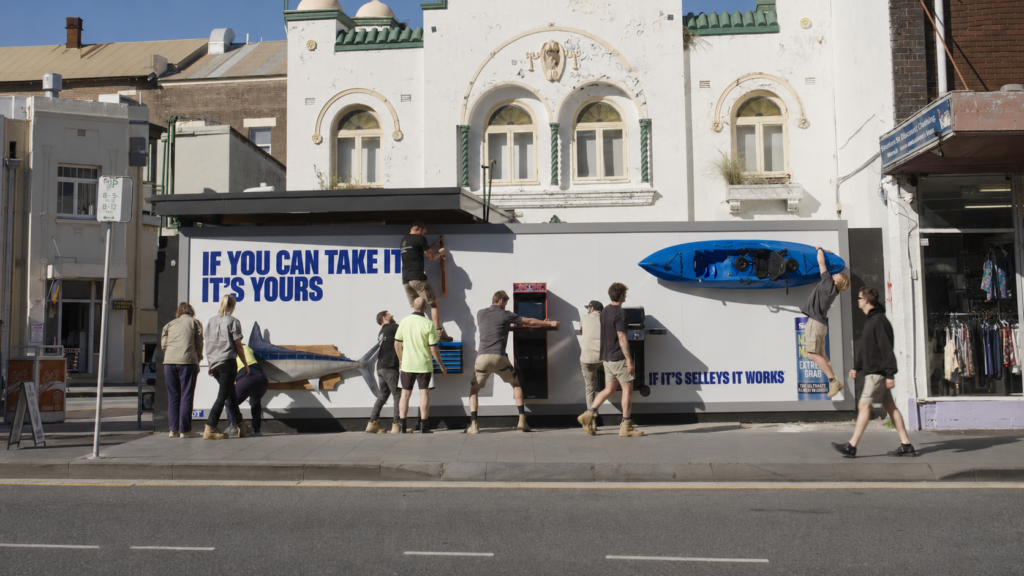
In October 2025, Selleys glued a kayak, an arcade machine and a 2.8-metre mounted marlin to a billboard in Sydney. Anyone who could pull an item free was allowed to keep it. Howatson+Company created If You Can Take It, It’s Yours as a public test of Selleys Liquid Nails.
The prizes attracted the crowd. The fact that nobody could claim them delivered the product message.
The product needed a public test
Selleys had strong recognition among people working on home repairs and construction projects. However, the brand wanted professional builders to consider Liquid Nails for more demanding jobs.
A product specification could explain the adhesive’s holding power. Still, numbers printed on an advertisement would ask builders to trust the claim.
Howatson+Company chose a demonstration people could examine for themselves.
The idea also extended Selleys’ long-running line, “If it’s Selleys, it works.” Instead of repeating that promise, the campaign gave the public a chance to challenge it.
The test needed to feel genuine. The items had to be desirable enough for people to make a serious attempt. They also needed to look surprising when attached to a vertical surface.
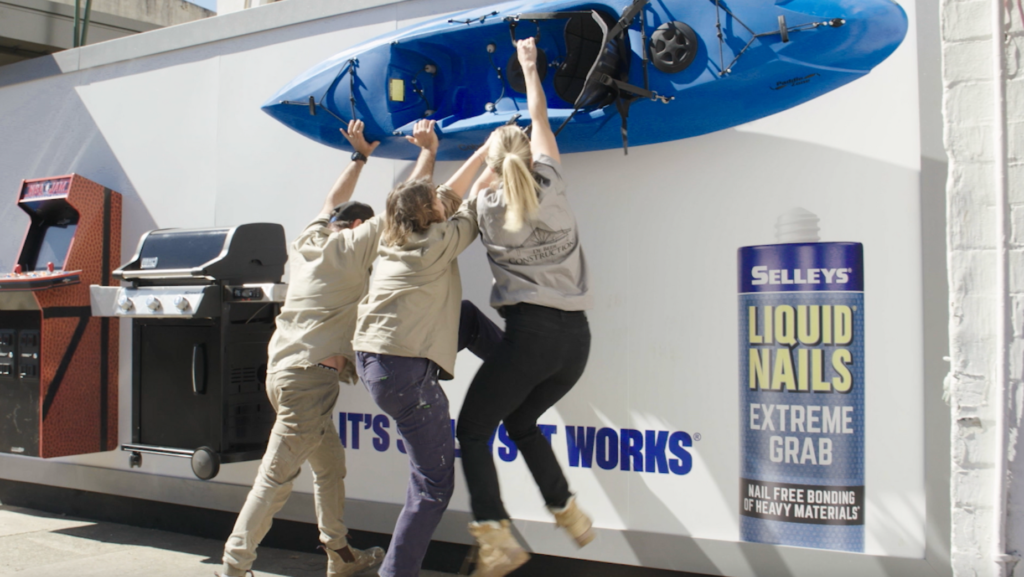
That led to a collection including a kayak, toolbox, cricket bat, arcade machine and large mounted marlin.
Each object came with the same invitation.
“If you can take it, it’s yours.”
The billboard offered real prizes
The installation appeared beside a busy road in Newtown, Sydney.
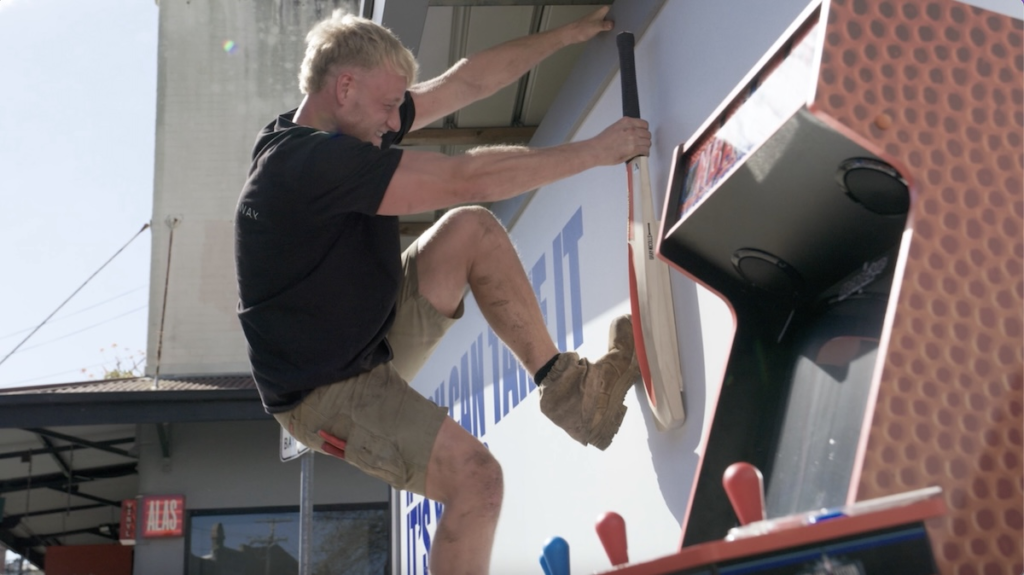
People passing the site could walk up to the billboard and try to remove anything they wanted. Builders, pedestrians, creators and other members of the public pulled, climbed and worked together.
Even Australia’s second-strongest man took part.
However, the challenge included no hidden release mechanism. The objects were not props designed to fall after a certain amount of effort. They were real items attached directly to the outdoor panels using Liquid Nails.
Nobody managed to remove one.
That failure created the advertising. Every attempt showed the product holding against another person’s weight, grip and determination.
Meanwhile, the offer kept the experience playful. The participants were not watching a controlled laboratory test. They were trying to win something useful, unusual or simply difficult to ignore.
The marlin became especially tempting. One visitor returned several times and considered using a vehicle and rope to pull it free.
The billboard held.
Fourteen days made the proof credible
The simple-looking installation required two weeks of preparation.
Selleys and the production team tested different materials and surfaces before choosing the final objects. Anything attached to the board needed a large enough flat area to form a reliable bond.
After the items were approved, the panels were assembled inside a warehouse. Each object was glued into position and left for 14 days while the adhesive cured fully.
The completed panels were then loaded onto a flatbed truck and transported to Newtown.
That process mattered because the campaign depended on trust. A visible bolt, support or safety device could have weakened the entire demonstration.
Instead, each approved item was fixed directly to the panel with the product being advertised.
The team also had to consider what happened once the public arrived. People could pull in unexpected directions, use their full body weight or attempt the challenge as a group.
Therefore, every element was stress-tested before the installation opened.
The preparation remained mostly invisible. However, it allowed the public reaction to be unscripted.
One wall became the campaign
The physical billboard operated for one day, but the campaign was designed to travel further.
Cameras recorded the attempts and turned them into a social film directed by James Dive. Creator partnerships added more versions of the challenge, while public relations and news coverage carried the demonstration beyond the people who visited Newtown.
As a result, the billboard performed several jobs at once.
It was an outdoor advertisement visible from the road. It was a live experience that invited participation. Furthermore, it supplied the footage for television, online video and social media.
The outdoor site did not need to reach the entire country by itself. It needed to create real moments worth filming.
That structure also protected the idea from feeling like an invented product demonstration. Viewers could watch different people try their own methods and reach the same result.
The film was funny because the efforts were real. More importantly, every failed attempt repeated the product claim without requiring an actor to say it.
The Impact
Campaign reporting later credited the work with more than 47 million video views.
Selleys also reported a 12 percent increase in brand awareness and a 5 percent sales lift. The company described it as the largest campaign-driven sales increase in its history.
The work received a Merit at The One Show in 2026. It also earned two Silver and one Bronze at Spikes Asia.
The results show how one outdoor placement can create a much larger campaign when the public interaction carries the message.
If You Can Take It, It’s Yours did not use the billboard as a surface for a product photograph. The product was performing inside the billboard itself.
The challenge gave people every reason to prove the advertisement wrong.
Their failure proved Selleys right.
Credits
If You Can Take It, It’s Yours (2025) — Selleys Liquid Nails, Australia. Agency: Howatson+Company, Sydney. Chief Creative Officer: Gavin Chimes. Creative Director: Simon Friedlander. Senior Art Director: Dan Smith. Senior Copywriter: Ernie Ciaschetti. Production: Scoundrel, Sydney. Director: James Dive. Director of Photography: Alexandra Adoncello. Producers: Aly Jolly and Charlie Taylor. Executive Producer: Adrian Shapiro. Media: IPG Mediabrands and Team Inspire. Awards: The One Show Merit, two Silver and one Bronze at Spikes Asia.
Related
More in Case Studies


Popular
Popular posts

More stories