Outdoor
Magic of Flying: British Airways made a billboard that pointed at real planes flying over London
 By Ridhi
·
·
3 min read
By Ridhi
·
·
3 min read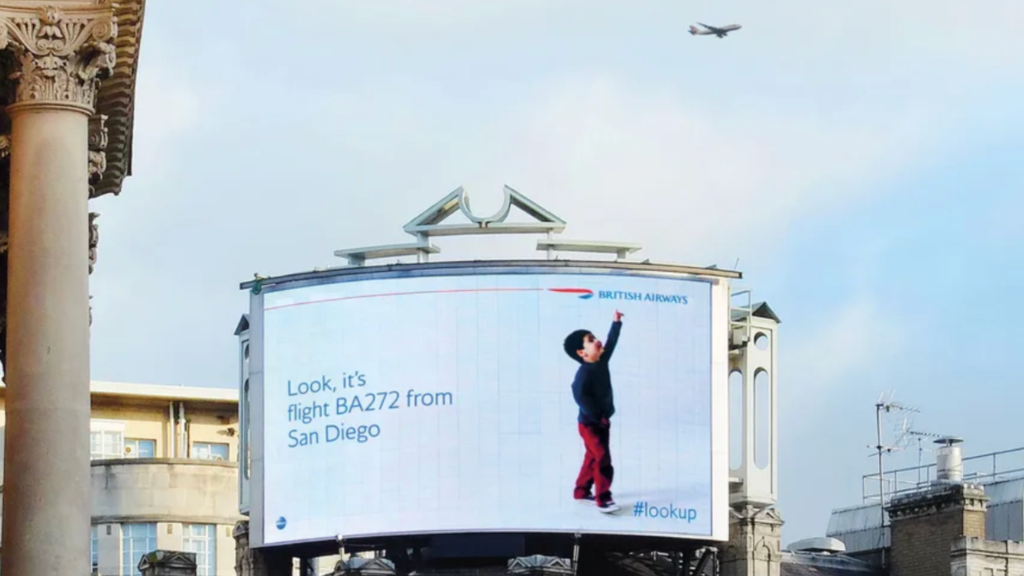
Most digital billboards are just fancier posters. Instead of following that path, British Airways went a very different way in 2013. The brand built a screen that stayed dormant most of the day, and only came alive when one of its own planes was actually flying overhead. When that happened, a small child stood up on the screen, pointed at the real aircraft in the sky, and the ad named the flight in real time. “Look, it’s flight BA475 from Barcelona.”
More than a decade later, Magic of Flying still sits near the top of almost every list of the greatest out-of-home executions ever made.
The Idea Behind the Screen
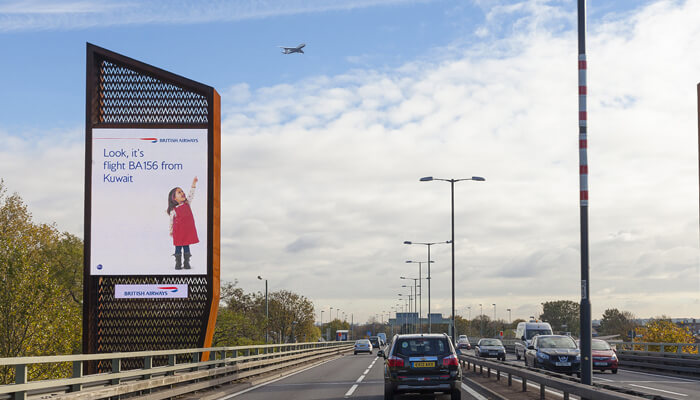
The concept was disarmingly simple. However, the plane wasn’t stock footage or a rendered animation. It was the actual British Airways flight passing overhead at that exact moment.
Before this campaign, digital billboards were mostly used to broadcast messages at people. Instead, Magic of Flying used the screen to react to reality. In doing so, British Airways quietly proved that the sky itself could be part of the ad.
How It Actually Worked
Ogilvy mounted an antenna on the roof of a building near Piccadilly Circus. Meanwhile, that antenna picked up live transponder data from every aircraft within a 200 kilometre radius. The data included flight number, speed, altitude and airline.
A custom app then filtered the data for British Airways flights only. Furthermore, before the screen was triggered, the app cross-referenced the flight number against Heathrow’s live database to identify the origin city, and checked cloud altitude to confirm the plane would actually be visible from the ground. Only after all conditions were met would the ad cue the child to stand up.
The whole process, from the moment a BA plane entered the trigger zone to the moment the ad played, took under a second.
The Reaction
The campaign ran on two large digital screens in central London. Passers-by quickly noticed something strange. Pedestrians would stop, look up, then look back at the screen to see it name the exact aircraft they were watching. In fact, the moment was so unexpected that people started filming it and posting it online.
That’s when the campaign truly went global. The billboard, seen in person by relatively few people, ended up reaching 350 million views worldwide through shared videos alone. Meanwhile, the earned media dwarfed the paid spend.
The tagline, “Look up,” was quiet by comparison. Still, it did all the work. British Airways wasn’t asking anyone to book a flight. Instead, it was asking people to notice the fact that the sky was full of them.
Why It Still Works
Most reactive campaigns are gimmicks that work once. Magic of Flying is different because the mechanic is inseparable from the brand truth. British Airways sells flights. Similarly, the ad only works when a flight is actually overhead.
Furthermore, the campaign resisted every temptation that usually kills good ideas at scale. There is no celebrity. There is no long voiceover. There is no clever slogan. Instead, it is a child, a screen, a sky, and a system that quietly waits for the moment to speak.
That patience is the reason it endures. Most brands try to fill every second of media they buy with more. Magic of Flying earned its place by choosing to say something only when it was true.
Credits
Magic of Flying (2013 to 2014) — British Airways UK, by Ogilvy One London. Data engineering by Ogilvy Labs. Media placement across Piccadilly Circus and Chiswick, London.
Related
More in Outdoor


Popular
Popular posts



More stories