I Want AI to Take My Job gave UNICEF’s child labour message a new voice
 By Archit
·
·
3 min read
By Archit
·
·
3 min readAI-assisted
Quick summary
UNICEF’s print and digital campaign, I Want AI to Take My Job, reframes a common adult fear about technological replacement to highlight the reality of child labour. Created by One Minute Briefs with copy and design by Arun Anoop, the March 2026 campaign features three images of children working in factories, workshops, construction sites, and homes. By having these children state that they want AI to take their jobs so they can return to school, the ads invert a familiar debate.
The campaign avoids showing robots or futuristic technology, using artificial intelligence strictly as an entry point to question why children hold these jobs. This restraint allows the single-frame print format to address diverse forms of labor while maintaining its central message that some jobs should disappear to preserve childhood. The initiative grounds global statistics in a human perspective, addressing a landscape where nearly 138 million children were engaged in child labour during 2024, including roughly 54 million in hazardous work.
AI-generated from this article. For complete context and credits, read the full story.
“I want AI to take my job.”
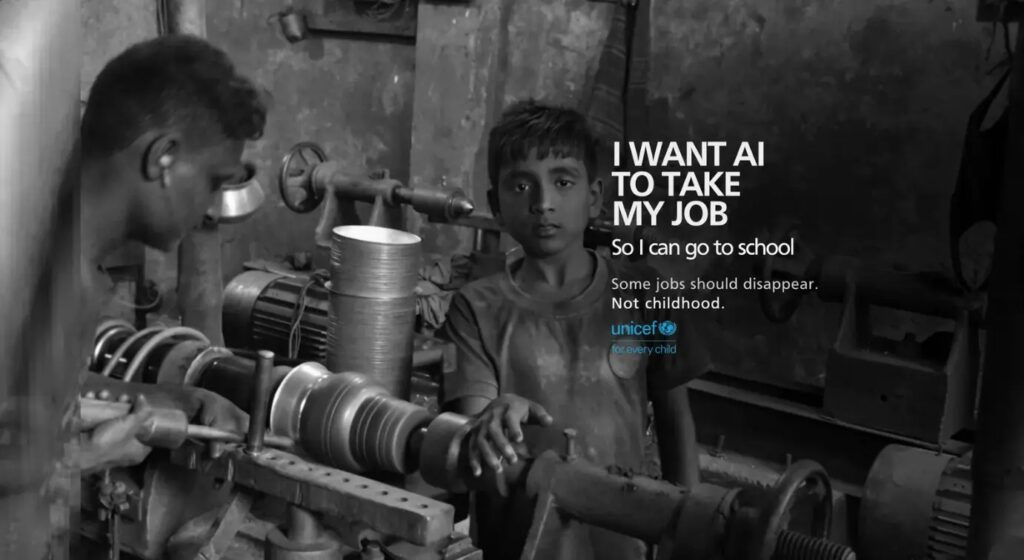
The words can sound like a warning when an adult says them. In UNICEF’s 2026 print campaign, they came from children shown working in factories, workshops, construction settings and homes.
For them, replacement meant a chance to leave work, return to school and reclaim their childhood.
Created by One Minute Briefs, the campaign used three images to connect a current technology debate with the continuing reality of child labour. Its closing message made the intended meaning clear. “Some jobs should disappear. Not childhood.”
The speaker changed the meaning of the sentence
The phrase already carried fears about income, employment and an uncertain future. The campaign kept those familiar words but changed the person saying them.
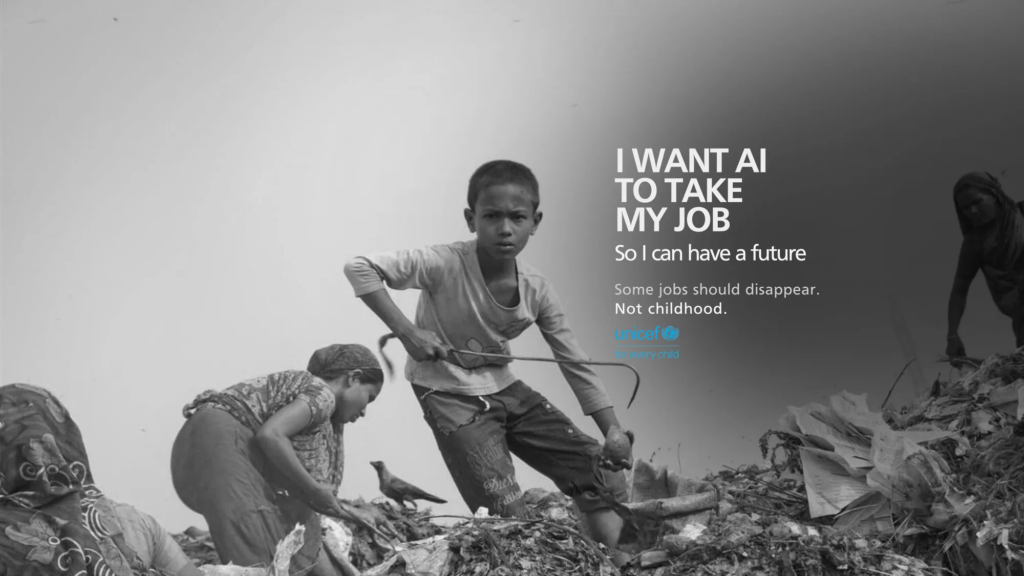
Each child looked directly at the viewer from a working environment. The main headline was followed by supporting lines such as “So I can go to school” and “So I can be a child.”
This change in perspective gave the sentence a different meaning. Losing work could give these children time to learn, play, rest and grow in safety.
The campaign also avoided treating child labour as a distant or abstract issue. The children appeared inside recognisable workplaces, bringing attention to the conditions that had taken them away from classrooms and playgrounds.
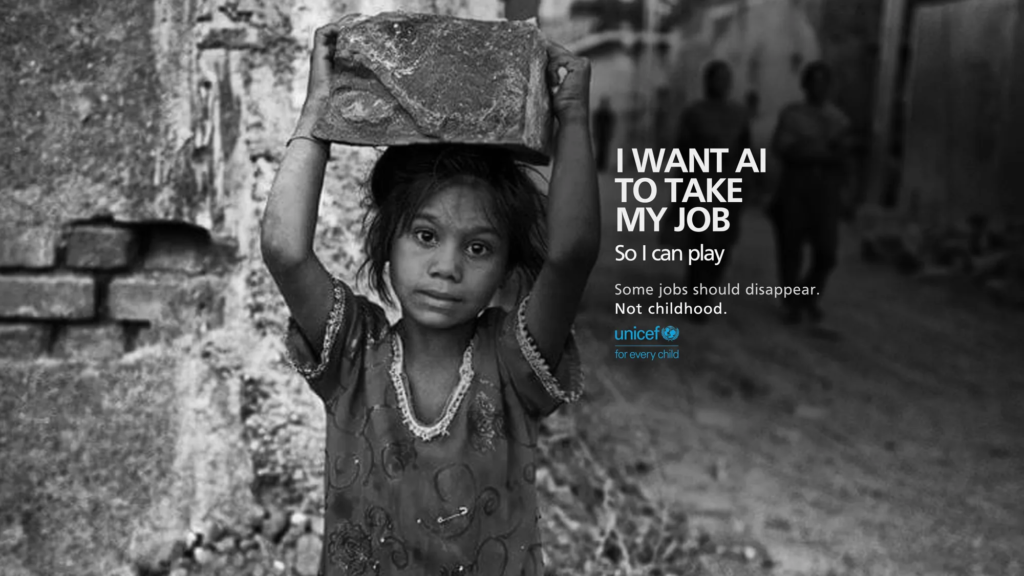
AI never appeared in the images
The campaign mentioned artificial intelligence without showing robots, screens or futuristic technology. Its images stayed focused on the children and the places where they worked.
AI served as the entry point rather than the proposed solution. The campaign did not suggest that automation could end child labour. It used the fear of technological replacement to ask why children had these jobs in the first place.
That restraint suited the print format. The viewer could recognise a familiar sentence, notice who was saying it and understand the contradiction within a single frame.
The line also gave the campaign room to speak about more than one form of labour. It could move between factories, workshops, building sites and domestic environments while keeping the same central message.
The real jobs crisis already involved 138 million children
Nearly 138 million children were engaged in child labour during 2024. Around 54 million of them were involved in hazardous work that could harm their health, safety or development.
The global number had fallen significantly since 2000, but the world still missed its target of eliminating child labour by 2025. Millions of children continued to lose access to education and the ordinary experiences of childhood.
I Want AI to Take My Job gave those numbers a clear human voice. Its children were not asking for better roles or different workplaces. They were asking for school, safety and the freedom to grow up.
Credits
I Want AI to Take My Job (2026). UNICEF, India. Created by One Minute Briefs. Copy and design by Arun Anoop. Published as a digital and print campaign in March 2026.
About the work
Campaign details
- Year
- 2026
Related
More in Print


Popular
Popular posts


More stories