Editor's Pick
Nestlé turned cheese waste into biodegradable packaging for the cheese itself
 By Archit
·
·
6 min read
By Archit
·
·
6 min readAI-assisted
Quick summary
The idea: Nestlé Central America and Ogilvy Colombia created Self-Packing Cheese, an initiative that transforms leftover liquid cheese whey into a biodegradable plastic alternative to wrap Nestlé’s ¡Qué Rico! cheese.
The execution: Using a biotechnological process with microorganisms, whey is converted into PHA biopolymer film suitable for primary and secondary packaging. Introduced as a pilot in Panama in May 2025, the printable material meets FDA food-contact standards, protects product freshness, and biodegrades in about 300 days compared to 900 years for conventional plastic.
Why it matters: The circular innovation addresses dairy waste management while replacing fossil-based plastic films. Although commercial scalability and long-term economic viability remain untested, the product-design approach earned a Silver Lion at Cannes Lions 2025.
AI-generated from this article. For complete context and credits, read the full story.
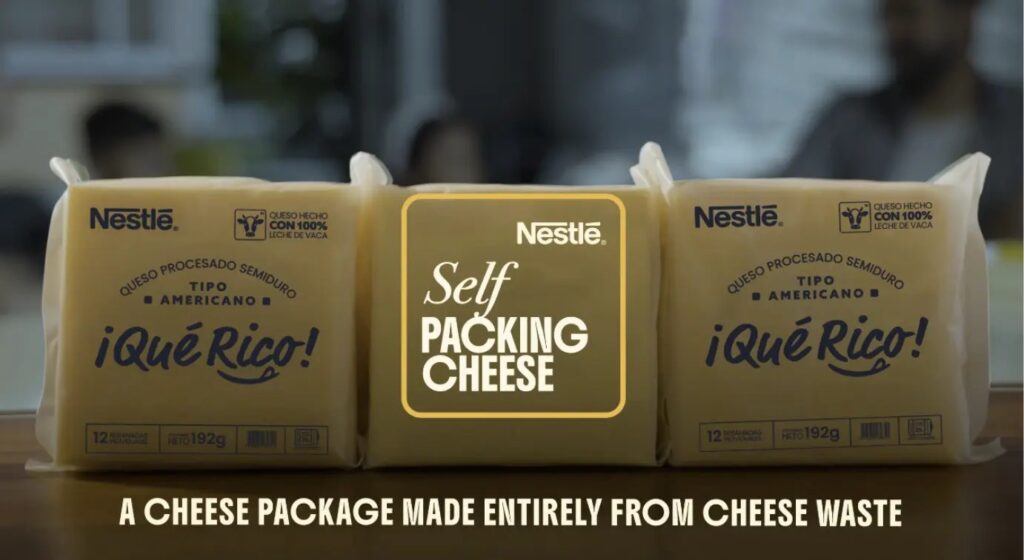
Nestlé Central America and Ogilvy Colombia have developed a cheese wrapper made from whey, the liquid byproduct produced during cheesemaking. Called “Self-Packing Cheese,” the innovation transforms material that might otherwise be discarded into biodegradable packaging for Nestlé’s ¡Qué Rico! cheese.
The project was introduced through a pilot in Panama in May 2025. Nestlé is testing the material as a replacement for both the primary and secondary packaging used across the cheese range.
It creates an unusually direct circular system: the waste generated while making the product becomes the material used to protect it.
Cheese creates more than a packaging problem
Conventional cheese packaging performs an important job. It protects the product from contamination, preserves freshness and helps it survive transportation and storage. However, the plastic films commonly used for this purpose can remain in the environment for centuries after the cheese has been consumed.
Cheese production also creates a separate waste-management challenge.
When milk is curdled and strained, it produces whey. This liquid contains proteins, lactose and other compounds, but it is not always fully used by manufacturers. If large quantities are released without proper treatment, their organic content can reduce oxygen levels in waterways and damage aquatic ecosystems.
Self-Packing Cheese connects these two problems. Instead of treating whey only as leftover material, the project uses it as a raw ingredient for an alternative to conventional plastic.
Whey is transformed into a plastic-like film
The process begins by combining cheese whey with selected microorganisms in a controlled biotechnological process. This transforms components within the whey into polyhydroxyalkanoates, commonly known as PHA.
PHA is a biodegradable biopolymer with properties similar to conventional plastic. Once processed, it can be turned into pellets and then formed into a thin, translucent film suitable for wrapping food.
According to the project team, the material meets international FDA food-contact standards and can protect the cheese without changing its nutrients, taste, freshness or other essential properties.
The wrapper is also printable, allowing it to carry the branding and product information normally placed on conventional packaging.
The wrapper is designed to biodegrade in 300 days
Nestlé and Ogilvy say the whey-based material can biodegrade in approximately 300 days under natural conditions. The campaign compares this with conventional plastic, which it says can take around 900 years to decompose.
That comparison gives the innovation a simple and memorable story. A material created during cheese production returns to nature in less than a year, rather than remaining as plastic waste for generations.
The claimed benefit is twofold. The system gives discarded whey another purpose while reducing the need for fossil-based plastic packaging.
This does not merely make the existing wrapper more sustainable. It attempts to redesign the relationship between the product, its production waste and its packaging.
Panama is the testing ground
The material is being tested on Nestlé’s ¡Qué Rico! cheeses distributed in Panama. The company said it was aiming to produce approximately 5,500 tonnes of cheese using 100% biodegradable whey-based packaging.
The project covers both primary packaging, which comes into direct contact with the cheese, and secondary packaging used to contain or group the products.
However, Self-Packing Cheese remains a pilot rather than a confirmed global packaging replacement. Nestlé has not announced a wider commercial rollout or published results demonstrating how much plastic and whey waste the project has eliminated so far.
Its long-term impact will depend on whether the film can be manufactured consistently, perform throughout the complete supply chain and compete economically with conventional plastic at scale.
An advertising idea became a product innovation
Self-Packing Cheese was created through Ogilvy Colombia’s Impact Lab, an initiative intended to combine creativity, sustainability and technology.
Rather than producing a campaign that simply asks consumers to recycle, the team intervened in the design and manufacturing of the product itself. The communication is built around a tangible invention, making the packaging both the medium and the message.
The name captures the idea in three words. The cheese effectively supplies the material needed to pack itself.
That clarity helped the project move beyond conventional sustainability advertising. It received a Silver Lion in the Transformative Design category at Cannes Lions 2025 and was also shortlisted in the festival’s Early-Stage Technology Innovation category.
The real challenge will be scaling the material
The concept has potential beyond a single cheese brand. Whey is produced throughout the global dairy industry, while flexible plastic packaging remains difficult to recycle in many markets.
If the technology proves technically reliable and commercially viable, it could give manufacturers a new way to convert their own production byproducts into useful packaging materials.
Yet scalability cannot be assumed. The pilot must still demonstrate that sufficient whey can be processed consistently, that the PHA film can withstand manufacturing and transportation, and that its cost is suitable for a mass-market food product.
For now, the most important achievement is the shift in perspective. Self-Packing Cheese does not ask only how waste should be disposed of. It asks whether that waste can become the next input in the production cycle.
The wrapper may disappear in 300 days, but the larger idea could have a much longer life.
Credits
Self-Packing Cheese was created for Nestlé Central America and ¡Qué Rico! by Ogilvy Colombia and Ogilvy Andina. Global Chief Creative Officer: Liz Taylor; Deputy Chief Creative Officer Worldwide: Joe Sciarrotta; Latin America Chief Creative Officer: Keka Morelle; Latin America Chief Strategy Officer: Thais Frazao; Latin America Chief Communications Officer: Marina Piacentini; Latin America Director of Creative Excellence: Adriana Weinberg; CEO Colombia: Fabio Quiroga; VP Creative Colombia: Gastón Potasz; Communication and NHW Director, Nestlé Central America: Kim Wagel; Communication Manager, Nestlé Central America: Ian Serrano; Content Studio Leader: Ehrior Sanabria; DGCs: Daniel Ávila, Francisco Villa, Alma Manrique, Amir Torres and Jhon Meza; Project Industrial Designer Lead: Omar Marroquín; Creative Directors: Daniel Puentes, Cristhian Arboleda, Mauricio Obregón and Sergio Acevedo; Art Director: Camilo Samboni; Copywriter: Jessica Cruz; Motion Graphics: Juan David Acosta, Jesús Quiroz and Laura Castro; VP Planning: Julio César Herazo; Account Director: Marcela Giraldo; Project Manager: Camila Cardozo; Content Senior Specialist, Nestlé Central America: Daniela Ponte; Senior Packaging Specialist, Nestlé Central America: Maria Sagastume; Sustainability Manager, Nestlé Central America: Claudia Alvarado; Public Affairs Specialist, Nestlé Central America: Sara Pérez; Creative Excellence: Pablo Lega; Production Company: MILA Films; Director: Juan Pablo Zuluaga; General Producer: Juliana Canal; Director of Photography: German Rodríguez L.; RTV Executive Production Director: Gala Vence; Photographer: Nicolás Fernández.
About the work
Campaign details
View original campaignRelated
More in Editor's Pick



Popular
Popular posts


More stories