
Case Studies
T-Rex Leather turned reconstructed dinosaur proteins into a luxury bag
 By Archit
·
·
4 min read
By Archit
·
·
4 min readAI-assisted
Quick summary
Unveiled in Amsterdam in April 2026, T-Rex Leather is an experimental luxury handbag crafted from lab-grown material inspired by prehistoric biology. Developed by VML Paris, The Organoid Company, and Lab-Grown Leather Ltd., the project used fragmented collagen proteins recovered from dinosaur fossils. Researchers employed computational biology and protein engineering to reconstruct a T. rex-inspired collagen sequence, which was produced in engineered cells and subsequently tanned. Avant-garde techwear label Enfin Levé then transformed the material into a structured teal handbag, exhibited beneath a life-sized T. rex at ARTIS before heading to a Paris auction with an estimated value of €300,000 to €500,000.
The project drew scientific criticism from palaeontologists who questioned the connection to actual dinosaur skin, noting that available traces came from fossilised bone rather than hide, and that replicated proteins cannot recreate an original animal's complex fibre structure. Consequently, the material is best understood as a T. rex-inspired biomaterial utilizing modern cell engineering alongside ancient protein data.
AI-generated from this article. For complete context and credits, read the full story.
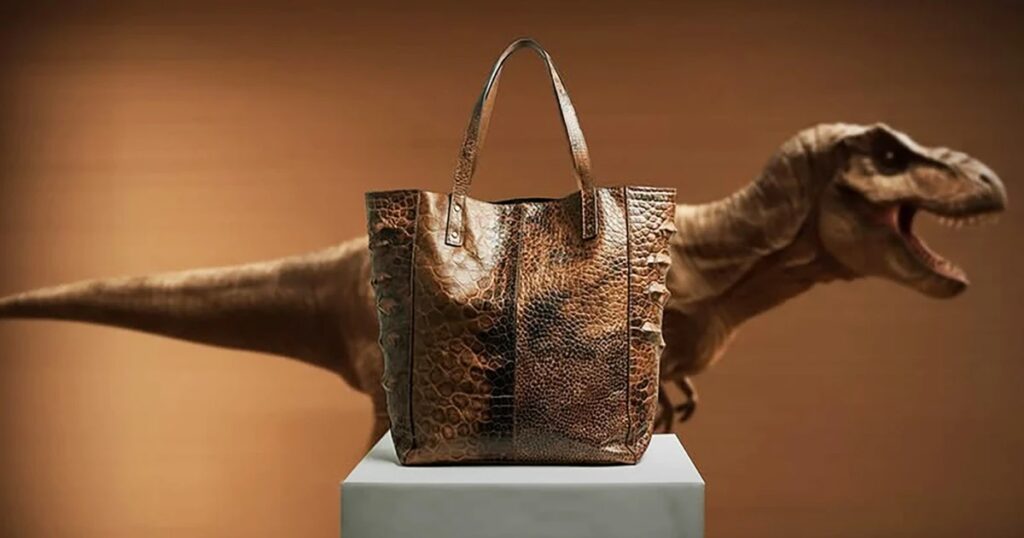
A teal handbag displayed beneath a life-sized Tyrannosaurus rex became the centrepiece of an experiment connecting biotechnology, luxury fashion and prehistoric biology.
Unveiled in Amsterdam in April 2026, T-Rex Leather was developed by VML Paris, The Organoid Company and Lab-Grown Leather Ltd. The team presented it as the first lab-grown leather material inspired by a prehistoric species.
The material was used to create a one-of-a-kind handbag designed by experimental techwear label Enfin Levé. It was exhibited at Amsterdam’s ARTIS before being taken to Paris for auction.
Fossil proteins provided the starting point
Scientists have not recovered a complete T. rex genome. However, researchers have identified fragments of collagen proteins preserved in dinosaur fossils.
The T-Rex Leather team used these ancient protein fragments as a starting point. Computational biology and protein engineering helped reconstruct and optimise a collagen sequence inspired by T. rex biology.
That sequence was introduced into an engineered cell line, which produced collagen that could be grown into a leather-like material. Lab-Grown Leather Ltd. then processed and tanned the material so it could be used by a designer.
The result was not a preserved piece of dinosaur skin. It was a modern biomaterial created from engineered cells using reconstructed prehistoric protein information.
Enfin Levé turned the material into a handbag
Avant-garde fashion label Enfin Levé transformed the experimental material into a structured teal handbag.
The bag gave the scientific project a form that people could recognise and evaluate. Leather is closely connected with luxury, craftsmanship and durability, so a handbag provided an effective demonstration of the material’s possible future use.
The finished piece was displayed beneath a large T. rex structure at ARTIS in Amsterdam. This presentation placed the prehistoric inspiration and the futuristic material in the same space.
After the exhibition, the handbag was taken to Paris and offered at auction with an estimated value between €300,000 and €500,000. Its rarity helped position the bag as a collector’s object as well as a material experiment.
A luxury story made biotechnology easier to understand
Lab-grown materials can be difficult to explain outside scientific and manufacturing circles. T-Rex Leather gave the technology a story built around an animal almost everyone recognises.
The dinosaur connection created curiosity, while the handbag made the potential application tangible. People did not have to imagine what engineered collagen might become because they could see it used in a finished luxury product.
The project also addressed a challenge facing alternative leather. New materials may offer environmental or ethical benefits, but luxury customers also expect rarity, emotion and a strong origin story.
By connecting lab-grown leather with 66 million years of natural history, the team presented the material as something new rather than simply an imitation of conventional leather.
The T. rex claim also attracted scientific criticism
Several palaeontologists questioned how closely the material could genuinely be connected to T. rex leather.
The available collagen traces came from fossilised bone rather than preserved skin. Scientists also noted that producing a matching protein would not recreate the complex fibre structure of an animal’s original hide.
For this reason, the material is more accurately understood as T. rex-inspired lab-grown leather. Its prehistoric connection came from reconstructed collagen information, while the physical material was produced through modern cell and tissue engineering.
The debate became part of the project’s wider impact. It encouraged conversations about where scientific reconstruction ends, where creative interpretation begins and how future materials should be described.
Credits
The project was developed by innovation partners The Organoid Company and Lab-Grown Leather Ltd., with VML Paris as the creative agency. Bas Korsten served as global chief creative officer for innovation and chief creative officer for EMEA. Enfin Levé was the design partner, with founder and lead designer Michal Hadas creating the handbag. Professor Che Connon represented Lab-Grown Leather Ltd., while Thomas Mitchell, chief executive officer of The Organoid Company, led the genomic engineering contribution.
About the work
Campaign details
- Brand
- Enfin Levé
- Agency
- VML
- Year
- 2026
- Awards
- 2026 Cannes Lions - A Gold and a Silver
Related
More in Case Studies



Popular
Popular posts




More stories