Spotlight
KOMPISHÄNG: IKEA made furniture you can move without a car
 By Archit
·
·
5 min read
By Archit
·
·
5 min read
In August 2026, IKEA launched KOMPISHÄNG, a 13-piece collection designed for people who expect to move again. Desks fold flat, a mattress can be carried like a backpack and a wardrobe organiser turns into its own moving bag. The collection was developed after IKEA spent time inside the homes of young renters and city dwellers.
The starting point was simple.
Furniture should be able to move as easily as the person who owns it.

IKEA designed for the next move
Moving into a first apartment once represented a step towards staying somewhere for years.
For many younger renters, that period can now include several addresses, shared flats and smaller spaces. A new job can mean another neighbourhood. A rent increase can mean another apartment. Meanwhile, furniture bought for one room may become difficult to carry into the next.
IKEA studied that behaviour before designing KOMPISHÄNG.
The company visited people aged 20 to 28 living in central London. Inside their homes, the team found improvised storage, moving boxes still being used as furniture and a small number of possessions that residents deliberately carried from one rental to another.
That changed the design question.
Instead of asking only whether a table fitted inside a small apartment, IKEA considered whether its owner could carry it out again.
Portability became a requirement from the beginning.
At the same time, the collection was not supposed to look like temporary camping furniture. Natural pine, beige surfaces and controlled touches of red and green gave the pieces a quieter domestic appearance.
The aim was furniture that understood the next move without constantly reminding people that one was coming.
A desk became something you could carry
The KOMPISHÄNG desk shows the idea most clearly.
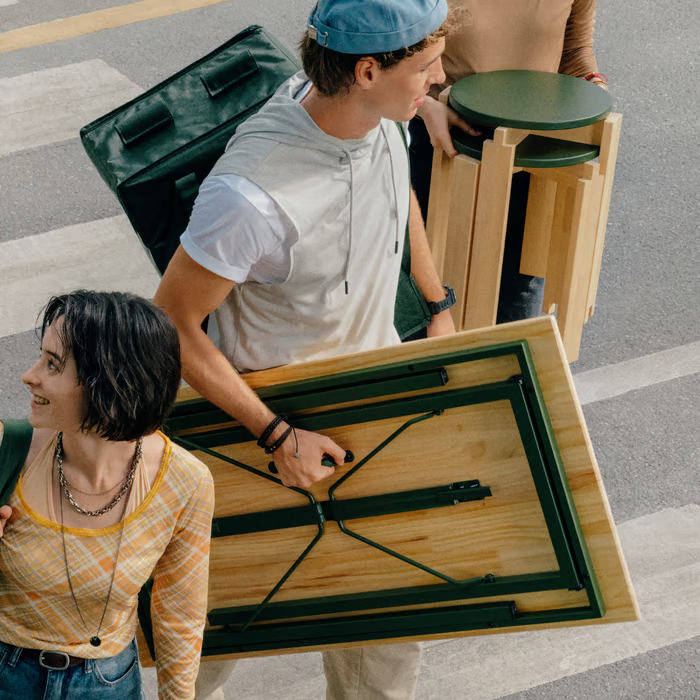
A handle sits underneath the tabletop. When someone needs to move it, the legs fold against the surface and the entire desk can be carried by one person.
Setting it up requires no tools. Two pulls and two clicks bring the legs into position. Afterwards, it can work as a desk, dining table or social space before being folded away behind curtains, inside a cupboard or beneath a bed.
The side table goes further. It folds almost flat and can be carried over the shoulder.
Meanwhile, two stools stack together when extra seating is unnecessary. Grooves in their legs allow them to lock into one another, turning the pair into a small display stand for books or plants.
Each adjustment solves more than a storage problem.
The furniture can change its role before changing its address.
Even the mattress has shoulder straps
Some of the more unusual ideas appear in objects that are normally difficult to move.
The mattress and pouffe includes adjustable shoulder straps. Folded up, it can be carried on someone’s back while leaving both hands available for something else.
Once home, it becomes a seat. Unfolded, it can provide somewhere for a guest to sleep.
A hanging wardrobe organiser solves another familiar moving-day problem.
Instead of removing clothes, folding them into boxes and unpacking everything at the new address, the organiser closes with a zip and becomes a carry bag. The clothes can remain inside throughout the journey.
Even the plant pot was redesigned around moving day.
Large handles make it easier to carry, while a protective cover rolls out around the plant during transport. After the move, that cover disappears back into a compartment inside the pot.
IKEA’s design brief pushed the collection towards one unusual standard.
The products should be movable using the human body alone, without needing a car.
Rental rules shaped the smaller pieces
Moving was only one part of the problem.
Renters can also face restrictions once they arrive. Drilling holes, adding shelves or permanently changing walls may not be possible.
KOMPISHÄNG responds with pieces that can personalise a room without changing the building.
Door organisers use straps rather than screws. One wooden version provides 12 hooks on the back of a door. Meanwhile, mirrors contain slots where photographs, tickets and small personal objects can be inserted around the frame.
A red metal bookend allows books to stand together even when there is no bookshelf.
The details may be small, but together they address a particular feeling of rental life.
Someone can occupy a room without being allowed to alter much of it.
KOMPISHÄNG tries to make the belongings do more of that personal work instead.
What Made It Different
KOMPISHÄNG treats moving as part of a product’s normal life rather than the moment when furniture becomes a problem.
A bed can become luggage. A wardrobe organiser can become a bag. A desk comes with its own carrying handle. Meanwhile, pieces designed for one small apartment can adapt when the next room has completely different dimensions.
The collection was also shaped partly by people close to the age of its intended users. Two recent industrial design graduates in their mid-twenties joined the project through IKEA’s internship programme and proposed six of the 13 products during development.
That makes the collection interesting beyond its individual objects.
Flat-pack furniture helped make it easier to carry furniture home from the shop.
KOMPISHÄNG asks what happens when you need to carry it away from home again.
Credits
KOMPISHÄNG (2026) — IKEA, global. Product development: IKEA of Sweden. Product Developer: Dora Ding. Range Leader: Ina Tidbeck Sjöblom. Designers include Wiebke Braasch, David Wahl, Constance Thiessoz and Lukas Albrektsson. Collection: 13 portable and multifunctional products for small and frequently changing homes. Global rollout: August 2026.
Related
More in Spotlight



Popular
Popular posts




More stories