Editor's Pick
Honda’s Vertical Bike helped harvest aguaje without cutting down Amazonian palms
 By Archit
·
·
4 min read
By Archit
·
·
4 min read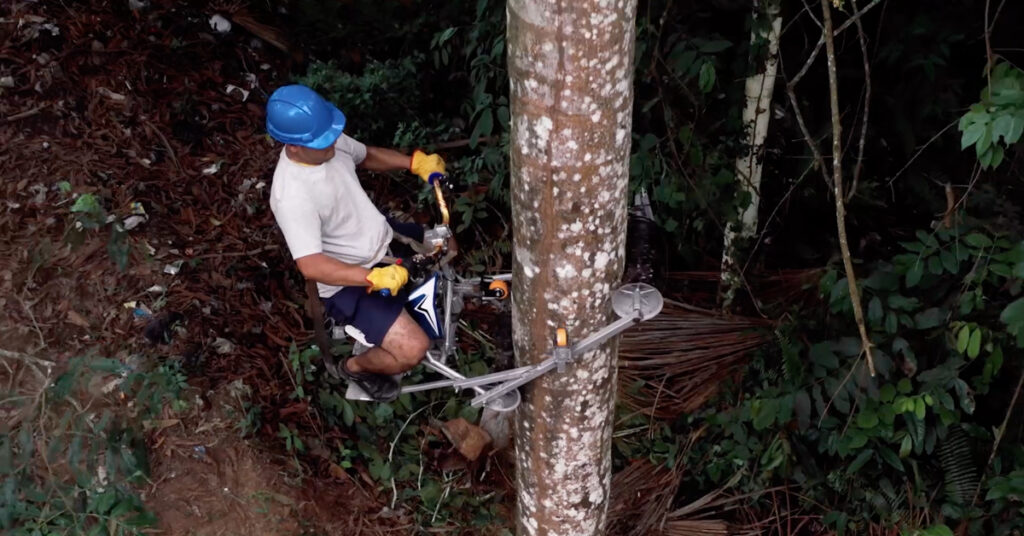
Aguaje fruit grows high above the ground on palms that can reach 35 metres. Reaching it is difficult, so harvesters sometimes take the quickest route and cut down the entire tree.
Honda and Ogilvy Perú approached the problem through mobility. Their Vertical Bike prototype was designed to help harvesters travel up the palm, collect its fruit and return safely while leaving the tree standing.
Aguaje harvesting created a destructive shortcut
Aguaje is valued for its nutritional qualities, including its high vitamin A content. However, the height of the palms makes traditional harvesting physically demanding and potentially dangerous.
The campaign highlighted that more than one million trees are cut down annually in the Peruvian Amazon as part of the harvesting process. Felling a palm provides immediate access to its fruit, but it also eliminates every future harvest from that tree.
This creates consequences beyond the loss of a single plant. Aguaje palms form part of the Amazonian ecosystem and provide a continuing source of food and income for local communities when they remain alive.
Vertical Bike made the journey go upwards
Vertical Bike is a climbing prototype created to help a person ascend an aguaje palm and reach the fruit growing at the top. Instead of moving along a road, Honda’s mobility concept travels vertically against the trunk.
The device gives harvesters an alternative to cutting down a palm simply because its fruit is difficult to reach. Once the aguaje has been collected, the tree can continue growing and producing future harvests.
Its name also connects the environmental solution to Honda’s identity. The project uses the familiar idea of a bike but redirects its movement towards a problem that conventional transport cannot solve.
The invention protected trees and future harvests
Vertical Bike addressed the immediate task of collecting fruit while considering what happens after the harvest. Keeping a mature palm alive means communities can return to it rather than searching for and cutting down another tree.
This makes the intervention relevant to both conservation and livelihoods. The prototype does not ask harvesters to abandon aguaje collection. Instead, it offers a different way to reach the same resource with less environmental damage.
The idea recognises that destructive practices are often connected to practical barriers. By making the less harmful option more accessible, Honda turned conservation into something that could become part of the harvesting process itself.
Honda made engineering the centre of the campaign
Rather than building the campaign around a conventional environmental message, Honda used a working prototype to demonstrate its role. The advertisement was not simply a warning about deforestation. It presented a tool intended to address one of its causes.
The resulting case study documented the environmental problem, the development of Vertical Bike and its purpose in the Peruvian Amazon. Honda’s association with movement and engineering gave the brand a credible place within the idea.
Vertical Bike showed that mobility does not always mean travelling farther or faster. Sometimes, it means finding a better way to reach something without destroying what supports it.
Credits
Vertical Bike, 2022. Brand Honda. Agency Ogilvy Perú, Lima. CCO Latin America Jessica Apellaniz. CCO Andean Juan Pablo Alvarez. CCOs Perú Yasu Arakaki and Mauricio Guerrero. CEO Perú Julián Torres. COO Perú Nicolás Llano. Creative Directors Philyp Caneva and Carlos Cárdenas. Copywriter Philyp Caneva. Art Directors Guillermo Ramos and Carlos Cárdenas. Head of Planning David Rosazza. Producer Jaime Iriarte. Editors Hector Mezarina and Santiago Herrera. Retoucher Juan José Martinez. Prototype development by Axl Baertl and Fernando Leiva Carrera. Production company Canica Films. Executive Producer María Teresa Benvenuto. Producers Josselyn Navarro and Camila Nuñez. Director Francesca Danovaro. Second Director Angel Nuñez. Videographers Franco Bernasconi, Daniel Garate and Ricardo Pigatti. Drone by Daniel Garate, Ricardo Pigatti and Abel Camacho. Direct Sound by Amador Del Solar. Editing and postproduction by Grecia Studio. Audio and music by Barba Roja. Client approval by Mónica Polo, Natalia Morán and Carmen Rodriguez.
About the work
Campaign details
Related
More in Editor's Pick

Popular
Popular posts


More stories