Digital
Firecatchers turned Twitch waiting screens into wildfire watchtowers
 By Archit
·
·
4 min read
By Archit
·
·
4 min read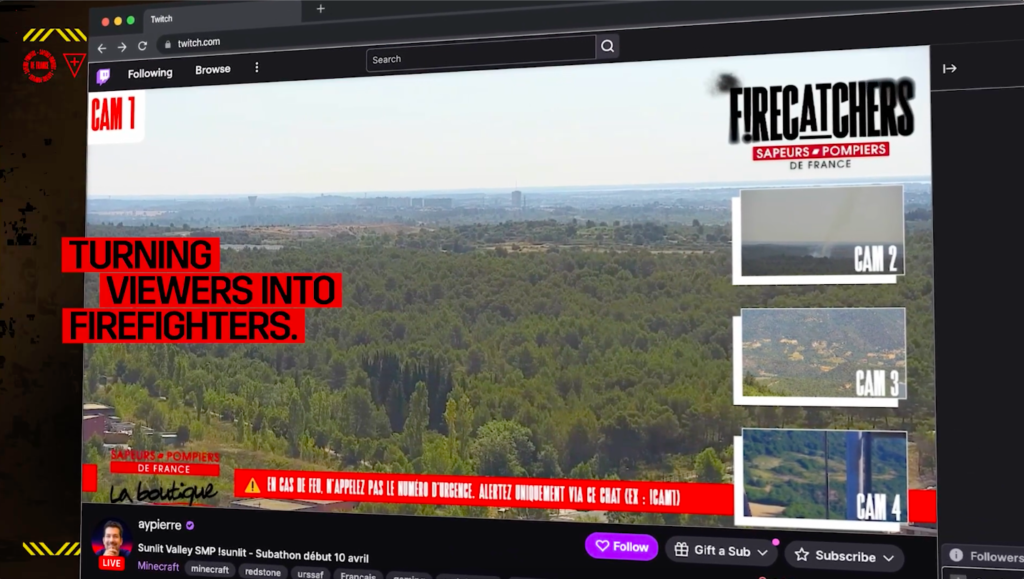
Before a Twitch broadcast begins, viewers often spend several minutes watching a “Starting Soon” screen. Firecatchers turned that familiar period of waiting into an opportunity to protect French forests.
Created by Havas Play France for Sapeurs-Pompiers de France, the campaign replaced selected streamers’ usual waiting screens with live footage from cameras monitoring areas at risk of wildfire. Viewers were invited to watch for smoke and report anything suspicious through the Twitch chat.
France had cameras but not enough people watching them
Early detection can determine whether a small fire is contained or develops into a much larger emergency. France already had surveillance cameras positioned across vulnerable forest areas, but continuously monitoring every feed required more people and resources.
Artificial intelligence might appear to offer an obvious solution, but deploying it at the required scale created financial, legal and operational challenges. Firefighters needed an approach that could work with the technology already available.
The campaign found that missing resource on Twitch. Gaming audiences spend long periods examining screens, noticing movement and reacting quickly to small visual changes. Those abilities closely matched what was needed to identify the first signs of smoke.
“Starting Soon” became a live surveillance feed
Firecatchers used a moment that already existed within Twitch culture. Before participating streams began, live footage from high-risk forest zones appeared in place of the usual holding graphic.
Viewers did not need to visit another platform, download an application or learn a complicated reporting process. They continued watching the same screen while waiting for the creator to begin broadcasting.
If someone noticed possible smoke, they entered the relevant camera number in the chat. When several viewers identified the same feed, the alert was escalated to emergency services for verification.
This system helped filter individual mistakes while allowing genuine concerns to reach firefighters quickly. The audience provided additional eyes, while trained professionals remained responsible for deciding whether action was required.
Gamers became part of the detection network
Firecatchers recognised that Twitch communities are participatory by nature. Viewers regularly communicate with creators, respond to events and work together through chat. The campaign gave that existing behaviour a public-safety purpose.
Creators explained the initiative in their own voices and encouraged their communities to remain attentive. This made the experience feel like part of the stream rather than an advertisement interrupting it.
As more creators joined, separate audiences became a distributed observation network. The campaign expanded from a limited pilot into an initiative involving more than 600 streamers and communities representing nearly 600,000 followers.
The idea did not ask gamers to stop playing or dramatically change their routines. It used a few otherwise inactive minutes before each stream and converted them into coordinated surveillance.
Twitch viewers helped detect five fires
During its first phase, participating communities produced 2,190 hours of active forest surveillance. Their reports contributed to the detection of five fires and helped protect approximately 1,700 hectares of forest.
The campaign also demonstrated that an online audience could become an operational resource rather than simply generating views or engagement. Twitch did not carry a message about wildfire prevention around its existing content. The platform itself became part of the detection system.
Because Firecatchers worked with existing surveillance cameras, creator communities and familiar Twitch behaviour, the model could be expanded without building an entirely new monitoring network.
An overlooked media moment gained a public purpose
The strength of Firecatchers came from matching an unused moment with an urgent need. Firefighters required more people watching forest feeds, while thousands of Twitch viewers were already looking at screens as they waited for streams to begin.
By connecting those two realities, the campaign turned passive attention into practical action. A holding screen became a watchtower, a chat message became an alert and a gaming community became part of France’s wildfire response.
Firecatchers launched in 2025 and later received Graphite and Wood Pencils at the 2026 D&AD Awards. Its recognition reflected both the inventive use of media and the role creators played in turning their audiences into an active civic network.
Credits
Firecatchers, 2025. Client Sapeurs-Pompiers de France. Advertising agency, design agency, production company and entrant company Havas Play France, Paris. Content Creator Aypierre. The campaign received Graphite and Wood Pencils at the 2026 D&AD Awards across Creator Content and Media.
About the work
Campaign details
- Agency
- Havas Play
- Country
- France
- Year
- 2025
- Awards
- 2026 D&AD Awards - Graphite and Wood Pencils
Related
More in Digital


Popular
Popular posts



More stories