Editor's Pick
Duolingo’s Phonetic Collection Teaches Fashion Fans How to Say It
 By Archit
·
·
4 min read
By Archit
·
·
4 min readAI-assisted
Quick summary
Duolingo launched The Phonetic Collection, a seven-piece SS27 fashion capsule created with designer Megan O’Cain around New York Fashion Week to help people pronounce luxury brand names correctly. The campaign transformed simplified phonetic spellings of designer labels into bold, wearable graphics using embroidery, patches, puff printing and vinyl transfers. Pieces included a bright green handbag featuring Hermès spelled out as air-mess, alongside black outerwear displaying Givenchy as zhee-vahn-shee.
The initiative extended to a two-day New York pop-up where Duolingo app users could bid for the items using the length of their daily learning streaks, directly rewarding consistent language practice with limited fashion pieces. Supported by outdoor placements across the city, the collaboration integrated the brand's core mission with high-fashion culture.
AI-generated from this article. For complete context and credits, read the full story.
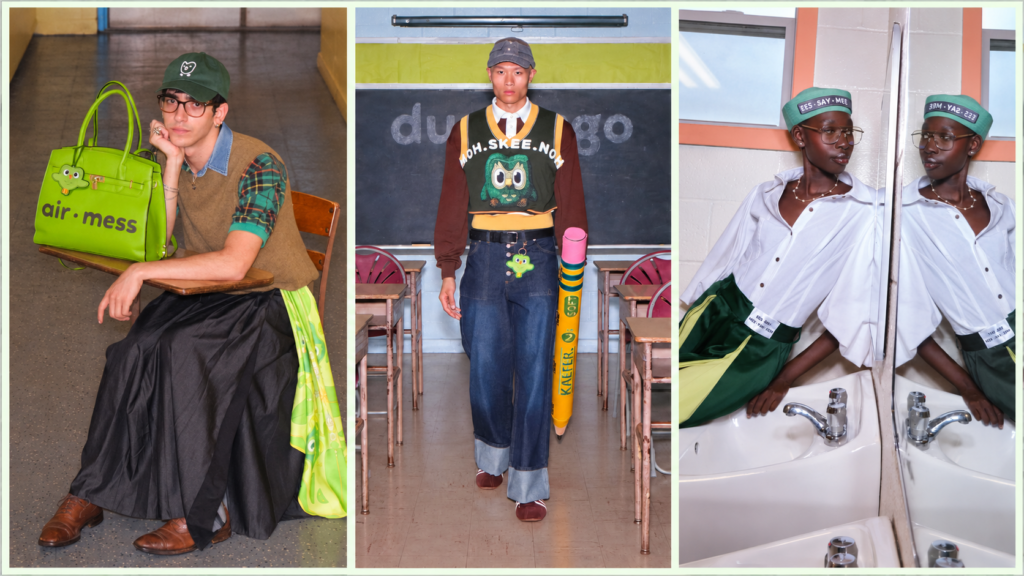
Fashion comes with its own vocabulary. Some designer names are instantly recognisable on a bag or jacket, but pronouncing them correctly can be a different challenge.
Duolingo explored that gap with The Phonetic Collection, a seven-piece SS27 fashion capsule created with designer Megan O’Cain. Launched around New York Fashion Week, the collection transformed the pronunciations of luxury fashion names into wearable graphics.
The campaign treated pronunciation as both a language lesson and a design element, helping people become what Duolingo called “fashion week fluent.”
Seven pieces turned pronunciation into fashion
The capsule applied simplified phonetic spellings to clothing and accessories inspired by familiar fashion-house signatures.
Hermès became “air-mess,” printed across a bright green structured handbag. Givenchy appeared as “zhee-vahn-shee,” with its syllables distributed across a black outerwear look. Jacquemus was presented as “zhahk-moos.”
The complete collection included sportswear, tailored layers, skirts, accessories and exaggerated silhouettes. Basketball-inspired pieces sat beside outfits that played with ties, kilts and classic tailoring.
Instead of placing the pronunciation guide on a small label, each spelling became the most noticeable part of the garment. The words were enlarged, separated and positioned across different parts of the designs.
The familiar Duolingo green connected the capsule to the language-learning brand, while black, white and neutral pieces gave the typography room to stand out.
Familiar fashion details were pulled apart and rebuilt
O’Cain approached the collection by studying recognisable fashion codes and reinterpreting them through Duolingo’s humorous visual language.
The production experimented with embroidery, patches, puff printing and vinyl transfers to place phonetic words across different fabrics and surfaces. Curved shapes, enlarged proportions and unconventional styling added another layer of visual play.
This process supported the campaign’s wider message. Fashion, like a language, can be learned through observation, experimentation and practice.
The collection acknowledged that people may understand a fashion reference without knowing how to say its name. Instead of treating that uncertainty as embarrassing, Duolingo turned it into the beginning of a lesson.
Learning streaks became bidding currency
The campaign extended into a two-day New York pop-up at Null Object, where visitors could view the seven pieces in person.
Duolingo learners were given the chance to bid for items using the length of their learning streaks. People with the highest streaks could receive pieces from the collection.
This connected the Fashion Week activation directly to behaviour inside the app. A streak usually represents the number of consecutive days someone has completed a lesson. At the pop-up, that digital achievement gained value as a form of fashion currency.
The approach also rewarded committed learners instead of simply selling the collection. Someone who had practised a language consistently could turn that effort into a chance to own a limited fashion piece.
Outdoor placements around New York introduced the phonetic spellings to a wider audience, allowing the pronunciation lessons to work even for people who never attended the event.
Duolingo found a natural role at Fashion Week
The Phonetic Collection gave Duolingo a credible way to participate in a major fashion moment. The brand entered the conversation through something closely connected to its purpose: helping people understand and pronounce unfamiliar words.
The campaign did not rely solely on adding the Duolingo owl to conventional merchandise. Its language-learning idea shaped the collection, photography, typography and pop-up experience.
It also made specialist fashion knowledge feel more approachable. Visitors did not need to understand every reference before taking part. The clothes provided the lesson themselves.
By turning difficult designer names into bold wearable graphics, Duolingo showed that pronunciation could become a fashion statement. The collection invited people to look, sound out the words and keep learning.
Credits
The Phonetic Collection was created by Duolingo in collaboration with designer Megan O’Cain. Photography was handled by A Damp Owl, with production by See Me Creative, styling by Sharifa, props design by Andrew Kaefer, set design by Alejandra Sabillon, hair by Uhmmwhat and makeup by Rose Grace. The featured models were Lilliteration, A Wet the Cat, Dopamine Deficiency, Shagadelic Grooves and Omar Sul.
About the work
Campaign details
View original campaignRelated
More in Editor's Pick


Popular
Popular posts

More stories