Editor's Pick
Oatly used 11 and 89 words to reveal climate action’s silent majority
 By Archit
·
·
4 min read
By Archit
·
·
4 min read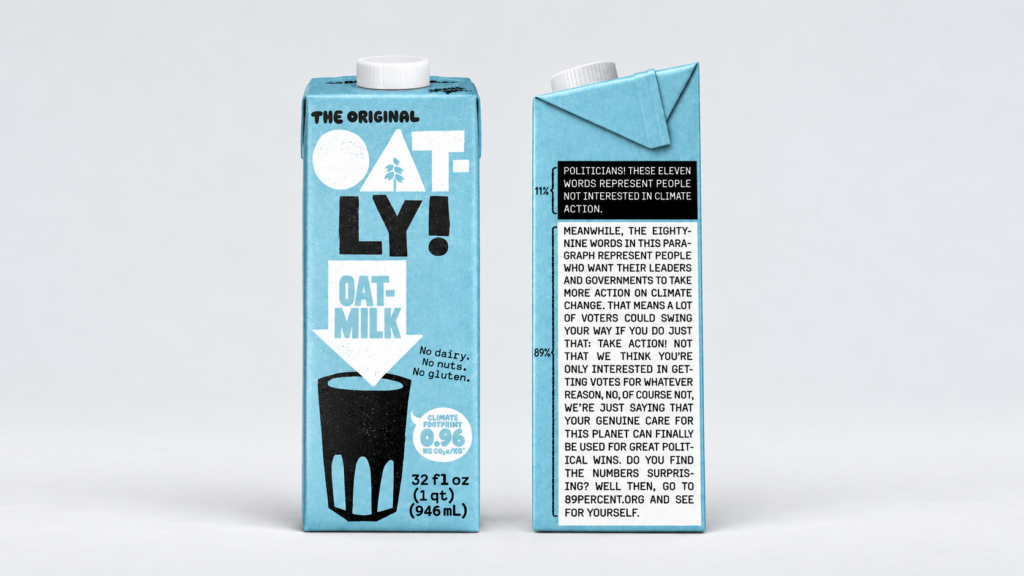
Oatly has divided the side of its oat drink cartons into two deliberately unequal sections to show how many people want governments to take stronger action on climate change.
The packaging responds to the 89 Percent Project, an ongoing global initiative built around research showing that most people support greater political action on the climate crisis.
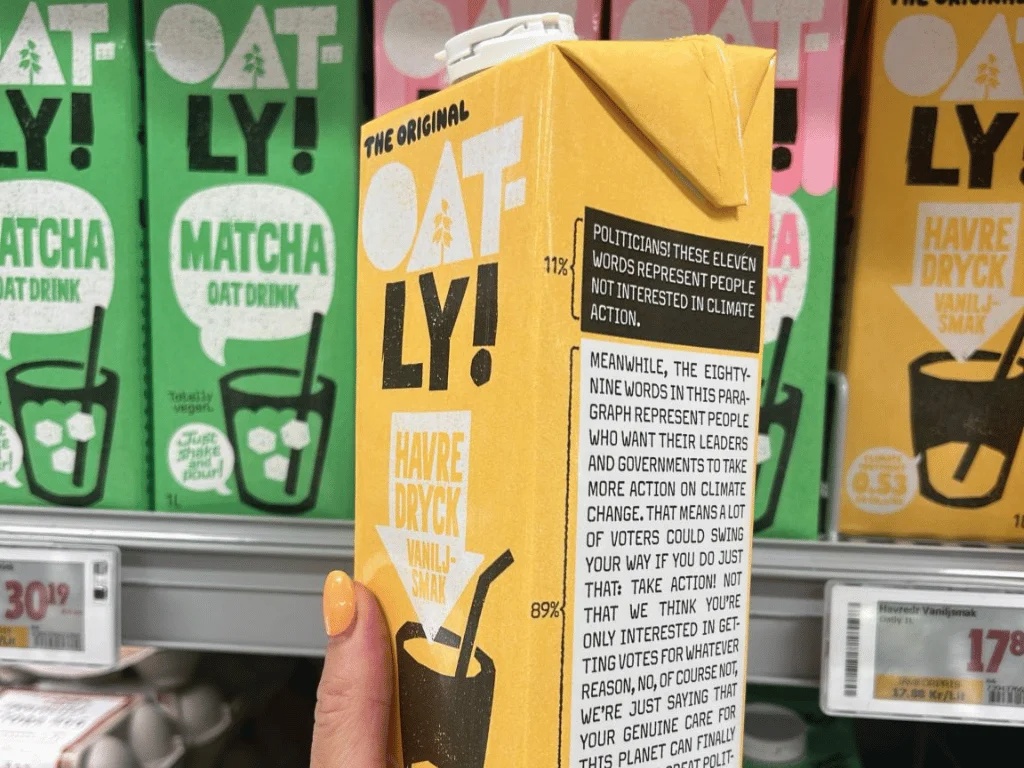
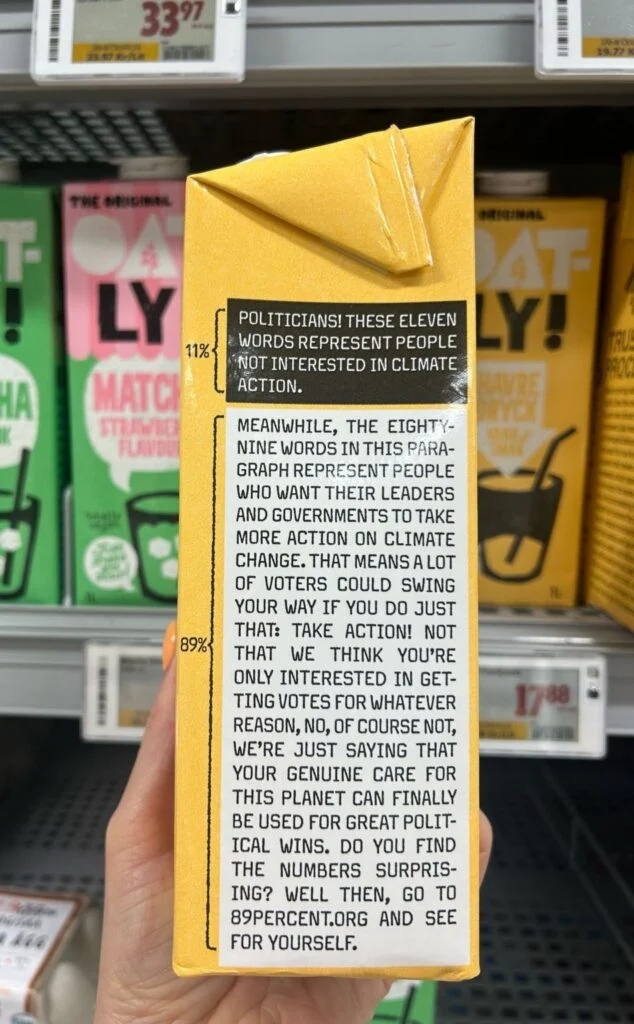
Instead of presenting the statistic as a conventional chart, Oatly translated the percentages into words. Eleven words represent people who are not interested in further action. A much larger block of 89 words represents everyone asking governments to do more.
Eleven words gave the minority its actual space
The smaller section contains exactly 11 words: “Politicians, these eleven words represent people not interested in climate action.”
Beneath it, the remaining 89 words occupy most of the available space. This longer message speaks for the global majority that wants stronger climate policies and reminds political leaders that many of those people are also voters.
The contrast makes the statistic understandable before the complete copy has been read. The smaller group receives a small section, while the majority takes over nearly the entire side of the carton.
Oatly’s familiar dry humour keeps the message from becoming a formal political statement. The copy playfully suggests that taking climate action could help politicians win votes, while pretending that electoral success would never influence their decisions.
The campaign exposed a gap between support and perception
The 89 percent figure comes from a 2024 study involving approximately 130,000 people across 125 countries. It found that 89 percent wanted their governments to intensify efforts against climate change.
However, many people do not realise that their view is shared by such a large majority. They may assume climate action is more politically divided or less widely supported than the research indicates.
This misunderstanding can create silence. People who believe they hold a minority opinion are less likely to discuss it, demand action or vote according to it. Their silence then makes public support appear even weaker.
By printing the statistic on everyday packaging, Oatly tells environmentally concerned customers that they are not isolated. The campaign’s central message is not only that 89 percent want action, but that the 89 percent need to recognise their collective size.
An oat carton became a platform for political pressure
Oatly began introducing the packaging in Sweden before a wider international expansion. The format allows the message to travel through supermarkets, cafés, kitchens and breakfast tables without requiring a separate advertising placement.
The company reported selling 593 million litres of oat drink and related products across more than 40 countries in 2025. That existing distribution gives the cartons the potential to repeat the message at considerable scale.
Packaging is especially relevant to Oatly because the brand has long used its cartons for explanations, arguments and unconventional copy. The 89 Percent Project continues that approach while giving the available space a more explicitly political purpose.
The carton still carries the product, but it also carries evidence of public demand directly into people’s homes.
Oatly called public support the ultimate climate solution
Technologies and policies capable of reducing emissions already exist, but governments play an important role in making those solutions easier to adopt. Political leaders may be more willing to support change when they understand how many citizens want it.
That is why the campaign describes the 89 percent as an “ultimate climate solution.” Public support does not replace renewable energy, cleaner transport or changes to food systems. It can help create the political conditions needed to introduce them at scale.
Oatly’s packaging makes an invisible majority visible through an unusually simple device. By giving 89 percent of the words to 89 percent of the people, the brand turns a research finding into something consumers can immediately see.
Credits
The 89 Percent Project Packaging (2026), Oatly, Sweden. Created in response to the 89 Percent Project, an initiative organised by the global journalism collaboration Covering Climate Now. Oatly Senior Sustainability Director: Caroline Reid. The packaging launched in Sweden in August 2026 ahead of a planned international expansion. Additional creative and production credits were not publicly listed.
About the work
Campaign details
Related
More in Editor's Pick


Popular
Popular posts



More stories